The KOSPI index hit its worst session since 2008. The Nikkei 225 shed 10%. Oil briefly cleared $115. Now, potential ceasefire signals are lifting Asian markets for a while, but investors are far from convinced.

The Shot That Rattled the World
Before February 28, 2026, global equity markets had been riding a remarkable wave. The KOSPI index had surged more than 75% across 2025. The Nikkei 225 sat at multi-decade highs. The BEL 20 index in Brussels had welcomed fresh constituents after a sector reshuffling. Gift Nifty live readings each morning pointed to an Indian market brimming with confidence. Traders watching Asian markets today had little reason to brace for catastrophe.
Then US and Israeli forces struck Iran. The strikes, which killed Supreme Leader Ali Khamenei, were the largest military action in the Middle East in a generation. Within hours, Iran closed the Strait of Hormuz to commercial shipping. The IEA called it the largest supply disruption in the history of the global oil market. Brent crude, which had been trading near $65 a barrel when tensions first began escalating, surged past $100 almost immediately. Within days, it was flirting with $115.
QatarEnergy declared force majeure on its LNG contracts. By March 4, LNG spot prices in Asia had more than doubled to three-year highs of $25.40 per MMBtu. For the energy-import-dependent economies that dominate Asian markets today (South Korea, Japan, and India among them), this was an existential jolt to their current accounts.
Bloomberg described the early market reaction as the fastest geopolitical repricing since the 2022 Ukraine shock, with oil volatility indices spiking to levels not seen since the Gulf War.
Why Asian Markets Today Bore the Deepest Wounds
No region felt the Iran war’s economic force more acutely than Asia. The reason is structural: these are among the world’s most oil-dependent economies, and the Middle East is their primary supplier.
South Korea sources approximately 70% of its crude oil from the Middle East. For Japan, that dependence rises to nearly 90%. India, one of the world’s largest importers, gets roughly 60% of its oil from the region, meaning Gift Nifty live data was flashing warning signals even before Indian cash markets opened each day. Europe’s BEL 20 index, meanwhile, tracks companies with deep exposure to global supply chains and energy-intensive industries, making it vulnerable in a different but equally serious way.
The KOSPI index — South Korea’s benchmark, bore perhaps the most dramatic single-session collapse of any major developed-market index. On March 4, it plunged 12.1%, triggering circuit breakers and logging its worst day since the 2008 global financial crisis. Samsung Electronics fell roughly 12%, SK Hynix around 10%. The Korea Composite Stock Price Index had entered the session with memories of a nearly 176% rally since April 2025; what investors got instead was a violent unwind.
The Nikkei index in Tokyo wasn’t spared either. Japan, which depends on oil shipped through the Strait for almost everything it manufactures, e.g. automobiles, semiconductors, consumer electronics, watched the Nikkei 225 shed around 10% from its pre-war level in the first week of conflict. Australia’s ASX 200 fell 6%. The pattern was clear: the more oil-dependent the economy, the more brutal the drawdown in that country’s equities.
The Nikkei 225’s retreat also reflected something deeper: the unwinding of years of bullish bets on Japanese equities fueled by a weaker yen. When oil spikes, Japan’s trade deficit balloons. A deteriorating current account puts upward pressure on the yen. And a stronger yen erodes the earnings of the export-led companies, like Toyota, Sony, Panasonic, that dominate the Nikkei index. It’s a triple-blow mechanism that markets repriced almost instantaneously.
South Korea’s Double Blow: Oil Shock Meets a Hawkish Central Bank
The KOSPI index’s suffering wasn’t limited to the oil shock. On March 22, South Korean President Lee Jae Myung named Shin Hyun-song as the next Governor of the Bank of Korea. Shin, famous in academic circles for predicting the 2008 financial crisis and currently the head of economics at the Bank for International Settlements, was immediately read by markets as a hawkish appointment.
ING analysts put it plainly: this BOK was now more likely to raise interest rates later in the year than to cut them. In an environment where global growth was already at risk, the prospect of higher South Korean borrowing costs layered domestic pressure onto external pain. The KOSPI index fell 5.8% on that single day’s news alone — compounding the war-related losses that had accumulated since late February.
For investors tracking Asian markets today, South Korea became the starkest case study: a technologically sophisticated export economy caught between a global energy shock and a domestic monetary tightening cycle, at the worst possible moment.
The Stagflation Trap: What the Iran War Means for Central Banks
For the world’s central banks, the Iran conflict arrived at the worst conceivable moment, just as policymakers in Europe and Asia believed they had finally begun to win the war on post-pandemic inflation and were gearing up for rate cuts.
The ECB postponed its planned rate reductions on March 19, raising its 2026 inflation forecast and cutting GDP growth projections. UK inflation is now expected to breach 5%. Economists warned that energy-intensive economies face a genuine risk of technical recession if the maritime blockade persists through summer, the critical refill season for European gas storage.
The Federal Reserve held rates steady at its March meeting, effectively abandoning earlier market expectations of two cuts in 2026. Fed Chair Powell acknowledged that higher energy prices would push near-term inflation higher, revising the PCE price index forecast for year-end 2026 to 2.7%, up from 2.4%. For investors watching the BEL 20 index and European peers, this matters enormously — it signals that the monetary easing tailwind that had supported equity valuations is gone.
The industrial damage has been swift. European chemical and steel manufacturers imposed surcharges of up to 30% to offset surging electricity and feedstock costs. Some analysts warned of permanent deindustrialization in certain energy-intensive sectors. The International Food Policy Research Institute noted that up to 30% of global fertilizer exports pass through the Strait of Hormuz, raising the alarming prospect that the crisis could metastasize into a food shock in the developing world, on top of the energy shock already underway. Therefore, “a prolonged disruption would significantly tighten fertilizer availability in major import-dependent regions such as Brazil, India, South Asia and parts of the EU,” Dutch bank ING found in a recent note.
For those tracking Gift Nifty live each morning, India’s position is nuanced. The country imports heavily from the Middle East, but its diplomatic non-alignment and trade relationships with both sides of the conflict have given Indian policymakers slightly more room to maneuver. The RBI has signaled vigilance without panic. Markets, however, have not been so measured — the Nifty 50 fell nearly 8% at the peak of the crisis before partially recovering.
South Korea Leads the Bounce But Doubts Linger
Wednesday’s session has been a dramatic reversal. Across Asian markets today, the mood shifted from defense to tentative optimism as traders absorbed Trump’s comment that Iran is “talking sense” and news that a 15-point ceasefire framework had been transmitted to Tehran. The KOSPI index outperformed every major Asian benchmark, rising 3% by mid-session. The Nikkei 225 logged its best day in three weeks.
The oil sell-off has been equally striking. Brent crude dropped from above $100 to around $94 in a matter of hours — its steepest single-day decline since the early days of the pandemic in 2020. For Asian markets today, that move translated almost directly into equity gains: South Korean petrochemical stocks, airline shares, and chip manufacturers all bounced sharply. The Nikkei index component of Toyota Motor surged more than 4%.
In Europe, the BEL 20 index opened higher alongside the CAC 40, DAX, and FTSE 100, as lower oil prices fuelled hopes that the ECB might yet find room to ease policy later in the year. Belgian industrials — many of which had been battered by the energy surcharge wave — posted some of the day’s sharpest recoveries within the BEL 20 index.
Gift Nifty live data pointed to a strong opening for Indian markets, with pre-open readings suggesting a gap-up of around 1%. Analysts at several Indian brokerages noted that oil’s fall to sub-$95 levels, if sustained, would be a meaningful relief for India’s fiscal position and could reopen the door to RBI rate cuts that had been firmly shut by the conflict.
What Wall Street Is Saying
Goldman Sachs, in a note widely cited by Bloomberg, urged investors to view the KOSPI index’s dramatic decline in the context of its exceptional 176% rally since April 2025, describing the pullback as “a correction that will likely be followed by a recovery to new highs.” The bank raised its Brent crude forecast again, but separately argued that Korean semiconductor and tech stocks, having been treated as collateral damage in an oil shock, were offering value for investors with a 12-month horizon.
Bank of Singapore’s chief investment strategist was measured: “We expected a knee-jerk risk-off market reaction. But barring an oil shock, history shows that geopolitical events typically do not negatively impact equity prices on a prolonged basis.” The Nikkei 225, he noted, had recovered from both the 2022 Ukraine shock and the 2019 Gulf tensions within six months.
Others were more cautious. An energy strategist at a major European bank noted that oil’s spike above $100 is being described in commodity markets as “a clear risk for consumer equities” globally. With the Brent strip still pricing above $95 for most of 2026, the belief that this was a brief spike was being tested. The BEL 20 index’s European industrial exposure, for instance, remains in a structurally challenged position even on today’s calmer session.
Two Scenarios: What Happens Next
Chatham House analysis outlines the fork in the road that investors across the KOSPI index, Nikkei 225, BEL 20 index, and Indian markets tracked via Gift Nifty live are all staring at.
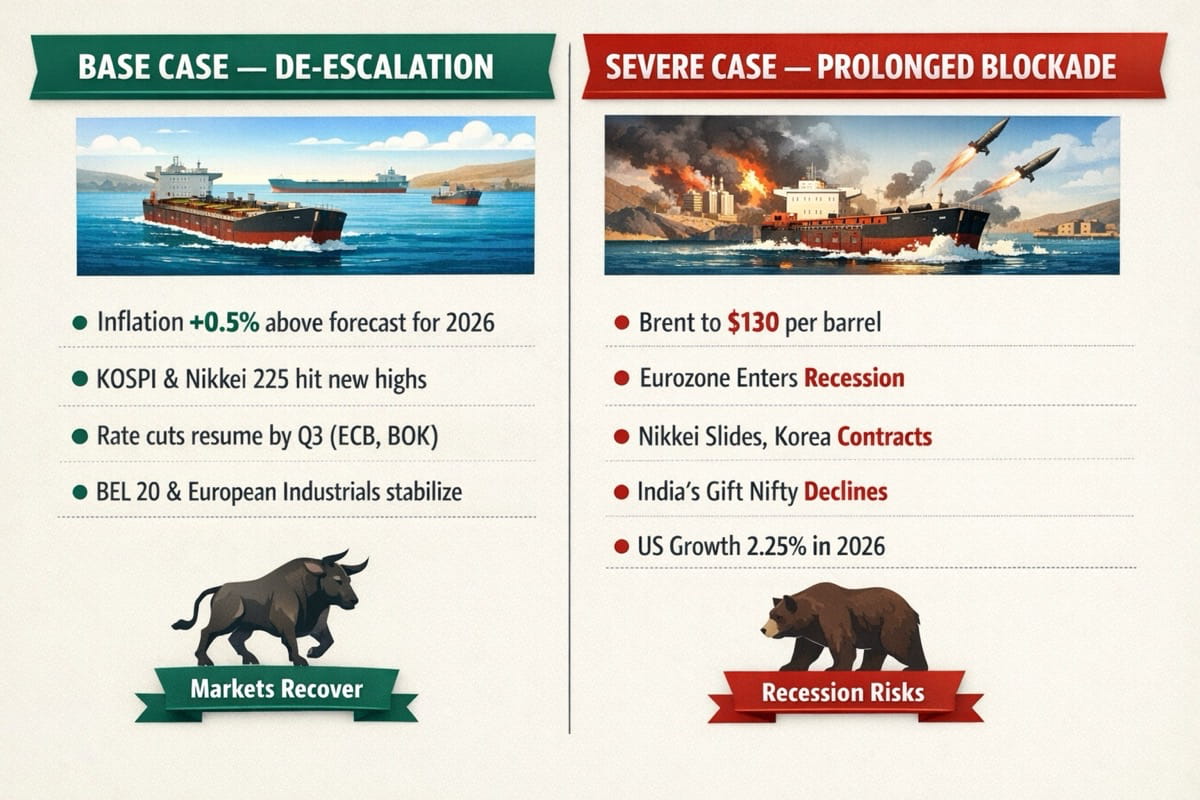
The critical variable, analysts agree, is not any single diplomatic development but the physical status of the Strait of Hormuz. Reports Wednesday that Iran allowed several commercial vessels to transit — possibly as a negotiating gesture — contributed meaningfully to the oil selloff driving today’s rally in Asian markets. But those reports remain unverified, and Iranian military officials publicly mocked the 15-point ceasefire framework within hours of its leak.
Meanwhile, the Pentagon is reportedly planning to deploy approximately 3,000 additional soldiers to the region — a signal that Washington is not assuming a quick resolution. For investors checking the KOSPI index, Nikkei 225, BEL 20 index, or Gift Nifty live data this morning, the honest answer is that Wednesday’s rally is a genuine signal, but not yet a verdict.
The Bottom Line
In fewer than four weeks, the Iran conflict has delivered one of the sharpest geopolitical shocks to global equity markets since Russia’s invasion of Ukraine in 2022, and in energy terms, potentially the most severe disruption on record. The KOSPI index plummeted 16% peak-to-trough. The Nikkei 225 lost 10%. The Nikkei index hit negative territory for the year. The BEL 20 index reflected deep European industrial anxiety. Gift Nifty live signaled distress before Indian markets even opened each morning. Oil nearly doubled from pre-conflict levels.
Today’s relief rally, driven by the first credible ceasefire signals and a 5.9% drop in Brent crude, is meaningful. South Korea leading Asian markets rebound today is the right symbol: it suffered the most, and its bounce reflects genuine repricing of tail risk downward. Bloomberg noted the session as the KOSPI index’s strongest since the 2025 rally began.
But the Strait of Hormuz is not yet open. Iranian officials are not yet at the table. The new BOK governor will still face a structurally more hawkish institutional brief. And oil at $94 is still nearly 50% above where it was when 2026 began. For investors watching the KOSPI index, the Nikkei 225, the BEL 20 index, and Gift Nifty live data, Wednesday’s session is a reason for relief. It is not yet a reason for celebration, however.