What Is MPE?
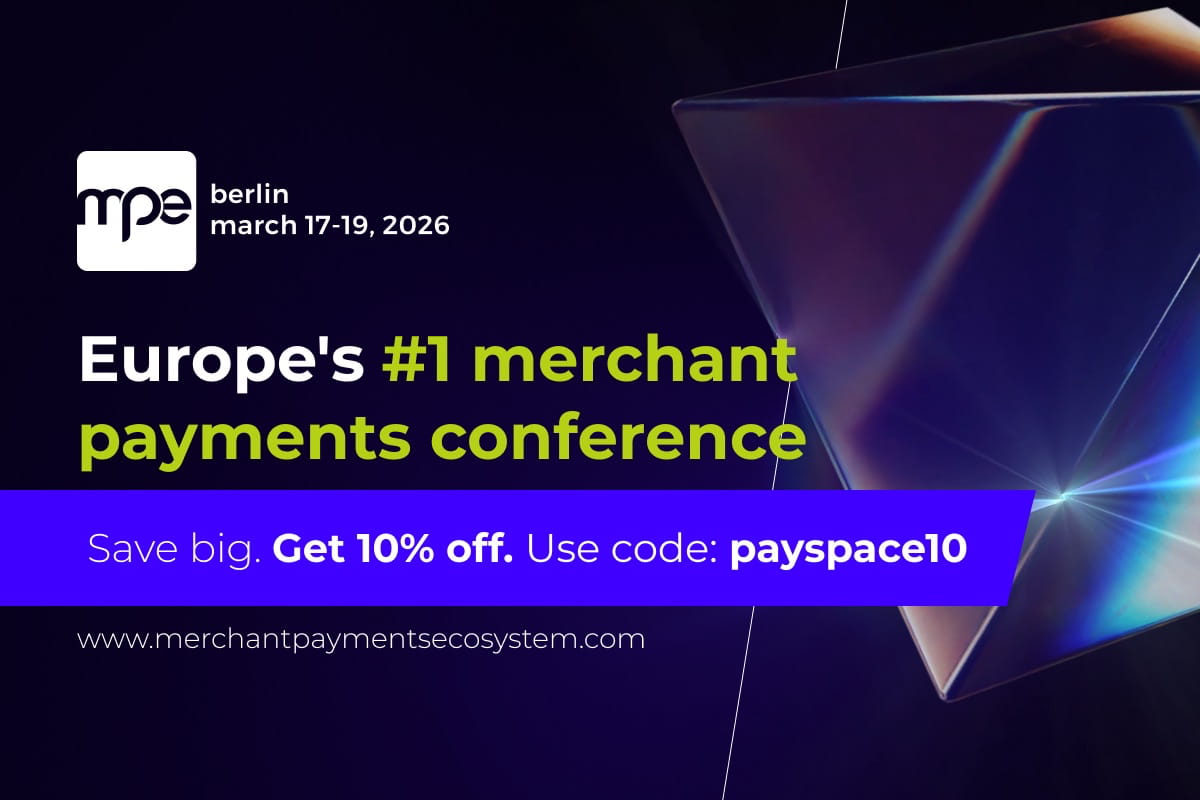
The Merchant Payments Ecosystem conference, universally known as MPE, is Europe’s leading annual gathering dedicated to merchant payments. Held in Berlin, it brings together the full payments value chain: merchants, bank acquirers, payment service providers, card schemes, fintechs, regulators, and startups. The event’s defining characteristic is its merchant-centric philosophy: unlike most financial industry conferences where merchants are a secondary audience, at MPE they are the acknowledged heartbeat of the programme. The 2026 edition, the 19th in the series, is set for March 17–19 at the InterContinental Berlin.
The scale has grown considerably over the years. The 2026 event expects over 1,600 attendees, 500+ global merchants and brands, 170+ speakers, and 90+ sponsors, making it, by attendance and scope, one of the most significant gathering in the European merchant payments calendar.
History and Origins
MPE traces its origins back to 2007, when it was launched as a relatively narrow card acquiring forum — a specialist event for bank acquirers and processors navigating the post-PSD1 European payments landscape. The early editions were smaller, more technical affairs, reflecting a payments world that was still primarily card-led and institution-driven.
The pivot toward a broader merchant ecosystem model came gradually and deliberately over the years that followed. As the payments industry fragmented, with PSPs, wallets, alternative payment methods, and eventually fintechs challenging the traditional acquiring model, the conference broadened its scope to reflect those changes. By the early 2010s it had repositioned itself as a forum for the entire payment acceptance chain, not just acquirers.
A notable institutional milestone arrived in 2010, when MPE launched what it describes as the first European awards programme dedicated to recognising excellence in card acquiring, processing, PSPs, and POS solutions. The MPE Awards have since become a fixture of the conference, evolving into a prestigious ceremony judged by a global jury of industry leaders, with categories spanning merchants, technology providers, and individual contributions.
Berlin was chosen as the host city from the start for practical reasons — strong international transport links and a genuinely accessible European hub, and has remained the home for 17 of the 19 editions. The InterContinental Berlin, now the exclusive venue for the event, has become integral to the MPE experience: delegates stay in the same building as the conference, and according to the organising team, the conversations about payments that start on stage tend to continue through meals, corridors, and hotel bars without interruption.
By the 2020 edition, MPE was drawing 1,250+ attendees including 300+ merchants and 400+ acquiring banks and PSPs from more than 40 countries — already a meaningful event by any standard. By the time of its 16th annual edition it was described as uniquely focused on merchant payments, connecting hundreds of large merchants with the acquirer and PSP community in a way no other European conference had managed to replicate.
Conference Evolution: From Acquiring Forum to Merchant Ecosystem
The most consequential strategic shift in MPE’s history has been its explicit repositioning around merchants rather than institutions. This was not simply a rebranding exercise but a sustained effort over several years to restructure who attends, who speaks, and what gets discussed.
The organisers invested in building a dedicated Merchant Programme — a hosted format in which major retailers and e-commerce brands are brought in specifically to engage with solution providers on structured terms. The result is that MPE consistently achieves over 40% merchant attendance among delegates, a figure the organisers believe is unique among European payments conferences of this scale.
The scope of topics has expanded in parallel. Early editions concentrated on card acquiring margins, interchange regulation, and POS hardware. Subsequent years incorporated mobile payments, alternative payment methods, cross-border commerce, and fraud. More recently the agenda has extended further into embedded finance, open banking, real-time payment rails, and AI. The 2025 edition pushed into questions of ecosystem design and what it means for payments to be genuinely customer-centric rather than institution-centric — a debate that left a mark on the community and set the tone for 2026.
MPE 2025: The Previous Edition
The 2025 conference, held under the banner of “human-centric innovation,” reflected a wider mood in the industry: a recognition that the frenzy of infrastructure build-out needed to connect more clearly to merchant and consumer outcomes.
Key themes that year included payment orchestration and infrastructure simplification, fraud prevention and chargeback management using AI tools, and embedded finance — the idea that merchants would increasingly want to weave financial products directly into their customer journeys through gift cards, real-time payouts, and embedded lending. The awards that year recognised Market Pay in the Merchant Payment Acceptance category, among others.
The 2025 event also sparked a pointed conversation about customer-centricity. One speaker asked directly whether the industry was genuinely consumer-focused or whether it continued to organise itself around institutions and infrastructure providers, with end users an afterthought. That question fed directly into the framing of the 2026 agenda.
MPE 2026: What to Expect
The 2026 edition, the 19th, carries the theme of Transformation — framed through the metaphor of mirroring: each part of the ecosystem reflects and reshapes the others, with merchants, PSPs, banks, platforms, regulators, and fintechs all in dialogue rather than in separate lanes.
Programme Structure
For the first time, the conference is formally split into two pillars. The on-stage programme delivers the traditional high-volume content: keynotes, panel discussions, interviews, and presentations for the broad audience. The off-stage programme is new and explicitly designed for depth: roundtables, workshops, micro-networking sessions, deep learning formats, and an expanded accelerator track. Roundtables, which were piloted in 2025, proved popular enough to return and expand.
A new Horizon Zone on the exhibition floor will spotlight early-stage startups, alongside a formal Accelerator Programme for startups and scaleups that provides structured visibility and mentorship.
MPE NXT
The most significant new addition to the 2026 edition is MPE NXT — a dedicated one-day professional development track aimed at individuals and companies at earlier stages of their careers or business lifecycles. It includes fireside chats, skill-building clinics, mentoring sessions, and peer roundtables. The initiative reflects a deliberate effort by the organisers to bring the next generation of payments professionals into the community rather than waiting for them to arrive organically.
Key Topics on the Agenda
The 2026 agenda is organised across three clusters:
Technology and product: AI in payments, payment orchestration, tokenisation, cybersecurity, fraud prevention, PSD3 and PCI compliance. AI is woven through the agenda rather than siloed into a single track — reflecting the reality that its applications now span risk, checkout, loyalty, customer service, and business model design.
Commerce and customer: Digital wallets, POS innovation, embedded finance, instant and cross-border payments. The commerce track reflects the growing importance of merchant experience in payments design.
Infrastructure and rails: Open banking and account-to-account (A2A) payments, CBDCs and stablecoins, B2B payments, and the cash lifecycle. The infrastructure track addresses the deeper plumbing questions that determine what payment experiences are even possible.
The Two Big Debates
The Head of Event Production, Filip Rasovsky, has identified two themes that will dominate the conversations in Berlin.
The first is agentic commerce — AI agents acting autonomously on behalf of consumers or businesses to initiate, approve, and complete transactions. It is being treated not merely as a technology trend but as a potential structural shift in how payments are triggered and authorised. Interest from would-be speakers has been so high that the organisers have had to actively curate the coverage to avoid the topic consuming the entire agenda.
The second is European payment sovereignty — a question that has gained new urgency given the geopolitical uncertainties of 2025 and 2026. As dependence on US card networks and infrastructure has come under fresh scrutiny, the debate about whether Europe needs genuinely independent payment rails and infrastructure has moved from a fringe regulatory conversation to a mainstream strategic one.
Awards and Gala
The MPE Awards ceremony and Gala Dinner remain a centrepiece of the event. In 2026, an independent jury of 23 global industry leaders will review entries across product, service, and impact categories, alongside a People’s Choice Award.
Why MPE Matters
The conference has achieved something that is genuinely difficult: a loyal, recurring community that treats attendance as a professional obligation rather than an optional diversion. Attendee testimonials repeatedly emphasise the quality of networking rather than just the content — the density of senior decision-makers in one venue, the absence of filler sessions, and the culture of closed-door discussions that allow frank conversations that would not happen in a public forum.
For payment professionals focused on merchant acquiring, PSP strategy, fraud, open banking, or the emerging infrastructure layer, MPE represents the most concentrated annual opportunity to take stock of where the industry is heading and who is building what.
At 19 editions and counting, it has moved well beyond the card acquiring forum that began in 2007. Whether the next two decades are shaped by AI agents, European sovereign rails, or something not yet visible, MPE will, on current form, be where that conversation happens first.
MPE 2026 takes place March 17–19, 2026, at the InterContinental Berlin. To attend it on better terms, our readers can enjoy 10% off tickets with a special discount code:
 payspace10
 Valid from January 29 until March 17