By Darya Ivanova, PR & Brand Director at Versus Trade
A buyer in Jakarta can store a one-gram ANTAM bar, buy a fraction of a gold token, or trade the dollar price of gold through a broker. All three can benefit from an upswing in bullion values. However, each has distinct requirements for sale. A bullion dealer can buy back a bar. A token holder needs a buyer or a trading venue. A CFD trader needs an executable quote to close the position.
Comparing tokenized gold vs physical gold involves considering both ownership and retrieval. Leverage is then added with the inclusion of CFDs. Versus Trade offers gold price exposure through derivatives. A gold token, a CFD, and a bar bought with rupiah can all track the same global gold price, but their costs and exit routes differ.
Physical gold and rupiah repurchase rate
Owning physical gold starts with two quotes: the dealer’s selling price and its buyback price. Manufacturing and distribution can make smaller bars more expensive per gram. At ANTAM’s Logam Mulia boutiques, the posted buyback price per gram is the same across bar sizes and production years. A higher retail premium therefore means the buyback price has to rise further before the buyer breaks even.
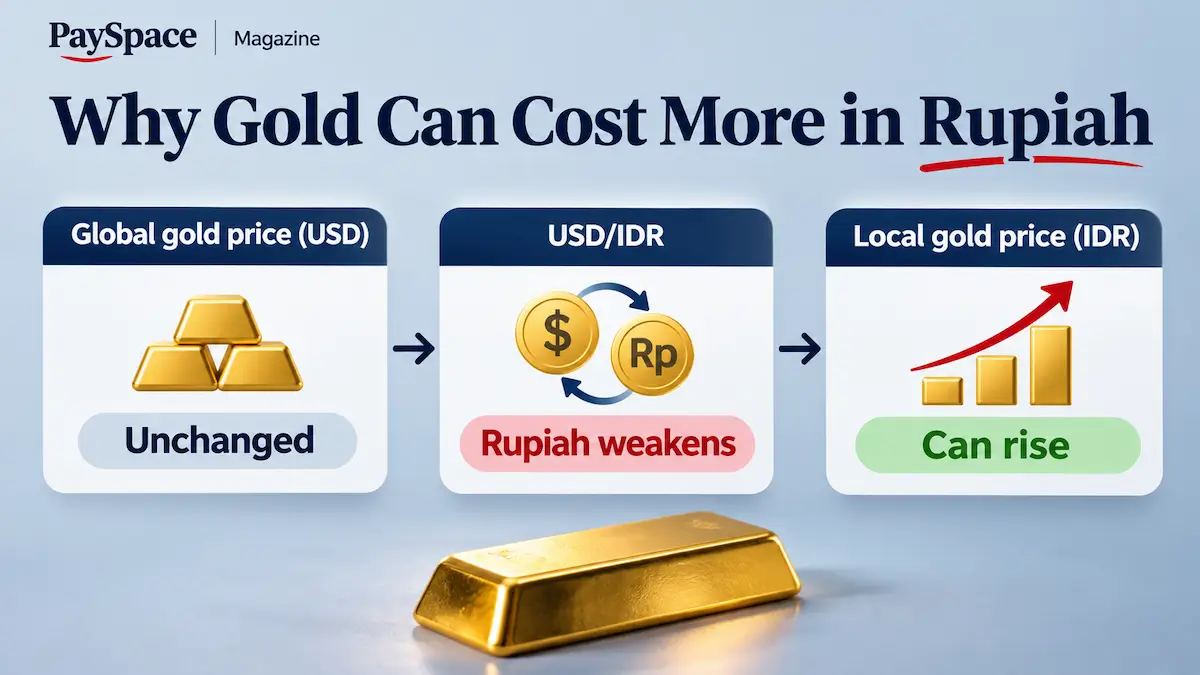
Alongside the gold value, the local repurchase rate is also influenced by currency. Should the dollar value of spot gold remain unchanged but the rupiah depreciate against the dollar, then gold effectively becomes more costly in rupiah terms before dealer rates are considered. Conversely, a stronger rupiah can offset some or all of an increase in the global gold price. Nevertheless, simply viewing the dollar spot gold price does not fully reflect what a dealer would repurchase gold for within Indonesia.
For people used to holding assets in apps, part of the appeal of physical bullion is simple: once the bar is in hand, access to it doesn’t depend on a platform. Once a physical gold bar has been obtained, there is no need to use an app or brokerage to access real gold. Secure storage is essential for physical gold. Those storing gold bars at home must bear any physical storage costs themselves. Individuals can also influence a dealer’s assessment of a gold bar, depending upon both the sales receipt and condition of the bar’s original packaging. ANTAM repurchases gold by bank transfer and states that this occurs within one to three business days.
Gold volume for a given budget will vary according to units. As dealers impose a greater price per gram for one-gram bars, an individual dividing their gold investment into multiple small units benefits from the flexibility to sell these sequentially. Although a larger gold bar may originally have been subject to a lower per-gram mark-up than a smaller bar, the larger item must be sold in full to a dealer.
Tokenized gold and retrieval cost
A gold-backed token is a digital version of physical gold, which is itself stored in custody. In the wider market for tokenized precious metals, issuers use different arrangements for custody, allocation, and redemption. Both Pax Gold (PAXG) and Tether Gold (XAUT) represent one fine troy ounce of gold per token. Fractional units can be stored within a wallet. Issuer records link token balances to specific gold bars. The issuer’s terms govern how a holder can claim delivery.
Various resources to learn about CFDs describe how a broker can be used to gain gold exposure via derivatives. Crucially, even though both tokenized and physical gold can exhibit similar price behavior, the entitlements available to individuals differ. A digital token can move between compatible wallets, subject to its transfer rules. Meanwhile, a CFD is an open broker book position. Closing a CFD realizes a cash profit or loss.
How PAXG and XAUT handle physical redemption
The PAXG vs XAUT comparison matters most when a holder wants delivery. Both tokens can trade in fractions, but direct physical redemption through either issuer starts at a much larger size. Consumers aiming to redeem tokenized gold for physical gold must undergo verification procedures. They also incur issuer fees and must arrange delivery. For those with a small token quantity, it may be more straightforward to sell their tokens and then purchase a small local gold bar.
| Direct issuer terms | PAXG | XAUT |
| Gold represented by one token | One fine troy ounce | One fine troy ounce |
| Bar redemption threshold | At least 430 PAXG, plus the applicable fee, per London Good Delivery gold bar | Increments of 430 XAUT, with the final amount adjusted to the bar’s actual fine weight |
| Delivery arrangements | The holder is responsible for arranging transport with a delivery service. | Delivery to an eligible address in Switzerland at the holder’s expense |
| Published charges | Paxos lists a 0.05% fee for conversion into allocated gold or unallocated gold and publishes a separate redemption fee schedule. | Tether lists a 0.25% redemption fee plus applicable charges, including delivery where relevant. |
Is tokenized gold safe when held by an exchange?
Alongside the gold security, a reserve attestation can demonstrate the quantity of physical gold held in custody on the reporting date. Yet this does not necessarily indicate whether an exchange will allow withdrawals if there is a system failure, or whether the local order book can cope with a high volume of sales around spot price. The exchange adds another layer of counterparty risk when it holds the digital asset on the customer’s behalf.
While the tokenized gold market is active, the issuer’s gold stock can remain static over the weekend. As with other tokenized commodities, there is separation between market activity and custody. If order book liquidity reduces, a limited trade can occur at a price that exceeds what a bigger seller could achieve. Moreover, an Indonesian consumer selling using a dollar stablecoin pair may face a second spread when converting sale monies into rupiah. For tokenized gold, both execution prices affect how much is ultimately deposited into a bank account.
Self-custody alters token control. Individuals must then manage risks relating to wallet access and ensuring that funds are sent to the correct network and wallet address. Meanwhile, vault gold continues to rely on both the issuer and the custodian. Indonesia’s Financial Services Authority (OJK) assumed oversight of crypto assets from Bappebti in January 2025. The regulation of, and permission for, local provision of tokenized assets will vary according to both the nature of the asset and the activity undertaken. Becoming listed on a foreign exchange does not automatically grant permission to operate locally nor does it provide a mechanism for asset retrieval into Indonesia.
Gold CFD payout
Usually, a long gold CFD benefits from an increase in the broker’s gold rate and suffers from a decrease. Conversely, a short CFD has inverse exposure. The broker settles the price difference in cash when the position closes. Importantly, no gold bar is ever physically released. FXStreet’s July 2026 recap of its interview with CEO and Co-Founder Vitalii Bulynin describes his view of a broker as a “vehicle, not a saving point.” Opening a leveraged broker gold CFD necessitates payment of initial margin.
Relative value also affects exposure. Those who trade Bitcoin vs Gold are effectively speculating on the relative strength of Bitcoin and gold. Let us say that Bitcoin increases in dollar terms by 5% and gold by 10%. Despite both assets strengthening against the dollar, the Bitcoin/gold ratio will have fallen by around 4.5%. “But markets don’t work in isolation. There’s always another side, another asset competing for capital,” wrote Yurii Matkovskiy, COO and Co-Founder, in a LinkedIn post explaining the rationale for the brokerage’s selection of pairs.
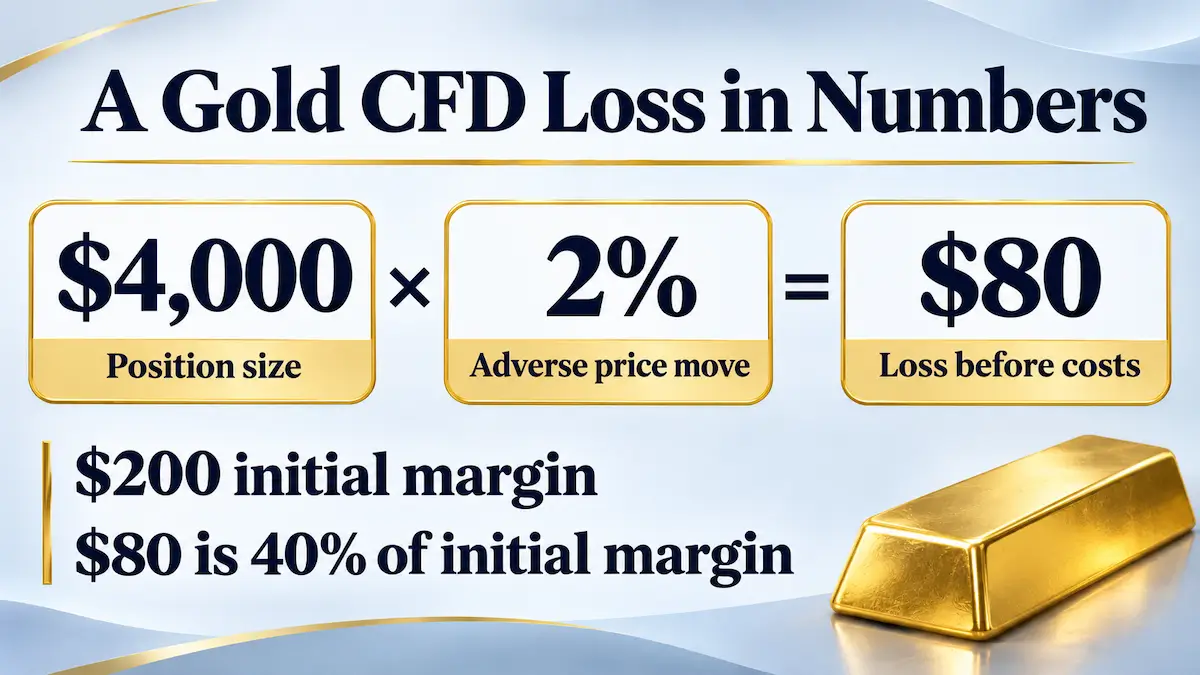
Alongside the trading spread, CFDs may incur further costs such as commission, overnight financing, and currency exchange. On a swap-free account, eligibility, holding-period rules, and any alternative charges are all subject to broker stipulations. Time is an important element where leverage is involved. Assuming a $4,000 notional position with $200 in initial margin, a 2% unfavorable price change results in an $80 pre-fees loss. This is equivalent to 40% of the initial margin. The broker may close the position if the account reaches its margin closeout threshold, even if gold later recovers.
Physical, tokenized, and gold CFDs—compared sales
| Product | What the buyer holds | Costs that matter on the way out | What an exit delivers |
| Physical bullion | A bar or coin | Dealer buyback spread and any applicable deductions | Sale proceeds, usually quoted in rupiah by Indonesian dealers |
| Tokenized bullion | A token linked to vaulted metal under the issuer’s terms | Trading spread, exchange fees, and possible network or redemption costs | Cash or another asset after a sale, or metal if issuer conditions are met |
| Gold CFD | A cash-settled contract with a broker | Spread, any commission, overnight charges, and possible slippage | Realized profit or loss in the trading account |
Different timings apply to various costs. An individual pays a dealer a mark-up for physical gold at the point of acquisition. Tokenized gold can incur a trading spread and exchange fees on a sale, network fees on a wallet transfer, or issuer charges on redemption. Furthermore, while a CFD position is outstanding, overnight financing charges may accumulate. A tight trading spread provides limited guidance regarding the total cost of maintaining a CFD position for a number of weeks.
Both the planned investment duration and account type are significant factors in how to invest in gold decisions. Some people prefer to own physical gold bars. Others prefer to trade shares through a securities account. Physically backed gold ETFs such as SPDR Gold Shares hold bullion in custody. Retail investors typically sell ETF shares on the secondary market. Only authorized participants can redeem baskets directly with the trust.
For Indonesians, the sales method is key. Individuals receive a dealer’s rupiah-based repurchase rate for physical gold. When tokenized gold is sold on a trading platform, the proceeds depend in part on that venue’s liquidity.
In addition, there are issuer conditions that determine how individuals can retrieve physical gold. As for gold CFDs, the broker’s closing quote is used and an account balance is updated accordingly. Even on days where the fundamental gold price shows little change, different payout amounts can be realized from the three options.