Stablecoins were not designed to compete with SEPA Instant on its home turf. When a euro payment stays within the EEA, existing rails already deliver speed, availability and efficiency. The harder problem begins when money crosses currencies or borders. That’s where correspondent banking, prefunding and reconciliation still stand between a payment being sent and actually being settled.

That is the market stablecoins are now moving into. Cross-border B2B payments are emerging as their clearest real-world use case, while the infrastructure needed to connect on-chain money to banks, currencies and businesses is rapidly consolidating. At the same time, Europe is considering changes to MiCA that could fundamentally alter the economics of euro stablecoins, particularly if issuers were ever allowed to pay interest. PaySpace Magazine Global set down with Patrick Mollard, Co-Founder & CEO of Fipto, a European fintech providing stablecoin payment infrastructure for businesses, to discuss why stablecoins could become a genuine payment rail, where they actually outperform existing systems, and what could stand in their way.
Stablecoin circulation passed $300bn in early 2026, but dollar-backed tokens still dominate. How big is euro-denominated stablecoin demand right now, and where does it come from?
Total stablecoin supply is around $305bn, up roughly 14% year on year, after a peak near $321bn in May 2026. Euro-denominated tokens are under $1bn, roughly 0.2 to 0.3% of the total.
The growth rate is the interesting number. The MiCA-compliant euro basket more than doubled in twelve months, +128% to about $674m at end June 2026. EURC holds around two thirds (63.9%). Société Générale-Forge’s EURCV is second at about $138m and the fastest growing of the established tokens, +180%. Banking Circle’s EURI went from zero to roughly $51m in five months. Revolut has just launched their own EUR stablecoin too.
Payments and Treasury demand increases, and what Fipto sees is corporates and PSPs that need a euro leg in a dollar-denominated on-chain world. EUR/USD conversion, intercompany settlement into emerging markets.
From July 1, 2026, unauthorised French PSANs can no longer operate. What do you expect to happen to the firms that don’t make the CASP cut: consolidation, exit, or a scramble to partner with licensed players like Fipto?
It has already happened. We saw actors, including big ones, having to make the hard decision to close all or part of their business to comply with MiCA.
Before MiCA, 2,747 companies were registered to provide crypto services in Europe. Today, 280 hold a CASP authorisation, and fewer than 20 combine it with a PSD2 licence the European Banking Authority recommends.
Behind these numbers are thousands of businesses, many of them well built, that could not meet the cost and scrutiny of authorisation. It is a hard truth for the industry: a strong technical stack no longer sets a provider apart in European digital assets. The licence does.
This is the conviction Fipto was built on. We were the first stablecoin infrastructure in Europe to hold a dual authorisation: a MiCA CASP licence from the AMF and a Payment Institution licence from the ACPR, both in France. It was the longer path, and it is the reason payment companies and financial institutions can build on us with confidence.
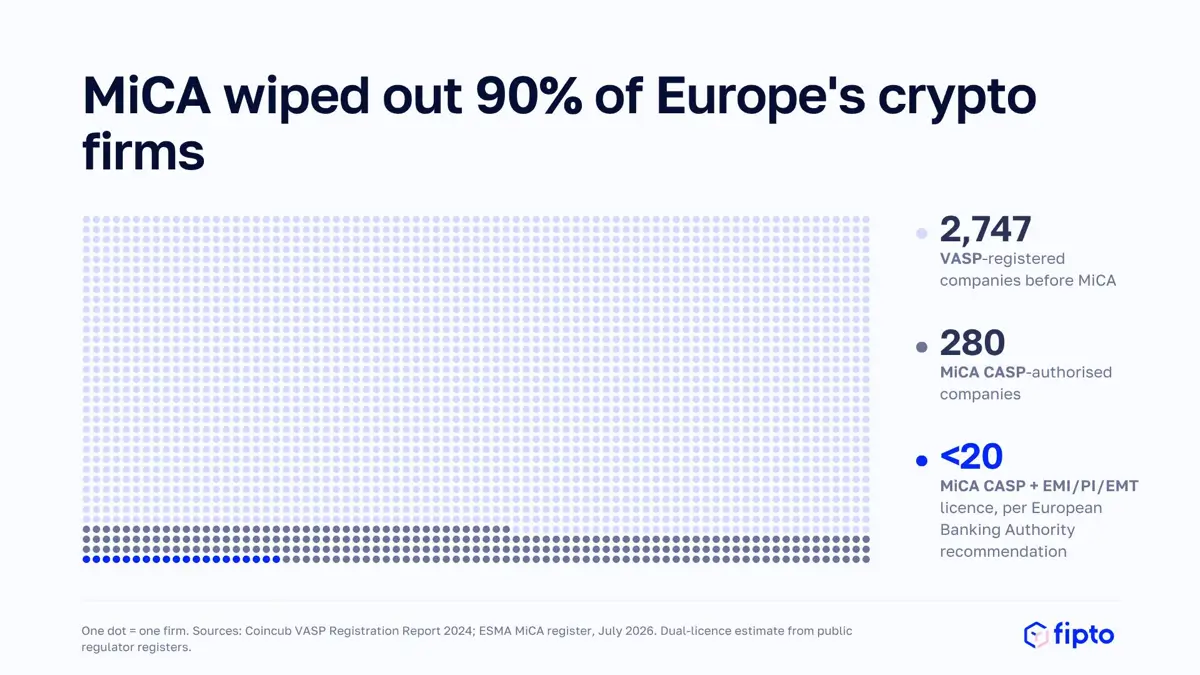
Image provided by Fipto
The ECB has resisted loosening constraints on euro stablecoins even as the US GENIUS Act moves in a more permissive direction. Does that put European issuers at a structural disadvantage, or does it protect something the US approach doesn’t?
The ECB has not softened. The GENIUS Act is more permissive on paper but is not yet in force. Where the real European constraint lies, specifically: MiCA’s reserve rules (30% and 60% of reserves held with EU credit institutions, plus concentration limits per institution). On interest, both regimes prohibit issuers from paying it, but MiCA reaches distributors as well, which is a genuine asymmetry.
Mastercard’s $1.8bn acquisition of BVNK and Qivalis euro stablecoin initiative growing to 37 banks across 15 countries both point to regional stablecoin infrastructure consolidating fast. Where does an independent player like Fipto fit between bank consortia and card networks moving into this space?
Bank consortia issue money, networks own distribution, and neither builds the regulated layer in between. Accounts and IBANs, on and off ramp, FX, compliance, treasury workflow, API and TMS integration. That layer is where Fipto operates, and it needs to be heavily licensed to be credible, we saw with MiCA that 90% of crypto went out of business. We’re the first European payment provider to hold both a PSD2 payment institution licence and a MiCA CASP licence, which is what allows it to hold both legs of a transaction, fiat and on-chain.
Independent infrastructure is becoming scarcer as it is acquired. Bridge belongs to Stripe, BVNK belongs to Mastercard. An infrastructure platform inside a network has different incentives from one outside it, whatever its stated intentions, and Fipto’s commercial model carries no exclusivity to a single issuer, chain or scheme.
Fipto’s recent partnership with Worldline aims to create next-generation payment rails. Could you explain for ordinary customers, what does a stablecoin-settled transaction do better than existing card or SEPA rails?
It’s a strategic collaboration to develop and deploy stablecoin settlement and payment use cases with Worldline. The development is ongoing.
Card rails and SEPA are excellent inside their perimeter. SEPA Instant clears in ten seconds, 24/7. But it is euro-only and EEA-only. The moment money crosses a currency or leaves the EEA, you are back in correspondent banking. What changes with stablecoins for a customer: settlement at any hour of any day, weekends and public holidays included; no idle prefunded accounts in every corridor; and programmability, so reconciliation becomes a property of the payment rather than a process after it. One of our clients, Mantu, had their Europe to Colombia intercompany flow moved from two to five business days down to minutes, at roughly 1% all-in against 3 to 5%.
The FSB 2025 monitoring data show only 35.4% of retail cross-border payments settling within an hour, and the BIS said in May 2026 that the G20 targets are unlikely to be fully met.
Stablecoins were originally built as fiat-to-crypto gateways. What has to be true, either technically or regulatory-wise, for them to become a default payment rail rather than a crypto-adjacent tool to existing systems? Is that even a possibility?
It is possible, and it is already occurring in one segment: cross-border B2B. It is unlikely in domestic retail, where instant rails and cards work well and there is no problem to solve. there are dozens of stablecoins use cases with trading, payments and treasury, where stablecoins are simply unbeatable, that is why every major payment player is implementing stablecoins.
In terms of “technically”, a few things need to exist: Interoperability across chains and issuers, so that accepting a payment is not a bet on one network. Identity and compliance at the payment layer, so that travel-rule data moves with the money. And bank-grade availability, because a treasurer’s real test is whether the rail works at four in the morning on 31 December.
Eventually stablecoins will become what you define as a default payment rail. For now, real-economy stablecoin payment volumes are estimated at roughly $350bn to $550bn for 2025, growing about 60% year on year. Set against global B2B flows, that remains a very small share. But the growth is impressive.
European crypto regulation is currently undergoing the consultation and potentailly recalibration process. What are the main changes discussed for MiCA 2.0 and what’s the one change that would most affect how Fipto or the broader euro stablecoin ecosystem operates over the next two years?
The Commission’s consultation closes 30 September 2026. The review report is due by 30 June 2027, a legislative proposal is expected in 2027, and new rules would realistically apply from 2028. On the table: multi-issuance with third-country issuers; an equivalence regime for third-country stablecoins; relaxing the 30% and 60% deposit floors; whether interest may be paid on stablecoins; and centralised supervision.
Permitting interest would change the economics entirely and place euro tokens in direct competition with bank deposits, which is exactly why banks would resist it.