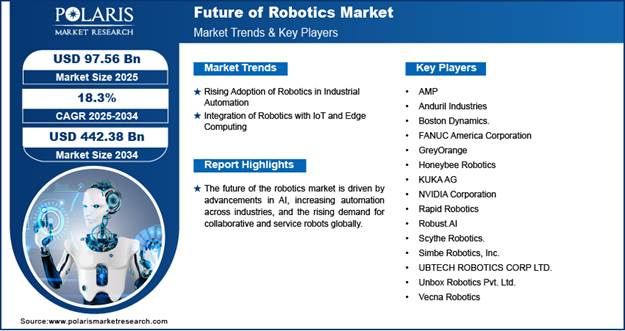
The global AI robotics market is entering a period of accelerated growth as businesses across manufacturing, logistics, healthcare, and infrastructure scale up automation investments. A new report from Polaris Market Research projects that the future of robotics market will reach $442.38 billion by 2034, expanding at a compound annual growth rate (CAGR) of 18.3% between 2025 and 2034.

The findings reflect a broader shift toward an automation economy, where intelligent machines, AI-powered systems, and advanced robotics platforms are increasingly embedded in enterprise operations and digital infrastructure.
AI Robotics Driving the Next Automation Wave
According to the report, advances in artificial intelligence, machine learning, and sensor technologies are rapidly expanding what robotic systems can do. Modern robots are no longer limited to repetitive industrial tasks; instead, they are evolving into autonomous systems capable of real-time decision-making, self-learning, and adaptive responses.
These capabilities are enabling a new generation of AI robotics solutions across industries. In manufacturing, robots are optimizing assembly lines and predictive maintenance. In logistics, autonomous robots are transforming warehouse operations and fulfillment processes. In healthcare, robotic systems are supporting surgical procedures, diagnostics, and hospital automation.
For technology and fintech analysts, the trend highlights a deeper convergence between AI infrastructure, data analytics, and robotics platforms. As companies integrate robotics with cloud computing and edge processing, automation is becoming a core driver of operational efficiency and digital transformation.
Cobots and Human-Robot Collaboration Expand
One of the fastest-growing segments in the robotics ecosystem is collaborative robots, or cobots, which are designed to work safely alongside human operators.
Unlike traditional industrial robots that operate in isolated environments, cobots feature advanced safety mechanisms, intuitive programming interfaces, and real-time adaptability. This allows them to assist human workers directly on factory floors, assembly lines, and warehouse operations.
The rise of cobots is particularly important for small and medium-sized enterprises (SMEs), which often lack the resources to deploy large-scale industrial automation systems. Cobots offer a flexible entry point into industrial automation, enabling companies to improve productivity while maintaining workforce collaboration.
As a result, collaborative robotics is expected to be the fastest-growing robotics category over the next decade, driven by demand for adaptable automation tools that can integrate seamlessly into existing workflows.
Industrial Automation Fuels Market Expansion
The report identifies ground-based robotics as the largest segment in the robotics ecosystem, accounting for the biggest share of deployments in 2024.
Ground robotics includes a wide range of technologies such as autonomous warehouse robots, industrial automation machines, agricultural robotics, and robo-delivery platforms. These systems are already widely deployed across manufacturing plants, distribution centers, and commercial facilities.
The continued expansion of industrial automation, combined with labor shortages and increasing operational complexity, is pushing companies to adopt robotic solutions at scale. For many enterprises, robotics is now a strategic investment rather than an experimental technology.
Asia-Pacific Leads, North America Accelerates
From a regional perspective, Asia-Pacific dominated the robotics market in 2024, supported by strong manufacturing ecosystems, aggressive automation strategies, and significant investments in robotics technology.
Countries in the region have integrated robotics deeply into their production systems, reinforcing their role as global manufacturing leaders.
However, the report forecasts that North America will see the fastest growth during the forecast period, fueled by rising investments in AI innovation, robotics startups, and advanced automation technologies.
Increasing adoption across sectors, including logistics, defense, healthcare, and manufacturing—is expected to drive significant robotics expansion throughout the region.
Key Players in the Global Robotics Ecosystem
The competitive landscape includes a mix of established industrial robotics leaders and emerging AI-driven automation startups. Key companies highlighted in the report include:
- Boston Dynamics
- KUKA AG
- FANUC America Corporation
- NVIDIA Corporation
- Anduril Industries
- GreyOrange
- Rapid Robotics
- Robust.AI
- Vecna Robotics
- Simbe Robotics
Many robotics developers are increasingly integrating AI chips, machine learning frameworks, and cloud-based control systems to create autonomous platforms capable of operating in complex environments.
The Rise of the Automation Economy
With the robotics sector projected to surpass $440 billion in value within the next decade, AI robotics is becoming a central pillar of the global automation economy.
As enterprises continue to digitize operations, robotics technologies are expected to play a growing role in supply chain automation, smart infrastructure, autonomous logistics, and data-driven industrial systems.
For investors, fintech strategists, and technology leaders, the message is clear: the convergence of AI robotics, industrial automation, and intelligent infrastructure is reshaping how businesses operate—and how the next generation of digital economies will function.