Alipay has launched a delegated payment feature through its AI Pay product, allowing users to authorize an AI assistant to make purchases on their behalf. The feature is now live on Taobao, Alibaba’s e-commerce platform.

The launch comes as agentic commerce (transactions initiated or completed by AI on behalf of users) gains traction in China and globally, with regulators and payment networks beginning to establish frameworks for AI-authorized payments.
How AI Pay Delegated Payments Work on Taobao
Users set a target price for an item. They then authorize a single purchase through Alipay AI Pay using a one-time delegation mechanism valid for that transaction only. After identity verification, the AI monitors prices and places the order when the conditions are met.
The process involves three steps in the Taobao app:
- Open the “Messages” tab, tap “AI Shopping Assistant,” and describe the item
- Select from the AI’s suggestions
- Complete identity verification via Alipay AI Pay to confirm the order
Alipay AI Pay Current Usage Data
Alipay AI Pay launched in 2025. It reached 100 million users in February 2026. During the week of February 5–11, 2026, the product processed over 120 million transactions.
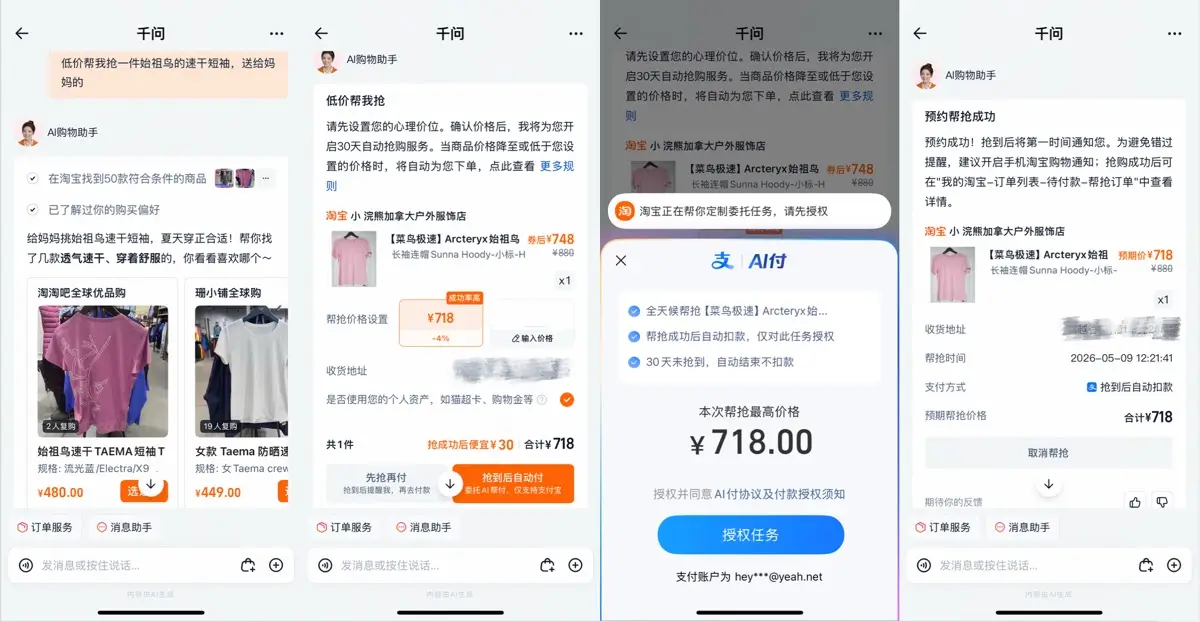
Delegating T-shirt purchases to AI via Alipay AI Pay on Taobao. Image provided by Alipay
Planned Expansion of Delegated Payments
Alipay says it plans to extend the delegated payment capability to recurring purchase scenarios, including daily commuting, utility payments, and repeat procurement.
The AI Pay product is already integrated with several third-party platforms and devices, including Luckin Coffee’s app, Rokid AI smart glasses, Alibaba’s Qwen AI assistant, and OpenClaw-type AI agents.
AI Payment Regulation in China
China’s central bank, the People’s Bank of China (PBOC), regulates digital payments under its Non-Bank Payment Institution Supervision Framework, updated in 2023. Alipay operates under an online payment license issued by PBOC. Delegated or agent-based payment flows, where software acts on a user’s behalf, fall under existing authorization and authentication requirements, including mandatory identity verification, which Alipay AI Pay addresses through its one-time delegation model.
As of early 2026, China has not introduced specific regulation targeting AI-initiated payments, though PBOC has signaled interest in updating consumer protection and supervision rules for digital payments, especially in areas where data use and payment-platform practices may affect consumer rights. As the technology gains traction, though, the government’s next regulatory measures may as well cover automated transaction scenarios.