Artificial intelligence (AI) is rapidly becoming part of everyday life, but its expansion comes with a growing challenge: energy consumption. Training and running advanced AI models requires vast computing resources, and the data centres powering these systems are consuming increasing amounts of electricity worldwide. Against this backdrop, Chinese technology giant Ant Group is attempting to demonstrate that AI innovation and sustainability can advance together.

On June 16, Ant Group’s digital payments platform Alipay unveiled a major upgrade to its AI capabilities with the launch of “Ah Bao,” an AI agent designed to help users access services and complete everyday tasks through natural-language conversations.
The new interface allows users to interact with more than 10,000 services ranging from ride-hailing and food ordering to home appliance repairs and electric vehicle charging. Instead of navigating through multiple apps and menus, users can simply describe what they need and the AI agent completes the task on their behalf. The company describes the launch as a significant step toward making AI a practical tool for everyday consumers rather than a technology reserved for specialists.
“Alipay has always pursued one goal: using technology to remove frictions from everyday services — whether it is paying bills without leaving home or booking doctor appointments without queues. Today, we continue to explore how AI can optimize the way users access services, turning AI from a productivity tool for the few into an everyday helper for the many,” said Jun Li, President of Alipay Business Group, Ant Group.
The company claims that this update makes Alipay the world’s first super app to evolve into an AI-native platform, where AI becomes the primary way users access services. However, Tencent has also been working on AI integration within WeChat, and other Asian super apps such as Grab and Gojek, for example, have also been actively incorporating AI capabilities, although not necessarily through a full AI-agent-first interface.
However, AI’s growing popularity is also raising concerns about its environmental impact. According to the International Energy Agency (IEA), global data centres consumed around 415 terawatt-hours (TWh) of electricity in 2024, representing approximately 1.5% of global electricity demand. The IEA expects that figure to more than double to around 945 TWh by 2030, with AI workloads becoming one of the main drivers of growth. Electricity consumption from AI-focused data centres is projected to triple during that period.
As AI adoption accelerates, technology companies are increasingly looking for ways to offset the additional energy requirements through efficiency improvements, renewable energy procurement, advanced cooling technologies, and smarter infrastructure management. Companies including major cloud providers have invested heavily in renewable energy projects and long-term clean energy purchasing agreements, while data centre operators continue to seek ways to reduce the amount of electricity needed for each computing task.
Ant Group argues that AI itself can help address part of the sustainability challenge. The company highlighted this strategy in its newly released 2025 Sustainability Report, which details both its AI investments and environmental initiatives.
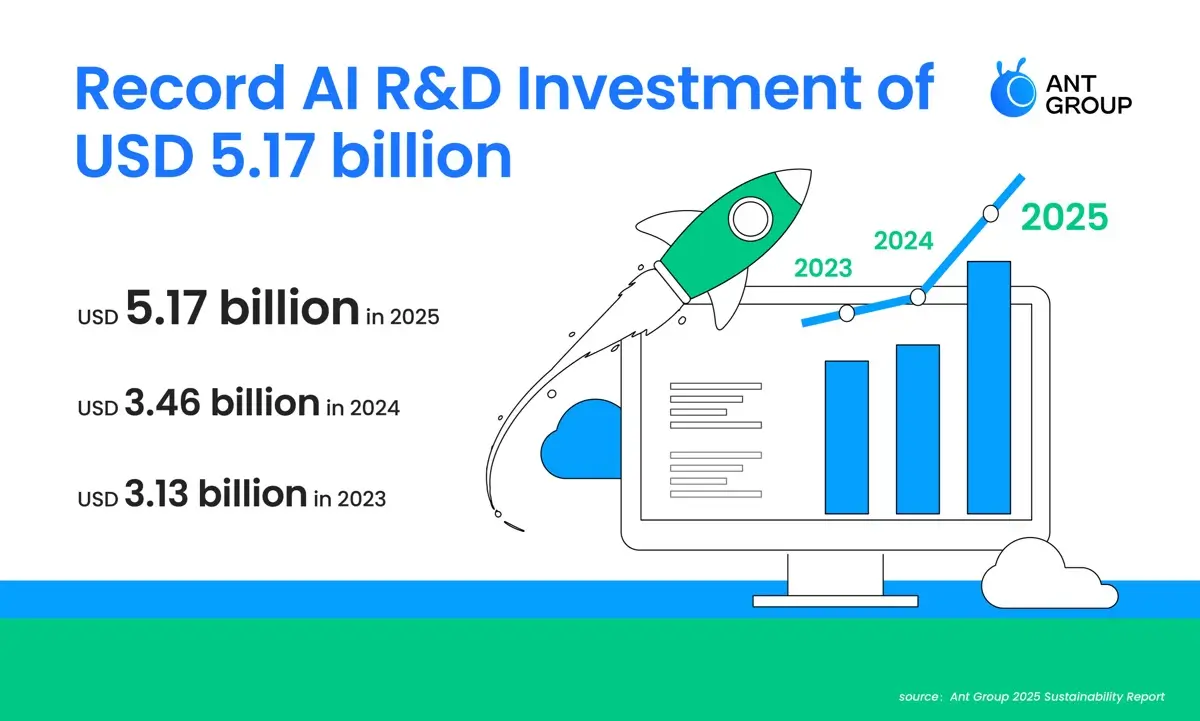
The ESG 2025 report reveals that Ant Group invested RMB 35.03 billion (approx. USD 5.17 billion) in research and development during 2025
The report reveals that Ant Group invested RMB 35.03 billion (approximately USD 5.17 billion) in research and development during 2025, marking its fifth consecutive year of increasing R&D spending. The investment supports three key areas: foundational AI models, AI-powered payment and lifestyle services, and AI-driven healthcare solutions.
“Does technological advancement necessarily lead to shared prosperity? The answer lies not in the technology itself, but in the people who use it,” wrote Eric Jing, Chairman of Ant Group, and Cyril Han, CEO of Ant Group in their joint address. “Making AI a driver for shared prosperity — this is our answer to the age of AI, and our shared commitment to the future.”
One of the company’s most significant sustainability achievements came from improvements in its computing infrastructure. Ant says its self-developed Theta AI platform increased GPU utilisation during AI inference by 2.3 times while reducing data-centre carbon emissions by 139,545 tonnes of CO₂ equivalent. The company reported that these and other efficiency measures helped reduce its operational carbon emissions by 55.32% compared with its 2020 baseline.
Ant also maintained operational carbon neutrality for the fifth consecutive year and increased the share of clean energy powering its data centres to 65% in 2025.
For readers unfamiliar with ESG metrics, the figures suggest that Ant is simultaneously expanding its AI operations while lowering the emissions generated by its own business activities. A 55% reduction in operational emissions means the company now emits less than half the carbon it produced from comparable operations five years ago, while nearly two-thirds of the electricity used in its data centres comes from cleaner energy sources.
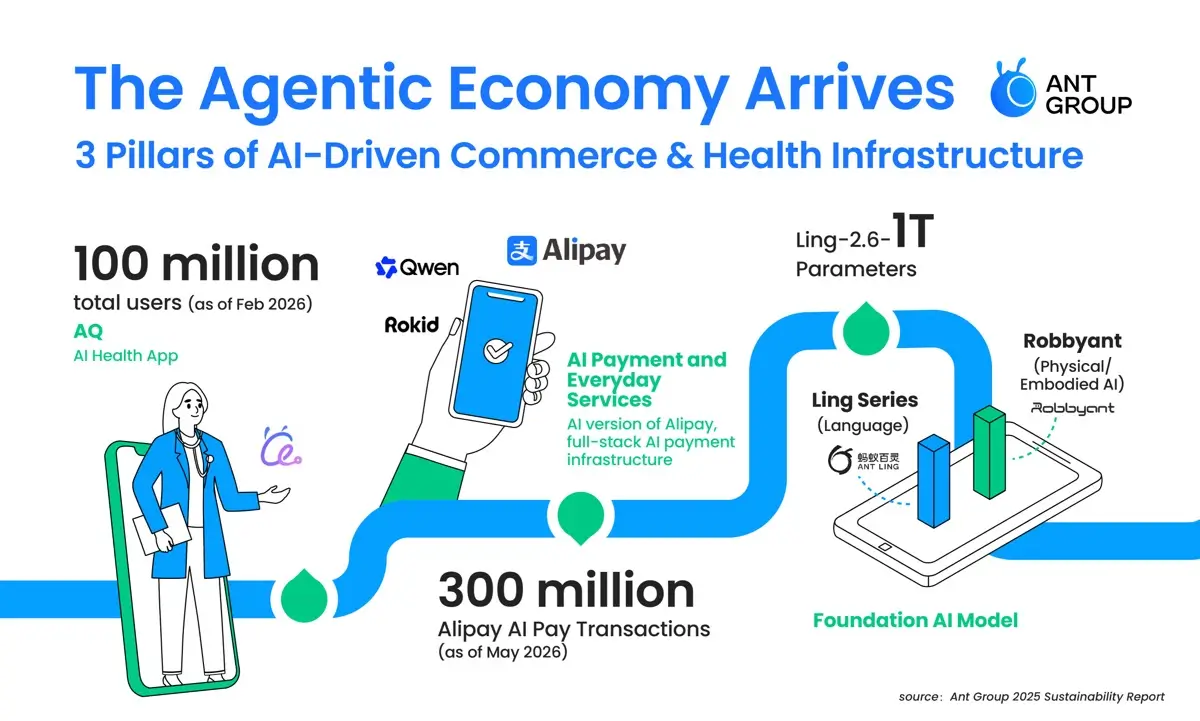
Ant Group’s agentic economy scheme. Source: Ant Group 2025 Sustainability Report
Healthcare remains one of Ant’s biggest AI initiatives. Its AI-native health application AQ surpassed 100 million users by February 2026. The platform now connects users with more than 5,000 medical institutions across China and has supported AI integration at 301 healthcare facilities.
The company has also partnered with more than 2,000 physicians to create “AI Doctor Agents” — virtual assistants trained on the expertise of individual doctors. Ant says these systems provided health guidance to more than 6.9 million users during 2025.
Beyond healthcare, Ant continues to expand its AI payment ecosystem. In May 2026, Alipay introduced AI Pay, AI Wallet, Token Pay and a new Agentic Commerce Trust Protocol designed to support transactions initiated by AI agents. According to the company, AI Pay has already processed more than 300 million transactions, making it one of the largest deployments of AI-native payment infrastructure globally.
The company’s AI ambitions also extend to foundational model development. During 2025, Ant open-sourced its Ling family of AI models, including the recently released Ling-2.6-1T, a trillion-parameter large language model designed for complex tasks such as coding and multi-step workflows.
Meanwhile, Ant’s embodied AI subsidiary Robbyant launched its “Evolution of Embodied AI Week” initiative and open-sourced a suite of models designed for physical-world applications. Among them is LingBot-World, a world model aimed at improving how robots and AI systems understand and interact with real environments.
Taken together, the sustainability report paints a picture of a company pursuing aggressive AI expansion while attempting to reduce the environmental costs typically associated with that growth. Whether the broader technology sector can replicate such gains remains an open question. The challenge is significant: according to the IEA, global data-centre electricity demand is expected to grow more than four times faster than electricity consumption in all other sectors through 2030.
“We believe that the true value of technology lies not in fleeting trends, but in genuine needs, steadfast commitment, and human well-being. How can technology reach everyone who truly needs it? With unwavering resilience, we will continue to use technology to bring small and beautiful changes to the world,” wrote Sabrina Peng, Chief Sustainability Officer of Ant Group.