Ant International announced the launch of the Agentic Mobile Protocol (AMP), an open-source framework designed to enable AI-driven payments across mobile services, including digital wallets, banking apps, and super apps.
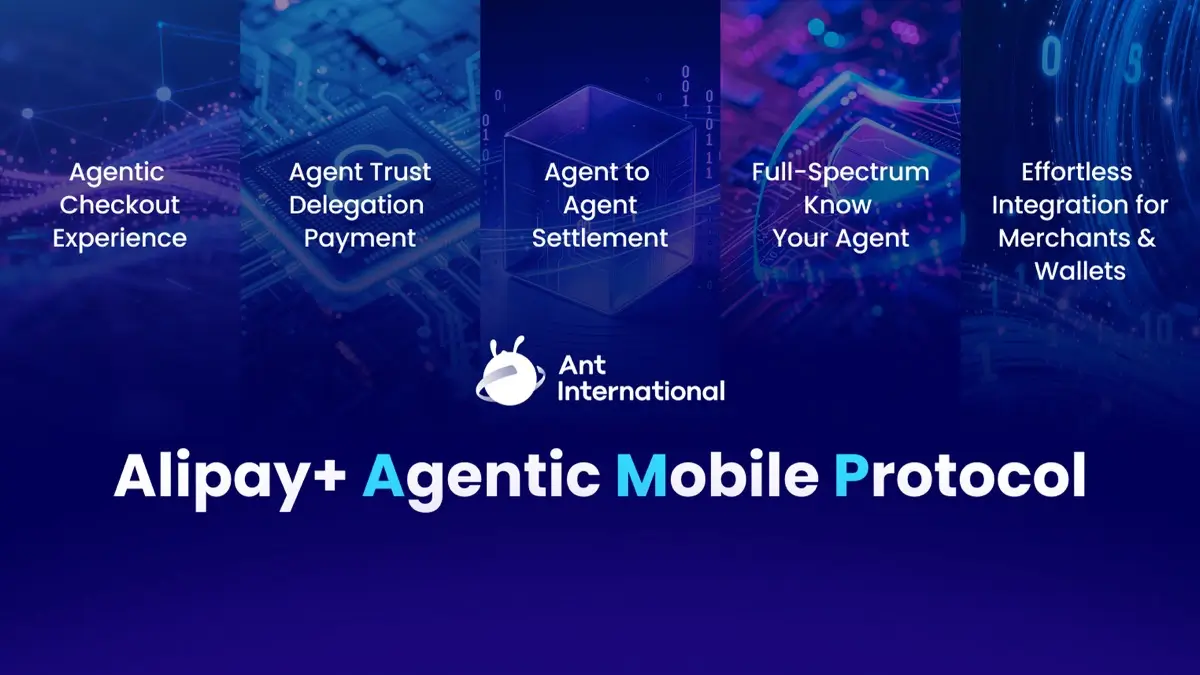
Agentic Mobile Protocol (AMP) is the world’s first agentic payment framework designed for mobile interfaces, including digital wallets, super apps, and wearable devices. Image: Ant International
The company said the protocol allows large language models, AI platforms, and merchants to connect to an estimated 4.4 billion digital wallet users globally through simplified integration.
By 2030, the global agentic commerce market could reach around $28 billion, while digital wallet users are predicted to grow to 75% of the global population (6 billion people).
According to the released information, AMP is intended to support agentic commerce by enabling AI agents to execute payments across mobile interfaces such as smartphones, wearables, and in-car systems.
“An agentic protocol for mobile commerce that ensures superior efficiency and security results will be key for businesses large and small expanding into the world’s fastest growing markets,” said Jiang-Ming Yang, Chief Innovation Officer at Ant International.
The framework includes features aimed at payment execution and risk management. These include a reduction in steps required to link payment agents to wallets by approximately 50%, a money-back guarantee mechanism for certain transactions, and cross-device compatibility.
AMP also introduces a trust architecture for delegating payment authority to AI agents, alongside a “Know Your Agent” framework to verify agent identity and capabilities. The AMP is intentionally being open-sourced to support the development of interoperable standards for AI-driven commerce.
The protocol supports agent-to-agent settlement designed for high-frequency, low-value transactions, including micro-payments as small as $0.000001, according to the company.
Ant International said the protocol is being implemented through its Alipay+ network, which connects more than 40 digital wallets, covering 1.8 billion user accounts and 150 million merchants worldwide. Alipay also aready has AI Pay payment solution that lets people place orders and complete payments entirely through natural language with an AI assistant.
These capabilities were recently enhanced by a user-facing service, allowing OpenClaw AI agents to make payments with user approval, as well as new A2A (agent-to-agent) payment processing service for businesses and merchants.
The mobile protocol update serves as a useful supplement to Ant’s broader Agentic Commerce Trust Protocol, launched in January, which establishes a standardized framework for secure and efficient collaboration between AI apps and service platforms, such as e-commerce and food delivery services.
Ant International’s Agentic Mobile Protocol (AMP) is not limited to China use, as well as its Alipay solution. However, it is not automatically universal as well, as actual protocol deployment is deeply tied to local integrations and regulatory compliance rules. Google, Stripe, PayPal, Visa and Mastercard are among industry players that are actively working on global payment protocols for agentic commerce.