To boost its control over payment settlement, Polymarket — one of the world’s largest crypto prediction platforms, rolls out its own stablecoin, Polymarket USD, and starts the most sweeping infrastructure upgrade in its six-year operation period.

Polymarket USD is a proprietary digital dollar token pegged 1:1 to Circle’s USDC reserves. It will replace the platform’s current financial instrument – a bridged stablecoin USDC.e, as the main collateral for trading on crypto prediction markets.
The upgrade will take place step-by-step. Scheduled to unfold over the next two to three weeks, besides a native stablecoin launch, it also includes a new central limit order book and a rebuilt trading engine — known as the CTF Exchange V2. Taken together, these enhancements are designed to improve trading settlement efficiency, reduce smart‑contract risk, and cut transaction costs for participants.
As the platform claims, the transition process will be seamless for most users. Automatic wrapping of USDC into Polymarket USD should be triggered nonchalantly via the interface. Power users and bot operators, however, will engage manually through a one‑time on‑chain wrap function.
Why Polymarket needs its own stablecoin if it successfully used third-party one for years?
Polymarket’s decision to issue its own stablecoin reflects several strategic priorities for the trading platform handling weekly volumes over $100 million.
To begin with, internalizing the collateral layer and eliminating reliance on bridged assets gives the company far greater control over its own liquidity. It also reduces systemic risk of a failure that cascades through an entire network — a common concern in decentralized finance (DeFi) where different platforms are interconnected (bridged) via smart contracts, tokens, and liquidity pools.
Second important point is that the new token bolsters the platform’s bid to attract larger institutional participants. It potentially enables multisig, smart‑contract wallet support and faster matches, which could lure bigger fish in the crypto pond.
Another not too far-fetched suggestion is that the move can unlock meaningful new revenue streams for Polymarket. User deposit stablecoin funds require equivalent reserves from the token issuer. These reserves, in turn, may be invested in safe yield-bearing assets. Some analysts estimate potential annual yields exceeding tens of millions of dollars earned on the reserves backing Polymarket USD.
Will Polymarket compete to secure top place in a growing stablecoin sector?
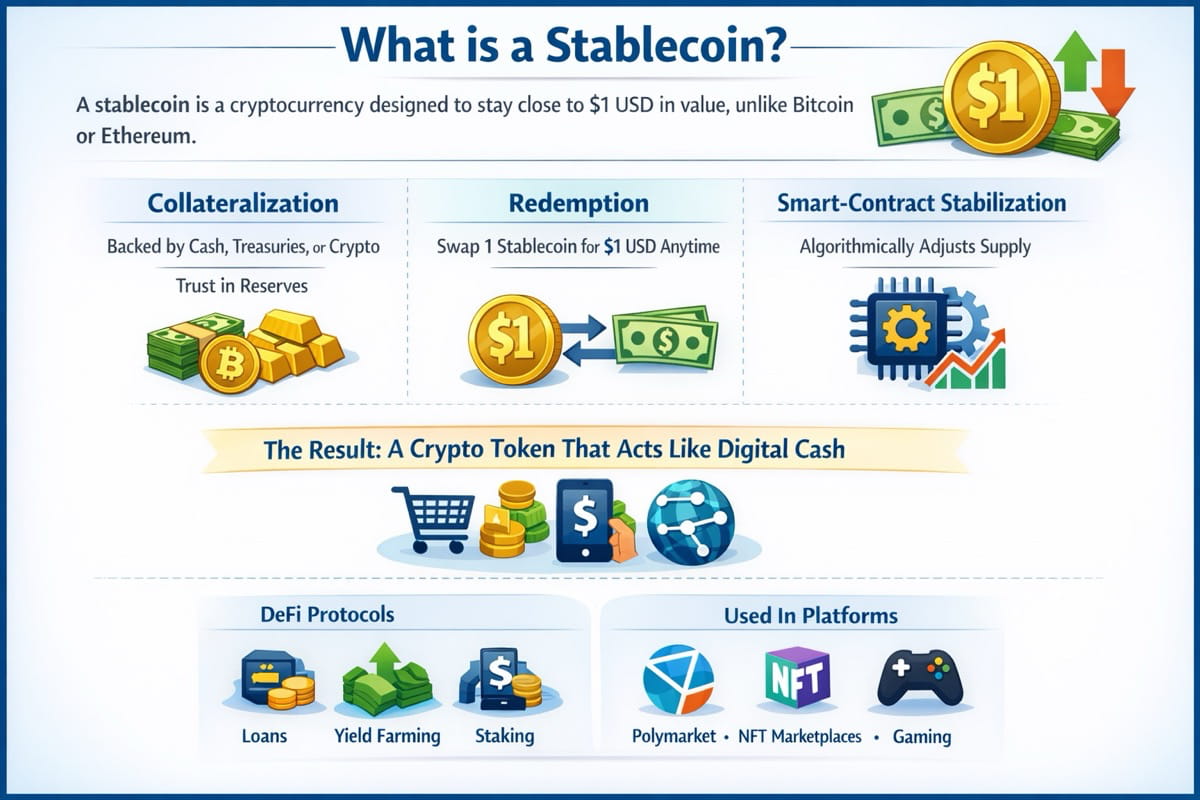
Polymarket USD doesn’t compete directly in volume or even utility with the major stablecoins on the market, e.g. USDT (Tether), USDC (Circle) or BUSD (Binance USD). It’s primarily meant for internal use on Polymarket rather than direct trading. At the same time, Polymarket USD launch could influence how prediction markets think about collateral.
Prediction markets — blockchain‑powered venues where traders bet on chances for something to happen, buying and selling contracts tied to real‑world outcomes, have surged in activity over the past several years. A recent sector report estimated that prediction markets’ total annual trading volume ballooned from roughly $15 billion in 2024 to more than $63 billion in 2025, driven by heightened interest around elections, sports, and macro geopolitical events, that occur far more often today and send ripple effects over major economies and consumer segments. Onchain metrics also show cumulative trading volume on trading platforms similar to Polymarket exceeding $29 billion over the last three years.
Polymarket itself claims to have the highest volume among crypto‑native prediction markets, hosting thousands of active prediction contracts (i.e. price outcomes, political events, or sporting results) and processing millions in daily trades. In the meantime, platforms such as Kalshi, which operate in the regulated U.S. market, have also not wasted their time and scaled rapidly, outperforming popular casinos at times, and helping push the sector toward legitimacy.
With that being said, this rapid growth has drawn much regulatory and ethical scrutiny. Polymarket, for instance, has faced numerous criticism and some legal challenges over its anonymous user model, suspicions of insider trading ahead of major geopolitical events, and select market themes that some say step well into ethically sensitive territory. Simultaneously, U.S. regulators like the Commodity Futures Trading Commission (CFTC) have clashed with state efforts to limit prediction markets, underscoring the policy tensions in this evolving asset class.
CFTC believes that event contracts listed on prediction markets can fall within multiple subsections of the definition of “swap” under the Commodity Exchange Act (CEA), giving this regulator broad jurisdictional reach over prediction market participants and platforms. In his first public remarks as CFTC Division of Enforcement (DoE) director, on March 31, 2026, David I. Miller stated that prediction markets and crypto assets are perhaps the two most dynamic markets in finance today. At present, DoE is examining prediction markets for possible cases of fraudulent trading practices, market manipulation, and market abuse. However, its main focus is insider trading. Once the state enforces tighter scrutiny over prediction market participants, platforms will be subject to stricter control as well.
What Polymarket USD Means Going Forward
The launch of Polymarket USD signals that crypto‑native prediction markets mature and become self-sufficient. We expect such platforms to be increasingly standardizing infrastructure, deepening individual liquidity they already have, and courting some institutional liquidity too.
As these markets grow, they may increasingly resemble traditional derivatives and event‑based trading products rather than informal betting venues. For users, this could translate to faster transaction processing, tighter pricing, and broader market access. If such platforms receive more regulatory recognition, the implications could be even more significant. For the broader crypto ecosystem, Polymarket USD launch underscores the expanding role of specialized stablecoins and internal collateral systems in decentralized finance.