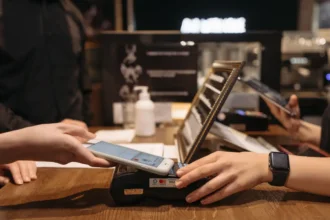
European fintech startup Handwave has expanded its agreement with Visa to support the rollout of biometric payments across European markets, combining palm-based payment technology with Visa’s tokenisation, authentication and fraud prevention capabilities.
The expanded partnership is designed to enable secure card onboarding within Handwave’s biometric payment platform. Users will be able to add payment cards through the Handwave app and link them securely to their biometric identity, allowing their palm to be used for payments.
Handwave will integrate Visa’s Token Management Service and authentication capabilities to replace sensitive payment information with secure digital tokens. The company will also use Visa fraud prevention and risk tools, including Visa Decision Manager, to monitor transactions in real time.
The collaboration is aimed at ensuring that biometric payments can meet security and compliance requirements comparable to those applied to conventional card transactions while providing consumers with a faster checkout experience.
“This agreement is a major step forward in making biometric payments ready for everyday use,” said Oskars Lakšēvics, Chief Revenue Officer at Handwave. “We’re building a platform where onboarding your palm and payment card takes seconds. A palm can be scanned with a regular phone camera, while cards are added as easily as in any leading digital wallet. Behind that simplicity is infrastructure built to meet the highest global standards for security, compliance, and performance.”
Palm, facial and fingerprint recognition can remove the need for consumers to present a physical card or smartphone at checkout, but concerns about the handling and security of biometric data remain a significant factor in adoption. Therefore, palm-payment solutions launched across the globe typically find limited use cases.
Yet, research published by Handwave in March 2026 found that nearly half of US consumers would consider using palm-based payments if security and privacy were guaranteed.
Younger consumers showed stronger confidence in biometric recognition. Some 46% of respondents aged 25–34 said they trusted biometric recognition as a secure way to make payments or process loyalty claims, compared with 28% of consumers aged over 55.
Across all age groups, 48% said they would regularly use palm payments if they were confident that their biometric data was being handled securely, highlighting the importance of trust for wider adoption.
“Biometric payments are increasingly becoming part of how people think about the future of paying,” said Juris Paegle, Country Manager for Visa in Latvia, Lithuania and Estonia. “Visa’s role is to help enable these innovations in ways that maintain trust, security, and choice. By connecting our infrastructure with solutions like Handwave’s, we support experiences that make paying and getting paid more seamless – without compromising on the protections people expect when they use Visa.”
Beyond integrating Visa technology, the expanded agreement will provide Handwave with access to market insights, data-driven intelligence, marketing support and Visa’s broader partnership network. The companies plan to identify priority markets beyond the Baltics, which will serve as the initial launch region.
Handwave and Visa are also working toward making the biometric payment solution available through the Visa Acceptance Platform. This could allow acquirers and merchants already connected to Visa’s infrastructure to integrate Handwave’s technology more easily.
Handwave is currently in discussions with banking and retail partners in the Baltic states and is preparing pilot programmes for everyday retail environments. The company expects to move toward production deployments during 2026.
The expanded agreement builds on the companies’ earlier collaboration, which focused on integrating Visa’s Token Management Service to enable tokenised biometric payments across Visa’s global network.