The foreign exchange giant Travelex is rethinking what an airport currency store looks like and it no longer has to be fixed to a wall.
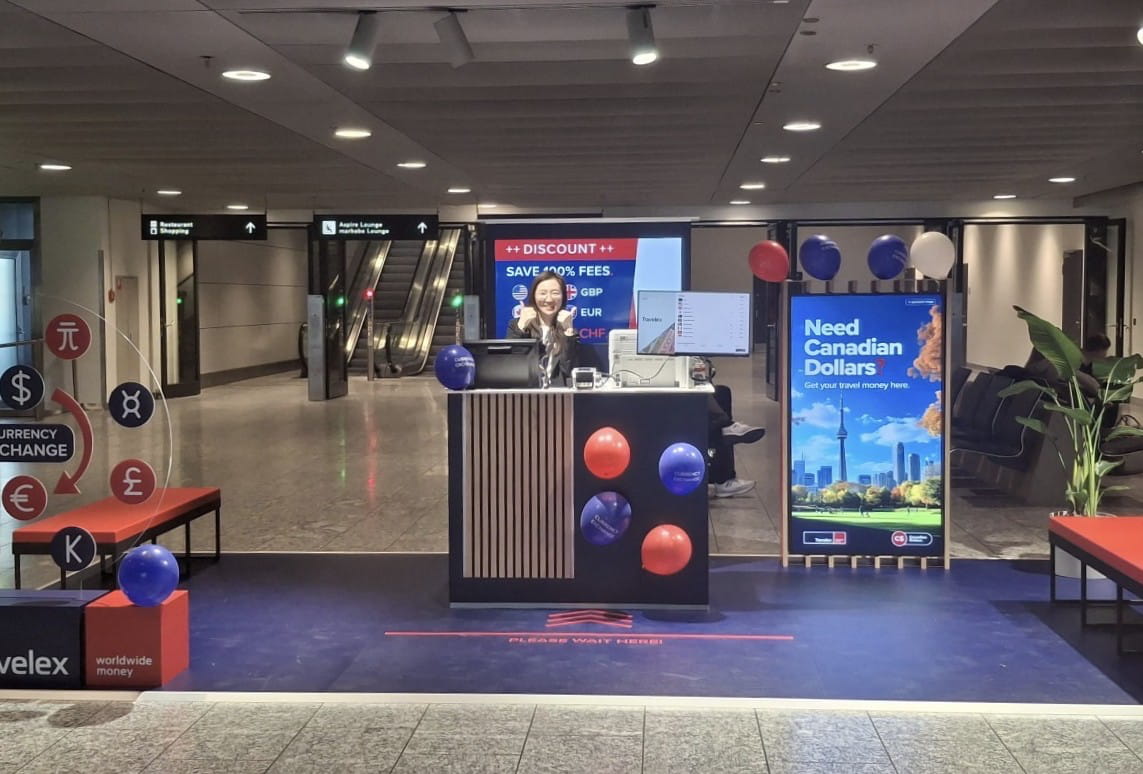
Travelex has launched a mobile currency store designed to move around airports and set up in minutes. The concept, called Nomad, is currently being piloted at Zurich Airport.
The unit is fully self-contained. It offers the same range of services as a traditional fixed Travelex location: multiple currencies, live exchange rates, and digital signage, but can be repositioned across an airport’s high-traffic zones depending on passenger flow.
The design is built around a simple pop-up system. A retractable screen extends to display exchange rates and promotions when the store is open. When closed, the unit is compact enough to remain in airside areas overnight without requiring a dedicated retail space.
That flexibility has practical implications for airports. Nomad can be combined with existing Travelex assets such as ATMs and fixed branches, to create a larger, temporary footprint during busy periods such as school holidays or peak summer travel. When demand drops, it converts back to a standalone mobile unit.
“Travelex is proud to pioneer our latest on-the-move mobile travel money store concept, catering to our customers’ expectations for a convenient, accessible and secure experience,” said Philip Bowcock, Travelex’s Chief Executive Officer. “Travelex’s Nomad ensures we are at the forefront of accessibility to better serve our airport customers whilst meeting a wide range of travel money requirements. We’re excited to partner with Zurich Airport and have already seen great success on Nomad’s roll out.”
Zurich Airport is the first location globally to host the Nomad pilot. Travelex has confirmed plans to roll out additional units across other international airports later in 2026, though specific locations have not yet been announced.
The move reflects a broader shift in airport retail. Fixed store leases in high-footfall terminal areas carry high costs, and passenger traffic is rarely evenly distributed across a terminal throughout the day. A mobile unit that follows demand rather than waiting for passengers to find it addresses both the cost and convenience challenge simultaneously.
For travellers, the most visible change is accessibility. Currency exchange desks are traditionally clustered near arrivals halls or dedicated retail zones. A mobile unit can position closer to departure gates or security queues, where travellers are more likely to realise they need local cash before boarding.