Graduate vacancies in January dropped to their lowest level since tracking began in 2016 — nearly halving in a single year, as a deteriorating jobs market squeezes young people hardest.

The number of graduate job listings in the UK fell below 10,000 in January for the first time since job search platform Adzuna started tracking the figure in April 2016. The drop — a 19.1% fall in a single month, pushed vacancies to a historic low and underscored how sharply hiring conditions have worsened for young people entering the workforce.
Measured over a year, the picture is starker still. Graduate vacancies are down 45% annually — the biggest annual decline since November 2020. That means the number of advertised graduate roles has essentially halved in twelve months.
The graduate figures sit within a wider picture of cooling hiring across the UK. Total advertised vacancies dropped 3% in January to 694,940 — the first time they have fallen below 700,000 since January 2021. Compared to January last year, vacancies are down 16%, and have contracted by nearly 20% over the past six months alone.
The data arrives within days of official figures from ONS, confirming that UK unemployment has risen to 5.2% — a five-year high, up from 4.7% just six months ago. Unemployment among 18 to 24-year-olds climbed to 14% in the final three months of 2025.
Several factors appear to be converging. Employers have cited the cost pressures from Rachel Reeves’s increase to National Insurance contributions and minimum wage rises announced in successive budgets, with chief financial officers at retail firms warning they may be forced to let staff go or have fewer hires as the Employment Rights Act is implemented.
Statutory sick pay from day one is likely to be the single most expensive measure within the Act, while increased absence rates as a result of statutory sick pay might result in operational losses. In addition, the guaranteed hours proposals in their current form might have significant unintended consequences. Although retailers support the idea of cracking down on unscrupulous employers, making continuous offers of guaranteed hours (even if an employee does not want them) can add to the significant cost burden the industry is under, and ultimately reduce the number of flexible job opportunities available.
Artificial intelligence is also shaping the picture, particularly at the junior end of the market. Adzuna’s data shows UK entry-level job postings have fallen by nearly a third since ChatGPT launched, with roles in technology, where AI exposure is highest, seeing steeper reductions than those in less-exposed sectors. Graduate roles, which often sit at the boundary of what automation can replicate, appear to be caught in the same compression.
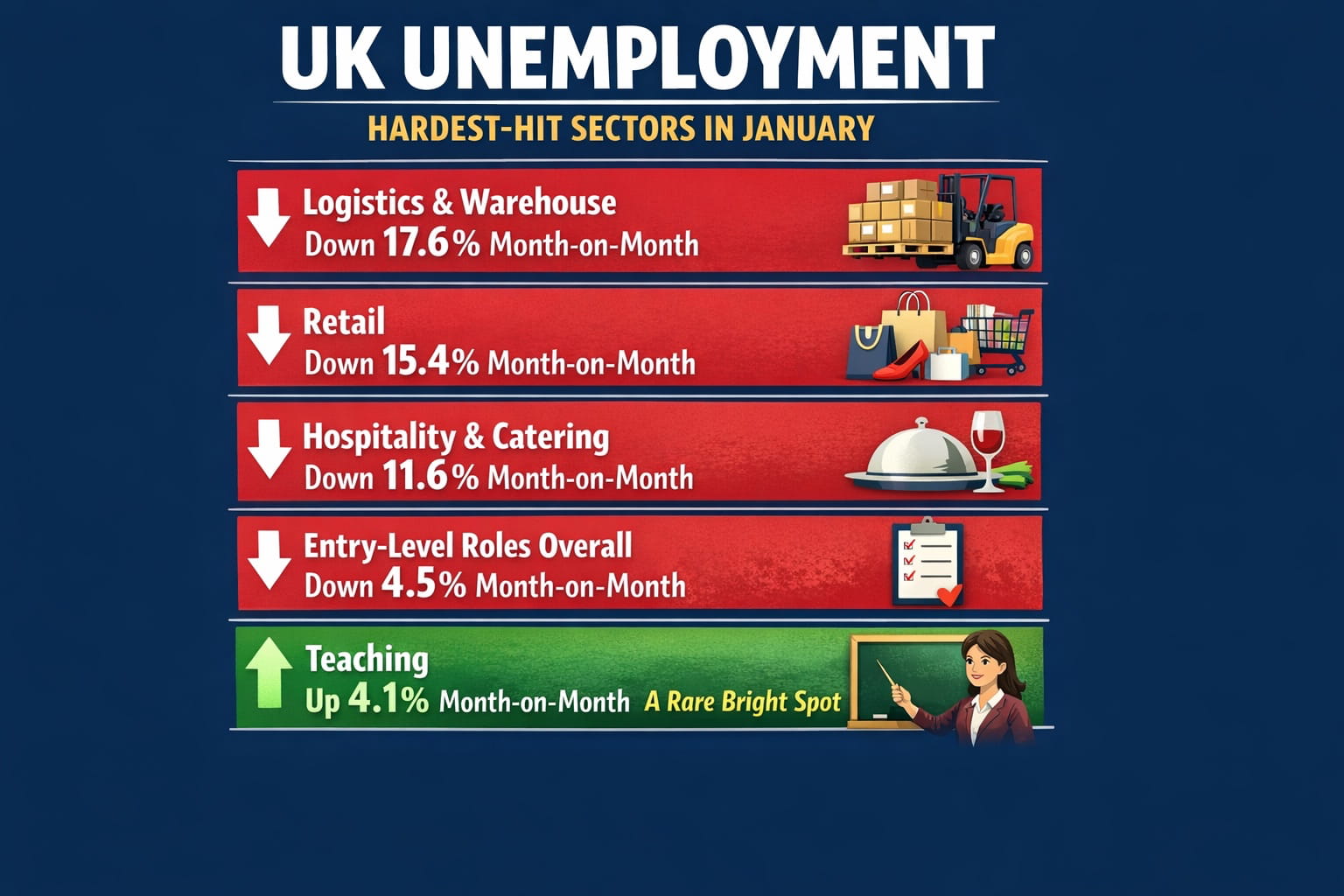
London bore the sharpest regional decline, with advertised vacancies falling 5.6% in a single month — the worst performance of any UK region in January. Sectorwise, the picture is as folowing:
Despite the contraction in openings, pay for the roles that do exist has continued to grow. The average advertised salary reached £43,289 in January, up 5.98% year-on-year — well above the current inflation rate of 3% and above the Bank of England’s estimate for non-inflationary wage growth. IT remained the highest-paid sector, with average salaries rising to £63,428 and annual growth of 12.79%.
Annual graduate pay also rose 2.7% in January, despite the fall in vacancies, suggesting that while opportunities have shrunk considerably, those that remain are, on average, better compensated than a year ago.
“The market remains challenging, with fewer vacancies and intense competition, but continued wage growth suggests employers are still willing to pay for the right skills.”
Andrew Hunter, Co-founder, Adzuna
The skills needed for well-paid jobs in 2026 are evolving. As earlier Morgan Stanley report on AI in coding noted, AI-assisted coding is shifting the developer’s role from manual programming toward more strategic functions such as curation, integration, review, and problem-solving. Ultimately, this shift is projected to drive headcount growth of between 1.6% and 10% annually through the end of the decade. However, the newly required skills are more characteristic of experienced professionals than graduates fresh out of college.
For students in their final year, the data lands at the worst possible moment. The number of people chasing each available role has risen. There are now 2.4 jobseekers for every vacancy, up from 2.27 in December, as the overall pool of opportunities shrinks. The proportion of young people not in education, employment, or training remains at around 946,000, a figure that has hovered near record highs since 2014.
Adzuna’s co-founder noted that some sectors are showing resilience and that businesses appear to be adapting to higher costs rather than halting hiring entirely. But with graduate vacancies at a historic low and youth unemployment at a five-year high, the data points to a labour market where the burden of adjustment is falling most heavily on those just starting out.