A company can grow 20% a year for years and still be one lost customer away from a crisis.
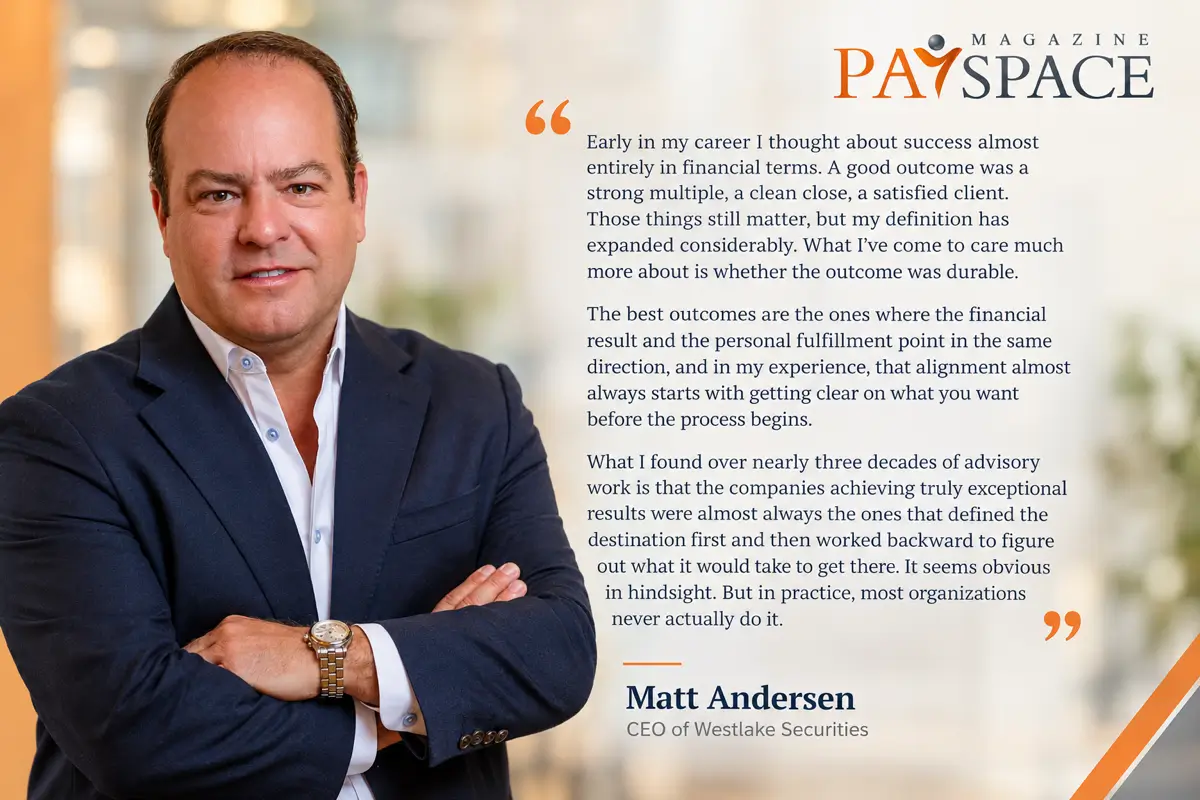
Matt Andersen has spent nearly three decades advising founders and CEOs, and he keeps seeing the same pattern: talented teams with real resources who still miss their goals, not because they execute poorly, but because they never defined where they were going. In his book Intentional Growth: A Proven Guide to Higher Performance and Better Outcomes for Your Company, the CEO of Westlake Securities argues that leaders should pick the destination first and work backward from there.
His lessons apply to businesses in any sphere, but they may hit hardest for fintech startups. Their tech stack goals rarely come into focus all at once and tend to shift with every wave of innovation. A clear end goal gives a team something steady to measure those changes against. Andersen also warns that revenue growth alone doesn’t make a company stronger. Growth, he says, magnifies everything, including the cracks that were already there. In this interview with PaySpace Magazine, he explains how to spot those weaknesses early, what drifting looks like, and how leaders can build something that outlasts a single good year.
- The book’s core idea is to start with the destination and reverse-engineer the strategy, rather than plan forward from today’s resources. What made you conclude that “beginning with the end in mind” — an idea popularized decades ago for individuals, is also what’s needed at the organizational level?
The honest answer is that I kept watching companies fail to get where they wanted to go despite having genuinely talented people and real resources. When I started pulling on that thread, the common factor almost every time wasn’t execution. It was that nobody had clearly defined where they were going in the first place. The idea of beginning with the end in mind has been around a long time in personal development, but organizations tend to skip it in favor of planning from today’s resources forward. The problem with that approach is that you do not end up building toward a great outcome. What I found over nearly three decades of advisory work is that the companies achieving truly exceptional results were almost always the ones that defined the destination first and then worked backward to figure out what it would take to get there. It seems obvious in hindsight. But in practice, most organizations never actually do it.
- You mention Warren Buffett’s distinction between a “wonderful” business and a “mediocre” one, built around durable moats and pricing power. How do you translate that investor’s POV framework into something operating leaders who run the business day-to-day can act on?
Buffett’s framework is useful because it forces the question that most operators never ask about their own business: would a sophisticated outside observer consider this a wonderful business or a mediocre one, and why? Well, operators tend to evaluate themselves against their own history, whether they grew from the previous year, whether margins held. And that tends to be a low bar. The more useful question is whether the business has something durable, a customer relationship that’s genuinely hard to replicate, a process or capability competitors can’t easily copy, pricing power that reflects real value rather than just market position. When I work with leadership teams through Westlake Securities’ proprietary Quality Value Growth (QVG) framework, I’m essentially asking them to look at their own business the way an acquirer or investor would. That outside-in perspective is uncomfortable, but it’s where the most honest and useful insight comes from.
- You argue that revenue growth alone doesn’t create a stronger company, and that growth “magnifies everything,” exposing cracks that were already there. Can you share an example (without naming names, if needed) of an organization that looked healthy on the outside while growing, but whose foundations were “built on sand”?
I worked with a business that had been growing revenue at roughly 20% annually for several years. From the outside, it looked like a success story. When we got under the hood, the picture was different. Customer concentration was severe: two customers represented nearly 60% of revenue and both relationships lived entirely with the founder. The management team was thin and had never been asked to operate independently. Financial reporting was informal and months out of date. The growth had been real but had also masked every one of those problems because the revenue kept coming in and nobody had to confront them. When one of those two customers started consolidating their vendor relationships, the business lost 30% of revenue in a single quarter. The growth hadn’t built resilience. It had actually delayed the work of building it, because as long as the numbers looked good, there was no urgency to address the underlying fragility.
- The book centers on your Quality Value Growth (QVG) Assessment Wheel, developed at Westlake Securities, which evaluates leadership, business performance, industry positioning, branding, and finance. Since you note that these are the same lenses acquirers, investors, and lenders use in diligence, how should a leader who has no near-term plans to sell or raise capital still use QVG differently than one who is preparing for a transaction?
For a leader preparing for a transaction, the Quality Value Growth (QVG) framework is essentially a readiness assessment. You’re identifying gaps that buyers will find in diligence and closing them before they become valuation problems. For a leader with no near-term transaction plans, the framework is more valuable as a performance tool. The five dimension of QVG, leadership, business performance, industry positioning, branding, and finance, are not just what acquirers evaluate. They’re the things that determine whether a business can sustain growth, attract and retain great people, and build the kind of durability that produces options over time. A leader who builds to QVG standards without any transaction in mind will almost always end up with a stronger, more valuable business than one who starts thinking about it only when a deal is on the table.

- In your book, you lay out three pathways every organization eventually faces at a decision point: continue executing, refine and reallocate, or reach the desired outcome and reset. You also describe drift (avoiding the decision) as itself a decision. What are the earliest warning signs that a leadership team is drifting rather than deliberately choosing to stay the course?
The earliest sign is usually that strategic conversations start getting shorter. The team stops really debating where the business is going and starts defaulting to operational updates. Meetings that used to involve genuine disagreement about direction become status reports. A related sign is that language around the future gets vaguer. Leaders start talking about goals in terms of percentages and targets rather than specific outcomes and what achieving them would actually look like. A third sign, and this one tends to come a little later, is that the team stops making hard tradeoff decisions. Instead of choosing between things, they try to pursue everything, which is often the organizational equivalent of choosing nothing. When I see a leadership team that can’t point to something meaningful that it said no to in the last six months, that’s a drift signal.
- A recurring theme of ‘Intentional Growth’ is the shift from founder- or CEO-led decision-making to systems and delegated ownership that can scale beyond one person. What is the hardest part of that transition for leaders to accept?
It’s not really about control, even though it looks like control from the outside. The hardest part is identity. Most founders built their companies by being the person with the answers, the one who could outwork and outthink anyone in the room. That identity is deeply tied to being in the middle of things. Letting go of that doesn’t feel like smart organizational design. It feels like loss. There’s also a competence dimension that doesn’t get talked about enough. Most founders are genuinely better at certain things than anyone else in the organization. Trusting someone else to handle those things requires a kind of humility that runs against the very grain of what made them successful in the first place. The leaders who make this transition well are usually the ones who find something genuinely compelling on the other side: the strategic work that only they can do, the relationships that only their credibility can open, the questions that only their experience positions them to ask. When the destination is appealing enough, letting go of the operational day-to-day work becomes much easier.
- You describe the 100-Day and Year 1 Plan as the bridge between formalizing a growth map and actual execution. For a payments or fintech company specifically, where product cycles, compliance, and partnerships can move faster than a typical annual plan, how would you adapt that 100-day discipline?
The 100-Day framework isn’t really about pace. It’s about establishing clarity, accountability, and the right operating rhythm before the noise of the business drowns out the signal. In a fintech environment where product cycles are short and regulatory landscapes shift, the principles apply just as much, but the content of the plan looks different. The first 30 days should still be about understanding the actual state of the business: where the real performance is, where the dependencies are, what the team believes versus what the data shows. The middle period is about establishing the non-negotiables: the metrics that will actually tell you whether you’re on track, the decision rights that need to be clear so the team can move fast without bottlenecking everything through the leader, and the strategic priorities that won’t change every time a competitor releases something new. In a fast-moving environment, that last one is especially important. Speed is an advantage only when it’s pointed at the right things. The 100-Day Plan is really about making sure the organization agrees on what those things are before it starts moving fast.
- After nearly 30 years advising founders and CEOs, how has your own definition of a “successful” growth outcome changed since you started your career?
Early in my career I thought about success almost entirely in financial terms. A good outcome was a strong multiple, a clean close, a satisfied client. Those things still matter, but my definition has expanded considerably. What I’ve come to care much more about is whether the outcome was durable. Did the founder build something that outlasted the transaction? Did the people inside of the organization have a better opportunity because of the growth work that was done? Did the company leave a mark on its customers, its community, its industry? I’ve also become much more interested in the leader’s experience of the outcome, not just the financial result. Some of the most financially successful transactions I’ve been part of left the founder feeling empty because they hadn’t thought carefully enough about what came next. The best outcomes are the ones where the financial result and the personal fulfillment point in the same direction, and in my experience, that alignment almost always starts with getting clear on what you want before the process begins.