GENIUS Act might still give stablecoin operators half a year of a grace period, but those who wish to remain compliant with new U.S. digital asset laws must get a head start.

By May 2026, U.S. regulators (such as Treasury, OCC, FDIC, etc.) have finished most of the rulemaking drafts linked to the GENIUS stablecoin bill signed into law last year. Though full implementation and associated legal enforcement are expected to come into force in early 2027, both fintech companies and banks that aim to deal with stablecoins in the USA should start operating as if the rules are already enforceable. This head start allows businesses to map some loopholes in their compliance, discover areas for improvement in reserve management and auditing, and avoid hefty fines or license withdrawals in future.
GENIUS Act and Related Legislation Overview
The GENIUS Act, introduced in the U.S. senate in January 2025, is a federal regulatory framework for payment stablecoins. It is fundamentally restructuring the digital asset ecosystem, defining strict rules for who may issue such stablecoins for U.S. citizens’ further use, demanding 1:1 stablecoin backing with fiat or liquid investment assets, establishing constant supervision and monitoring of stablecoin issuers activity, and more.
For implementation of such legal framework, different U.S. regulatory bodies additionally developed sets of rules for various aspects of stablecoin issuance and settlement. For instance, the U.S. Department of the Treasury’s Financial Crimes Enforcement Network (FinCEN) and the Office of Foreign Assets Control (OFAC) propose a separate rule, which implements the GENIUS Act’s anti-money laundering and sanctions compliance program requirements.
“President Trump is strengthening American leadership in digital financial technology,” said Secretary of the Treasury Scott Bessent. “This proposal will protect the U.S. financial system from national security threats without hindering American companies’ ability to forge ahead in the payment stablecoin ecosystem.”
In simple terms, the new legal framework establishes operation standards for stablecoin issuers such as Circle and Tether similar to those applied in the banking industry.
If a company issues regulated dollar-backed stablecoins (“payment stablecoins”), it must:
- verify customer identities (KYC)
- monitor transactions for suspicious activity
- follow anti-money laundering (AML) rules
- comply with U.S. sanctions laws
- report illegal or suspicious financial activity to authorities
- maintain formal compliance programs and controls
- embed dedicated sanctions compliance systems in their fintech stack
- implement internal monitoring procedures
- follow risk management processes similar to financial institutions
- hold 1:1 backing reserves only in approved safe assets
- prove they have daily liquidity sufficient for instant redemption of issued assets
- publish monthly reserve reports
- undergo regular independent audits
- prevent mixing reserves with operating capital
- segregate customer assets from corporate funds
- strengthen custody security systems
What Should Banks and Fintechs Do to Comply With GENIUS Act Requirements
As the rules are finalized and starting to roll out gradually, banks become the primary candidates to become regulated issuers of stablecoins id they wish to do so. They already comply with most of the rules, have reserve management capabilities, compliance infrastructure, and access to federal financial systems. Regulated stablecoin-native fintechs with compliance budgets can also become licensed issuers. Even if they don’t issue stablecoins themselves, but deal with these digital assets as payment intermediaries, custodians, crypto wallet providers, etc., they will be also affected by GENIUS Act changes.
GENIUS Act Preparation Guideline for Fintechs
To comply with the long set of newly-established rules, financial institutions aiming to offer stablecoins as payment means in the U.S. market can follow this simple action plan:
- Overview current AML/KYC policies, reserve structure, the state of audit-readiness
- Compare existing practices with new legislative requirements. Define legal gaps.
- Check licensing application details. Prepare and apply for stablecoin issuance license (if applicable) with the appropriate federal or state regulator.
- If you’re a foreign stablecoin issuer, check whether foreign regulations you operate under compare to the GENIUS Act requirements.
- If you don’t aim to issue stablecoins, but want to facilitate stablecoin payments, choose reliable regulated issuer as a partner.
- Automate auditing and reporting processes where possible.
- Restructure treasury & custody practices if gaps were in place.
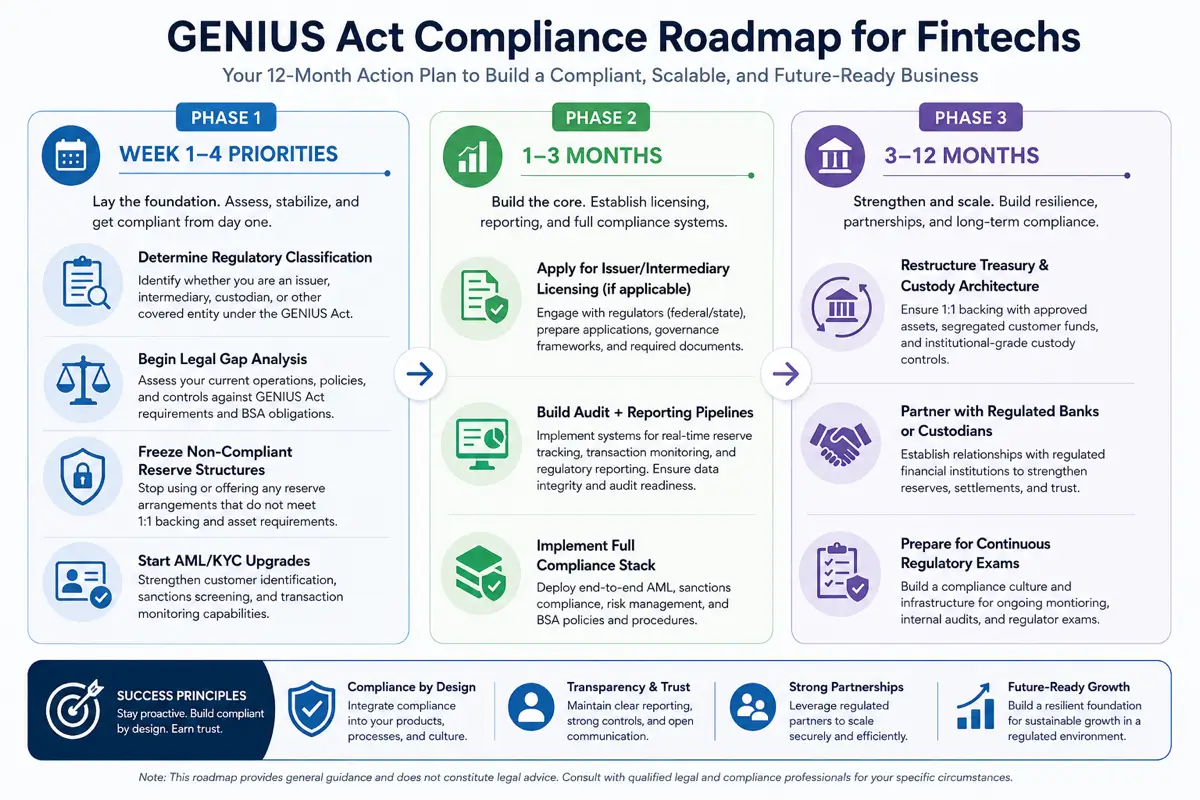
GENIUS Act compliance roadmap for fintechs. Created via ChatGPT
Banks Actions Ahead of GENIUS Act Full-Scale Implementation
As already mentioned, banks have certain advantages over fintech institutions when it comes to the new regulatory regime introduced by GENIUS Act. As they choose to gain formal authority to issue or back stablecoins, they already have most of the required practices in action. They independently control reserve assets (such as cash and short-term Treasuries) and can now expand influence into digital payment rails, leveraging regulatory trust to become system anchors, while compliant fintechs would be responsible for infrastructure management.
However, it doesn’t mean becoming a stablecoin issuer goes unnoticed for U.S. banks. Several factos may become banks’ structural limitations, i.e.:
- Slow product innovation cycles
- Weak consumer-facing UX
- Dependence on fintech partners for distribution
To not miss out on this perfect opportunity, banks should
1. Create the legal entity ASAP
The law requires banks to set up a separate subsidiary to issue stablecoins and get it approved by regulators. Banks move slowly with their bureaucracy, so they should start the paperwork, governance structure, and internal approvals as soon as possible. January 2027 sounds far away but for a large bank with slowly turning gears in its internal mechanisms, it isn’t.
2. Don’t just add a stablecoin to existing banking app, think of software upgrade
The whole point of stablecoins is faster, programmable, real-time payments. If a bank slaps a new feature onto its clunky mobile app, customers will ignore it and use a fintech instead. This is a reason to invest in genuinely better UX ahead of implementation of digital asset infrastructure or partner with someone who already has it.
3. Turn fintech partners into allies but maintain control over payment rails
Right now many banks rely on fintechs to reach customers. Under the GENIUS Act, fintechs that want to issue stablecoins face a much harder regulatory path. Banks should use that leverage, positioning themselves as the licensed, insured backbone that fintechs plug into, rather than the other way around.
4. Update compliance systems for crypto transactions
Banks’ fraud and anti-money laundering systems may be excellent. Nevertheless, in many cases, they were built for traditional wire transfers and card payments. Blockchain transactions look completely different and have more risks for financial systems. Before regulators come knocking at the door with inspection, banks that only now enter the crypto world need tools that can actually monitor on-chain activity and flag suspicious behavior in real time.
“In a world where traditional financial intermediaries and stablecoins co-exist, bespoke measures are needed to fend off financial integrity risks. One way this could be done is by enforcing comprehensive compliance checks at the crypto ecosystem’s points of contact with the banking system – the so-called on- and off-ramps. Artificial intelligence-assisted monitoring of the history of blockchain transactions can support assessments of whether stablecoins have possibly been used in illicit transactions. This is particularly important as some estimates suggest that stablecoins now account for most illicit transactions within the crypto ecosystem.”
Pablo Hernandez de Cos, General Manager of the BIS
5. Defend deposits before customers start leaving
Another stablecoin risk flagged by BIS executive is that they could potentially shift power and capital away from central banks toward private issuers. Stablecoin platforms may find ways to offer rewards that make them look more attractive than a savings account. Banks should be pushing regulators to close that loophole, and in the meantime, build their own reasons for customers to stay, whether that’s FDIC insurance peace of mind, loyalty perks, or seamless merchant payment features.

While banks and fintechs have different aspects to work on, both categories of financial industry players have a fair share to accomplish before GENIUS Act enters the full legal enforcement stage in early 2027.