Mexico’s banks have spent decades paying savers little to nothing. For a while now, three of the world’s most aggressive fintechs have been dangling 15% annual yields to pull those customers away. However, today, these economics shifting. Here’s the full picture, and what it means for your money.

Walk into almost any branch of BBVA Mexico, Santander, or Banamex and ask what your savings account will earn you. The answer is typically somewhere between 1% and 3% annually, if you receive anything at all, given the inflation rates that practically eliminate a fair share of savings income. Many accounts pay close to nothing. Meanwhile, open Nubank, Mercado Pago, or the newly launched Revolut Mexico apps on your phone, and you will find rates of up to 15% per year credited daily, accessible at any moment, with no minimum balance and no fees. Where’s the catch?
This is not a promotional stunt or short-time limited offer. Hightened fintech savings rates have been Mexico’s financial reality for most of the past two years. But the environment that made 15% possible is now being eroded by Mexico’s central bank, whose aggressive rate-cutting cycle is currently squeezing the spread that allowed fintechs to offer these rates in the first place. The question whether the era of 15% will end is not on agenda anymore. It is now wiser to think about how fast and by how much it will change, and what savers should do about it.
Why Mexico Is a Host to Such Rate Discrepancy? The Structural Vacuum That Made This Possible
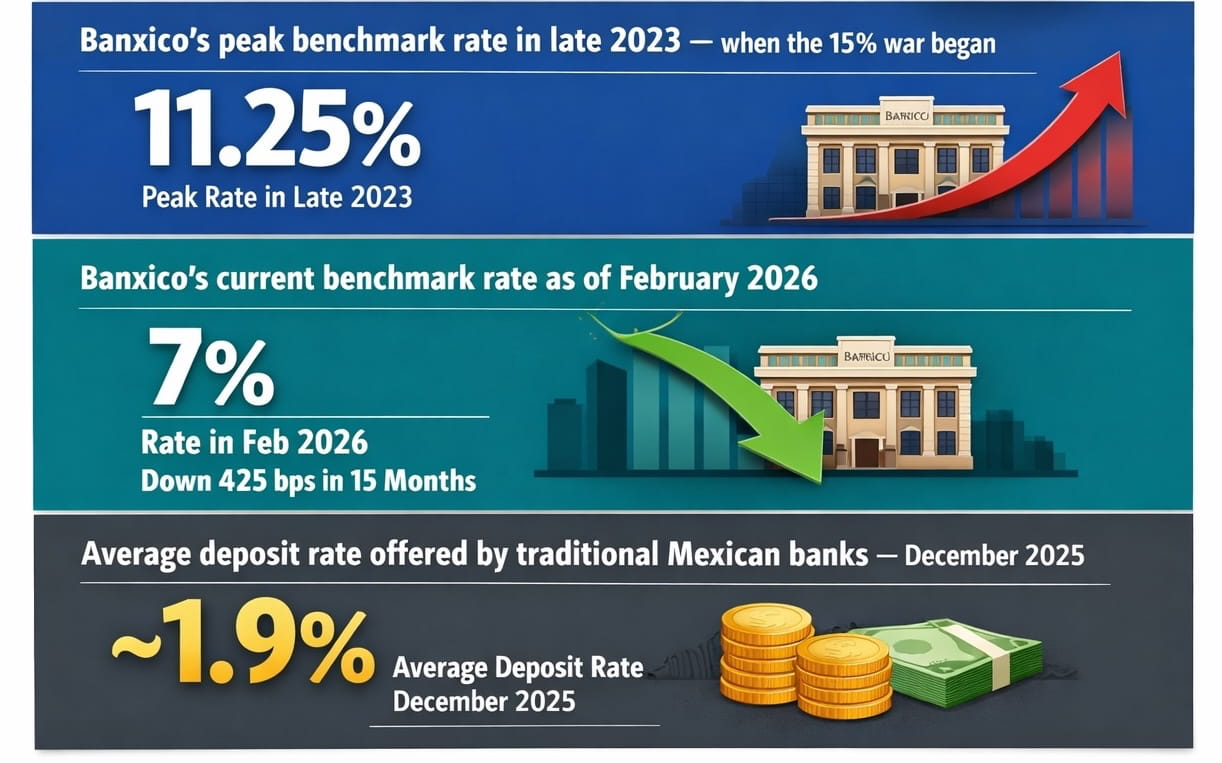
To understand why the rate war erupted in Mexico specifically, you need to understand just how badly the traditional banking system has served ordinary savers here. Mexico’s five largest banks: BBVA, Santander, Citibanamex, Banorte, and HSBC, control the overwhelming majority of deposits and have historically paid savers a fraction of the central bank’s benchmark rate. That benchmark, the overnight interbank rate set by Banco de México (Banxico), sat at 11.25% at its peak in late 2023. Traditional banks were earning this on their deposits with the central bank while passing only a tiny slice of that return on to customers.
The mechanism was simple: take cheap deposits from retail customers, park them at Banxico or in government securities at the full policy rate, and pocket the difference. It was, for many years, one of the most profitable banking models in Latin America, but also one of the most opaque. A 2024 National Survey of Financial Inclusion (ENIF) survey commisioned by National Banking and Securities Commission (CNBV) found that fewer than 40% of Mexican adults actively saved with a financial institution, with many citing low returns as a primary reason.
It was this vacuum in Mexico savings opportunities that Nubank arrived into back in 2022 with a straightforward proposition: we will pay you close to the full benchmark rate. Forgot to mention, there will be no branches, no paper forms, and no fees attached to the favourable offer. Open an account in three minutes with your INE (national identity card). The response was immediate. Cuenta Nu reached one million accounts in its first month after launching to the public in May 2023 — a pace that shocked even Nubank’s own executives.
Nubank CEO David Vélez has been also explicit about the strategic ambition of the fintech in the country: Mexico “has the potential to be as important as Brazil for us,” he said, pointing to the country’s 130 million population and higher income per capita than Brazil at the time of entry. With 107 million customers in Brazil representing 60% of the country’s adult population, the Mexican opportunity is significant, and competing for deposits in the tight profit market is the fastest route to relevance.
How the Rate War in Mexico Actually Works
The 15% rate figure we’re talking about is not straigthforward and linear, though. It requires some careful reading. It is not a simple savings account rate in the way European or North American readers might understand it. The savings mechanics in the payment market of Mexico differ across players, and the conditions attached to each rate matter considerably.
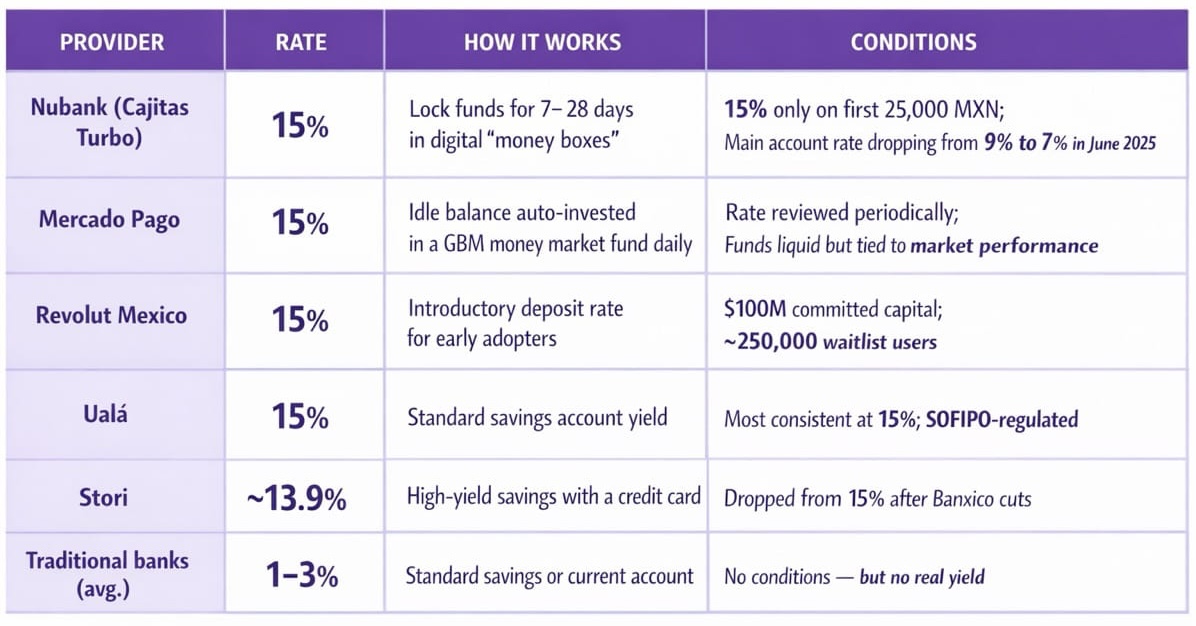
Comparative table of Mexico fintech savings rates. Image created via Sora.
The Mercado Pago model deserves particular scrutiny. Its “15%” is technically the yield of an investment fund managed by GBM (Grupo Bursátil Mexicano), not a guaranteed deposit rate. When a user deposits money into Mercado Pago, it is automatically placed into this fund, which invests in short-term peso-denominated instruments. The daily return closely tracks Banxico’s benchmark rate, minus the management spread. This is structurally different from a bank deposit: the fund can fluctuate, although in practice it tracks closely to the rate advertised. The product has been enormously popular, nevertheless. By mid-2024, the invested amount in Mercado Pago’s fund had tripled over 12 months.
And yet, responding to the market rate changes, Mercado Pago’s 15% yield incentive transitioned into 2025 with new conditions tied to user activity. Starting January 2025, users must deposit a minimum of 3,000 pesos monthly to maintain the full 15% annual rate through the following month. Otherwise, it drops (potentially to around 10%, per some reports).
Nubank‘s savings rates have also strongly reacted to the central bank rate updates:
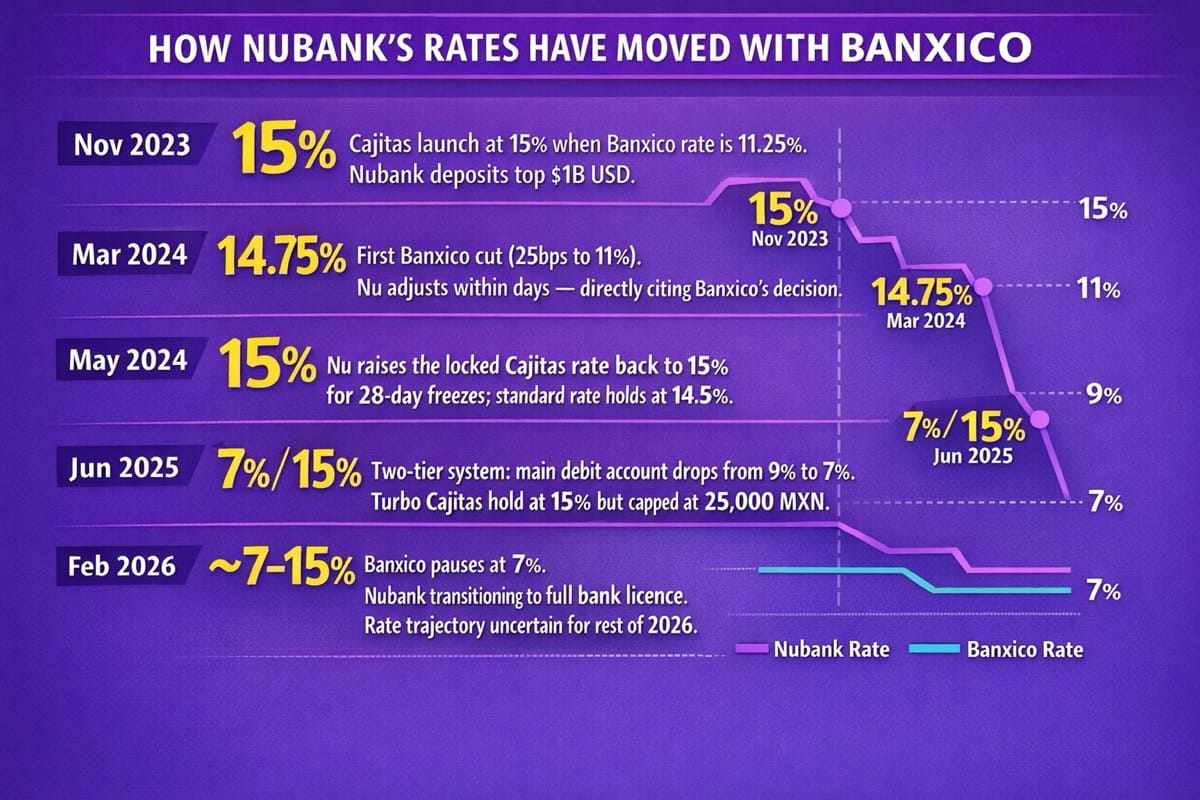
Nubank’s response to rate changes visualized. Image created via Sora.
The Economics of Savings Rates: How Can They Afford 15%?
This is the question that traditional banks, economists, and perplexed industry observers have asked since the battle began. The short answer: they could, because Banxico’s benchmark rate was high enough to make it work and because the strategic value of acquiring customers through promising offers quickly exceeded the cost of subsidising it in the short term.
When Banxico’s overnight rate was at 11.25%, a fintech paying depositors 15% was not losing money on the differential alone. The math required that the fintech invest those deposits in instruments yielding close to or above 15%, which, in a market where government Cetes (treasury bills) were yielding 11–12% and money market funds were offering more, was achievable. The spread was thin, but the unit economics held.
The deeper strategic calculation was customer acquisition cost. Nubank was willing to absorb a narrower or even negative spread on deposits because each Mexican customer acquired through a savings account was a candidate for future credit products like personal loans, credit cards, payroll accounts, etc. where margins are dramatically higher. The 15% rate was, in part, a marketing budget: paid out in interest rather than spent on billboards. Besides, by providing competitive rates, fintechs like Nubank encouraged the mere idea of savings as passive income variation in Mexico.
“We firmly believe that giving our customers high returns on their deposits is the right strategy to encourage the habit of saving, and proof of this is the more than one billion dollars deposited by our customers in their Cajitas at the end of 2023.”
Ximena Salgado, Product Leader of Nu Mexico
The Banxico Problem: 12 Cuts in 15 Months
The single biggest threat to the 15% era is Mexico’s central bank, which has been cutting rates aggressively since March 2024. By December 2025, just 21 months later, Banxico had made twelve consecutive rate reductions, dropping the benchmark from 11.25% to 7.00%. That is a 425 basis point decline, or roughly 38% of the original rate, cut away in less than two years.
The rate-cutting cycle was driven by a combination of a global disinflation trend and slowing GDP growth. Namely, Mexico’s economy contracted 0.2% in Q3 2025 after stagnating in Q2. Banxico halved its 2025 growth forecast to 0.3%. On February 5, 2026, the board voted unanimously to hold the rate at 7%, although inflation rate accelerated, pausing the easing cycle for the first time after a run of twelve cuts. Core inflation remains stubbornly above 4%, and new fiscal measures including higher excise taxes are expected to put temporary upward pressure on prices in early 2026.
The implications for fintech deposit rates are direct and mathematical. A fintech paying 15% on deposits when the benchmark was 11.25% had a gap of 375 basis points to bridge through its lending spread and investment returns. Today, with Banxico at 7% and Cetes yielding around 7.3%, a firm paying 15% is paying more than double the risk-free rate — a position that is increasingly difficult to sustain through normal treasury operations alone.
Surprising Newcomer: Revolut Enters Market With a Bold Opening Bet
Precisely as the rate environment is tightening, a new player has arrived to Mexican fintech scene offering the same headline rate. Revolut, the London-based neobank valued at $75 billion, launched full banking operations in Mexico in early 2026 with a 15% deposit rate as its opening move, committing $100 million in capital and targeting two million customers by end of year.
The arrival is strategically significant and competitively revealing. Revolut built its initial Mexican user base through a limited trial that attracted around 40,000 customers; a further 250,000 people joined a waiting list before the official launch. The company, however, now faces a tighter market in which the benchmark rate is 7%, not 11.25% as when Nubank launched. Offering 15% at this point involves a wider subsidy, which can only be justified if Revolut believes rapid customer acquisition now will translate into profitable lending and premium subscriptions later.
The competitive landscape Revolut is entering is also considerably more crowded than when Nubank first arrived. Nu Mexico now has more than 10 million customers and a full banking licence granted in April 2025. Mercado Pago has 50 million users across Latin America and the structural advantage of integration with Mercado Libre — Latin America’s dominant e-commerce platform. Ualá, Stori, Klar, Hey Banco, and others occupy various niches in the same deposit market.
How Long Will 15% Last? Three Scenarios
The trajectory of the savings rates in the nearest future depends on three variables operating simultaneously: where Banxico takes its benchmark rate, how aggressively fintechs compete for deposits as they scale, and when each player transitions from customer acquisition mode to profitability focus. Based on current data, three scenarios are plausible.
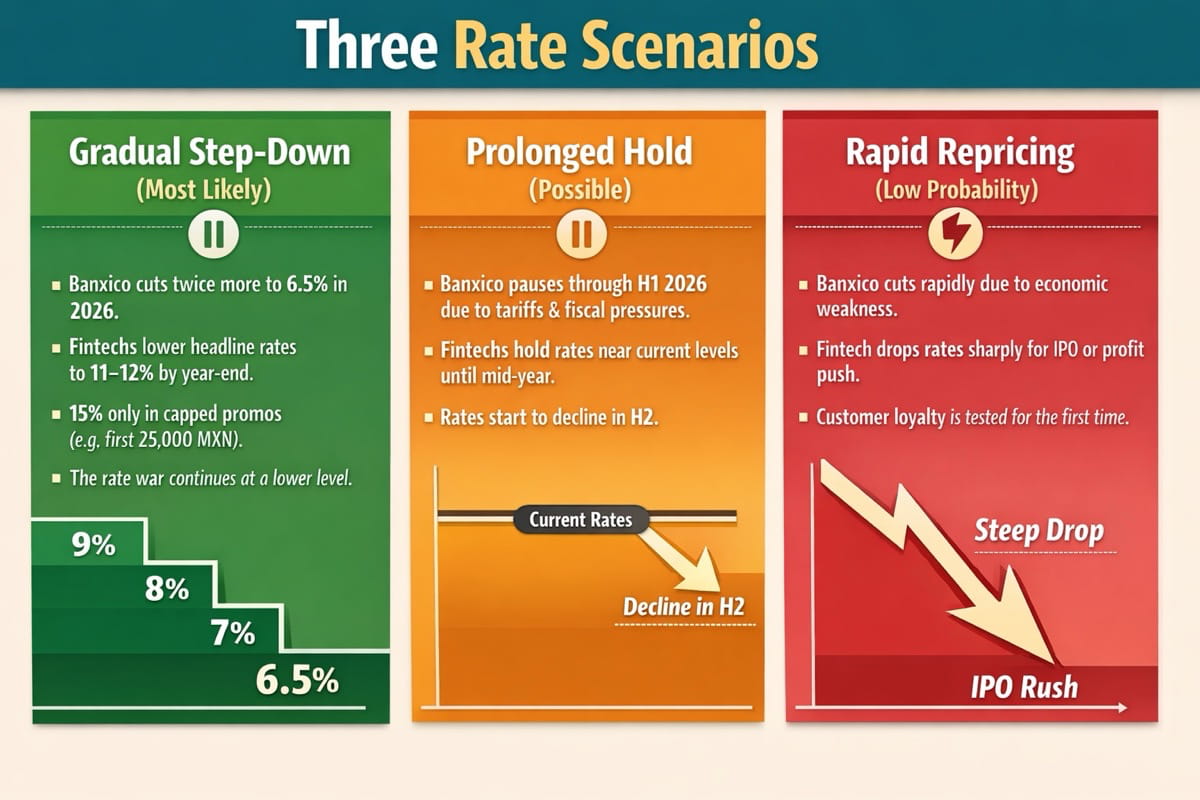
Savings rate in Mexico forecast. Image created via Sora.
BBVA Research forecasts that Banxico will resume gradual cuts in H2 2026, reaching a terminal rate of around 6.5% by year-end. At that level, sustaining 15% becomes structurally untenable for any firm that is not heavily subsidising its deposits from another revenue line. The more likely floor is somewhere between 10% and 12% — still dramatically above what traditional banks pay, but no longer the 15% headline that drove the initial excitement.
Whatever happens to the specific rate number, the structural shift underway in Mexico is unlikely to reverse. Fintechs have demonstrated, at scale, that a significant portion of the Mexican population was waiting for a reason to engage with formal savings. The rate war is, at its core, a story about financial inclusion through competitive pressure. Millions of Mexicans who either held no formal savings or parked money in zero-yield accounts have been pulled into a system that actually works for them, not because regulators mandated it, but because fintechs used high rates as a wedge. Even if those rates normalise downward to 10–12% over the next 18 months, Mexican savers remain in a fundamentally different position than they were in 2022, as traditional banks might also reconsider their low-income savings model that was uncontestable for decades.