Payment infrastructure company DECTA has published findings from a study examining two specific failure points in digital banking and payment apps: the frequency with which automated systems block or decline user transactions, and the rate at which AI chatbots subsequently fail to resolve the resulting issues.
The study draws on a survey of 1,506 UK adults who use at least one major banking or payment app, combined with a two-year analysis of 159,600 reviews (34,167 of them negative) from the Apple App Store and Google Play across ten widely used apps in Europe: Revolut, bunq, Monzo, Wise, N26, Sumeria, Starling Bank, Bourso, Monese, and Chase UK. The results are quite disappointing from the payment infrastructure point of view.
Gabriel Stefanak, Head of Sales at DECTA, said: “The whole point of a well-built digital banking platform is that the problems users complain about never reach them in the first place. Identity edge cases, account decisions, declined transactions. Those are the moments where infrastructure either does its job or hands the customer to a chatbot that can’t help them.”
DECTA study shows that’s not even remotely the case in thousands of customer interaction instances.
Blocked payments frequency
77.2% of surveyed users reported having a payment, transfer, or transaction blocked, declined, or paused by their app. Of those affected, 38.9% said it had happened more than once. Despite this, only 13.4% of surveyed users said they felt their app was over-cautious with their money. The study notes a 64-point gap between that perception figure and the 77.2% who reported an actual blocked payment.
Of the 1,162 respondents who had experienced a block, 48.0% said the transaction never completed. They had to find another way to pay or did not pay at all. Out of those affected with blocked payments, 56.7% said resolving the issue took hours or days. 27.6% said they experienced embarrassment at the point of failure, typically at a checkout. 10.0% completed the same payment using a different app or bank. 15.0% missed a bill or incurred a late fee as a result.
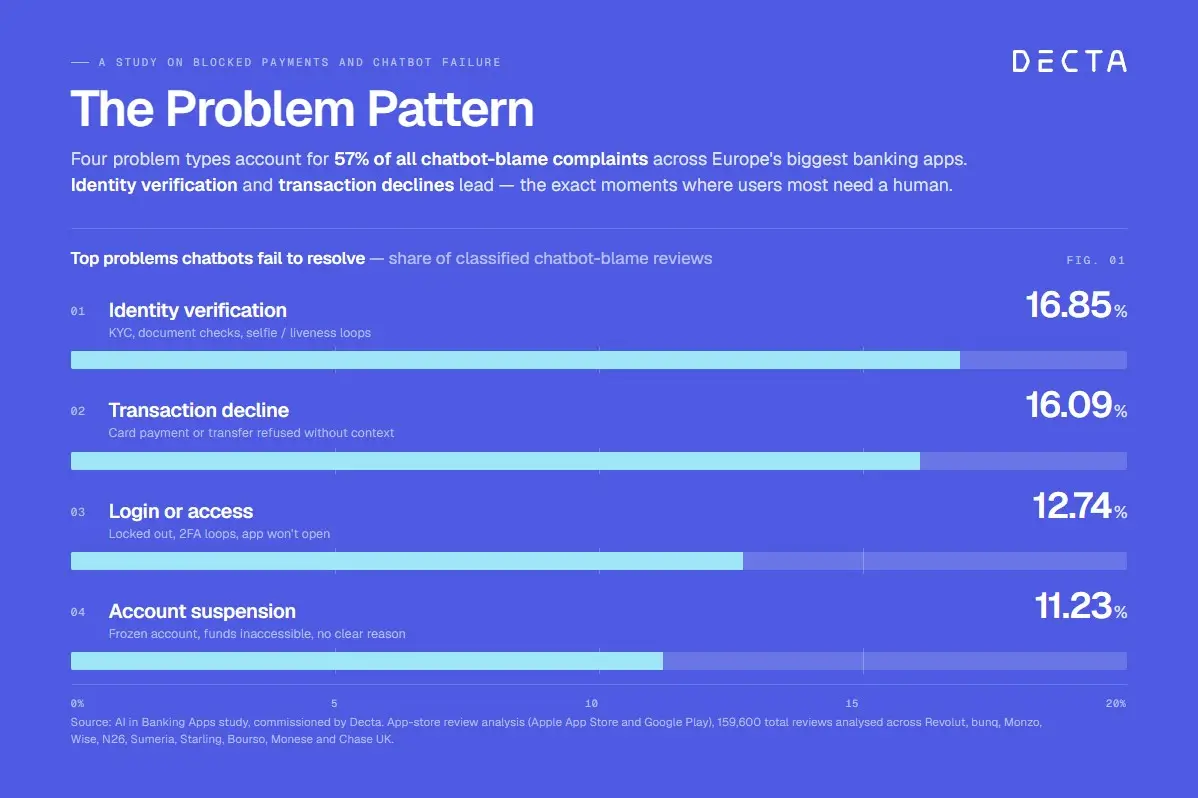
Main problem types that account for chatbot complaints
Chatbot resolution rates are unsatisfactory
Of the affected users, 12.0% chose a chatbot as their first point of contact for resolution. By the end of the process, 76.3% had interacted with a chatbot at some point. 11.4% said the chatbot resolved their issue. 50.0% had to escalate to a human agent. 14.9% said they never received a real resolution.
65.2% of all surveyed users said they trust a human agent most to resolve problems with their money. 5.4% said they trust a chatbot or AI assistant most. A further 24.5% selected either the chatbot or “neither, I expect to have to escalate,” indicating no confidence in their app’s frontline support options.
App store review analysis
Across the ten apps, negative reviews citing a chatbot or AI assistant as the cause of an unresolved problem rose 55.49% year over year, based on a comparison of the periods April 2024–April 2025 and April 2025–April 2026.
Among the chatbot-blame reviews where an underlying problem was identifiable, the most common unresolved categories were: identity verification (16.85%), declined transactions (16.09%), login and access issues (12.74%), and account suspension (11.23%). These four categories together accounted for 57% of all classified chatbot-blame reviews.
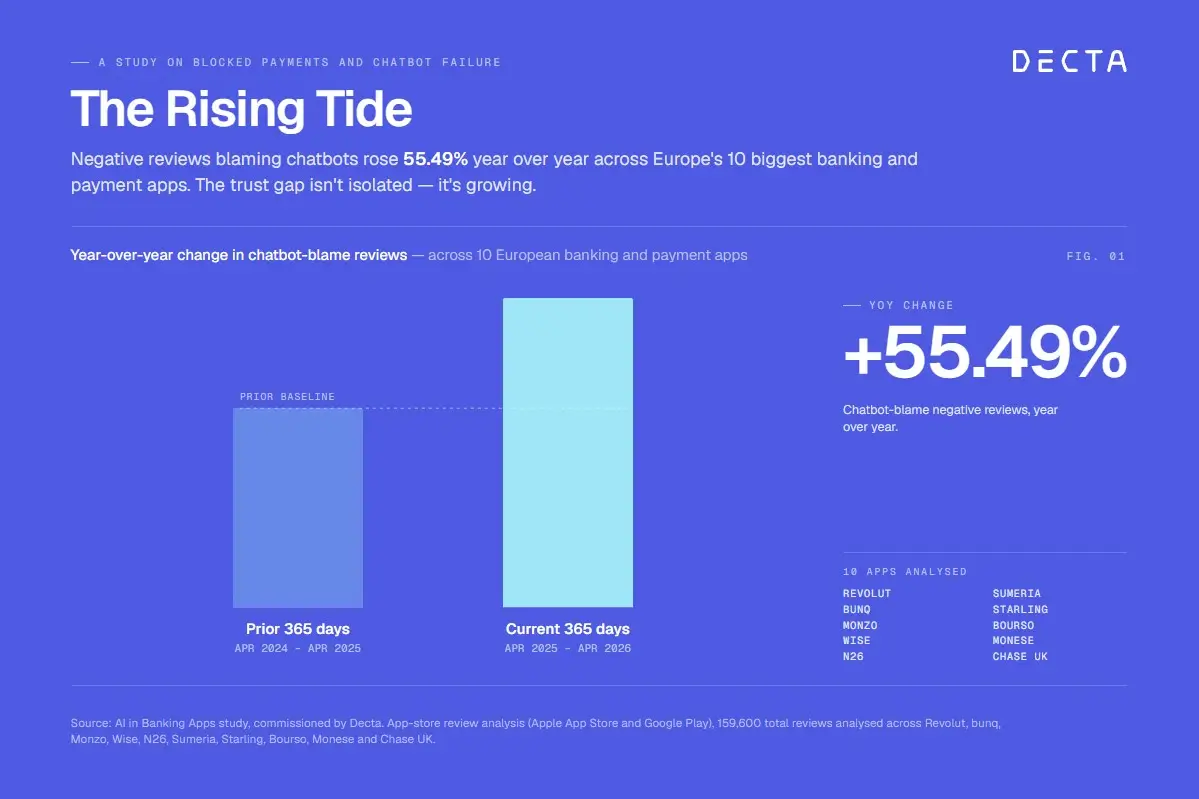
The growth of negative chatbot experience reviews illustrated
Research methodology
The consumer survey was conducted between 27 April and 4 May 2026. Respondents were UK adults aged 18 or over who used at least one of the named apps and had done so within the previous month. Age and location quotas were applied to match the UK adult population. The survey contained eight questions in total (two qualifying and six main) with conditional routing directing resolution and impact questions only to respondents who had experienced a blocked payment (n=1,162).
App store reviews were collected using Apify. Each negative review underwent two classification passes: one to identify chatbot or AI blame, and one to identify the underlying problem the user was attempting to resolve. Results are reported in aggregate. No individual app-level grading is published.
The full study is available at Decta website.
The article was updated with relevant illustrations on June 4, 2026