Fees and features reflect each provider’s public disclosures as of publication; confirm current terms directly with the provider before opening an account.
Key Takeaways
- Etsy’s own 2025 annual report puts active sellers at 5.6 million, so the bank behind a shop rarely gets much scrutiny until tax season makes the gap obvious.
- Novo, Bluevine, Found, and Lili’s Core plan all charge $0 a month with no minimum balance; the differences are in integrations, interest, tax automation, and cash handling.
- Novo and Relay do not accept cash deposits at all. That is a non-issue for a shop that sells only through Etsy Payments, but a real constraint for anyone also working craft fairs.
- The self-employment tax rate is 15.3% on top of regular income tax, according to the IRS, which is why several accounts on this list build a tax-set-aside feature directly into checking.
Handmade margins are thin. Once you subtract Etsy’s listing fees, transaction fees, payment processing, and shipping, what’s left over shouldn’t disappear into a $15-a-month maintenance fee some banks still charge without blinking. This guide compares business banking platforms against what actually matters for an Etsy shop: how fast Etsy Payments deposits land, what the account costs monthly, whether it plugs into QuickBooks or Shopify without manual re-entry, and whether it keeps tax money separate from materials cash.
Novo is listed first, on the strength of its fee structure and native integrations, and its most significant limitation, no cash deposits, is disclosed upfront rather than left for the fine print. Four other accounts round out the list, each suited to a different way of running an Etsy shop.

Compare at a Glance
| Bank | Best For | Price / Credential | Verdict |
| Novo | Sellers who run mostly online | $0/mo, no minimum | Full e-commerce toolkit, but no cash deposits |
| Bluevine | Sellers who keep a cash cushion | $0/mo, 1.3% APY to $250k | Best interest rate on idle cash |
| Found | Solo sellers who hate doing taxes | $0/mo (Plus $35/mo adds tax tools) | Built-in Schedule C tax automation |
| Relay | Sellers running Profit First budgeting | $0/mo, up to 20 sub-accounts | Best for splitting income into named buckets |
| Lili | Sellers who want a simple mobile app | $0/mo (paid tiers add tax bucket) | Clean app with an early-ACH perk |
What to Look For in a Business Bank Account for Etsy
- Monthly fees and minimum balance: a $0 account with no conditions beats one that waives a fee only above a set balance.
- ACH payout speed: Etsy Payments deposits by ACH, so check how quickly a provider posts incoming credits.
- Accounting integrations: native QuickBooks, Xero, Shopify, or Stripe connections cut manual reconciliation at tax time.
- Cash deposit support: only relevant for in-person sales, but a dealbreaker if that’s part of the business.
- Sub-account or bucket features: a way to set aside tax and materials money separately from spendable cash.
1. Novo
No monthly fees, no minimum balance, and native integrations with Stripe, Shopify, QuickBooks, and Xero.
Verdict: A fit for sellers whose income runs through Etsy Payments, Shopify, or off-platform Stripe invoices, and who don’t need to deposit cash.
Who it’s best for: Etsy sellers who run their shop mostly online and rarely handle physical cash at markets or fairs.
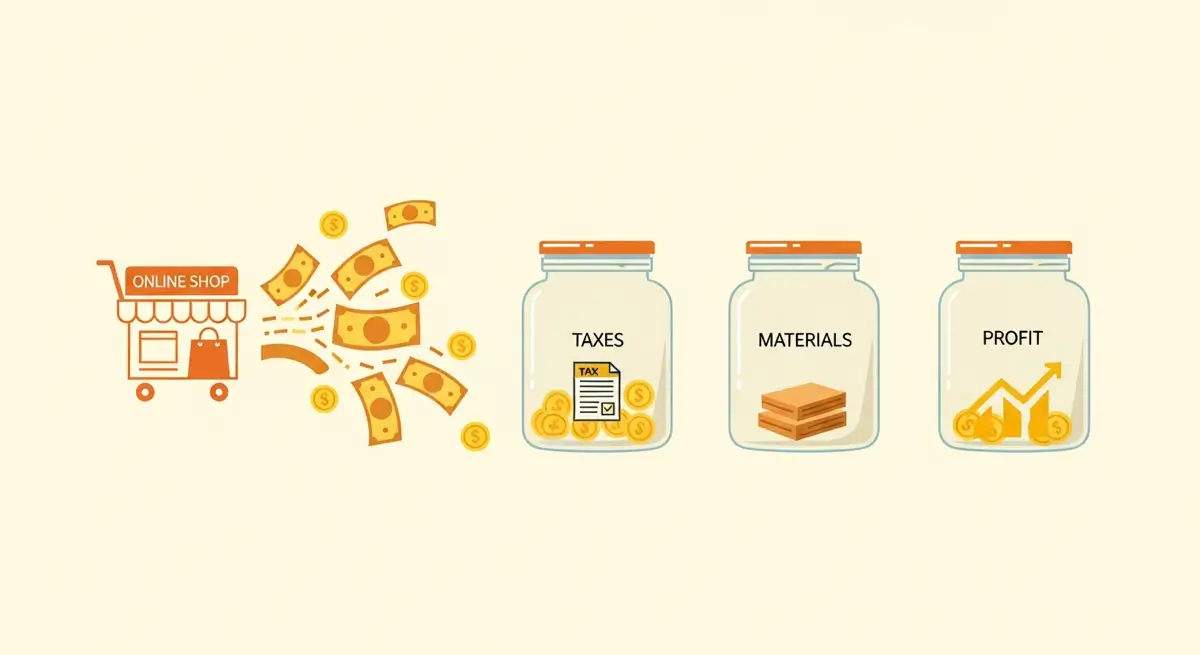
Novo is a fintech, not a bank itself; banking services are provided by Middlesex Federal Savings, F.A., Member FDIC. It charges $0 monthly fees and requires no minimum balance, and it connects directly to Stripe, Shopify, QuickBooks, and Xero, so an off-Etsy Stripe sale lands in the same feed as your Etsy Payments deposits. Novo Reserves lets you carve out named buckets inside one balance, things like “Quarterly Taxes,” “Materials,” and “Profit,” without opening separate accounts. Free invoicing is included for off-Etsy commissions.
What stands out: Reserves is a budgeting layer on top of one checking balance rather than a separate savings account, which lets a seller track a tax set-aside without moving money between accounts.
The honest downside: Novo does not accept cash deposits. If a meaningful chunk of your income comes from craft fairs or farmers markets where buyers hand you bills, you’ll need a workaround (a personal account for cash, then an ACH transfer to Novo) or a different account entirely.
2. Bluevine
Standard plan pays 1.3% APY on balances up to $250,000, with FDIC coverage extending to $3 million through a multi-bank sweep network.
Verdict: The pick if you tend to keep a running cushion in your business account rather than sweeping it out every week.
Who it’s best for: Sellers who carry a healthy operating balance and want that money actually earning something instead of sitting idle.
Bluevine is a financial technology company, with banking services provided by Coastal Community Bank, Member FDIC. The Standard tier has no monthly fee, no minimum balance, and no per-transaction charges, while paying 1.3% APY on balances up to $250,000, with FDIC coverage extending to $3 million through Coastal’s sweep network. Bluevine added invoicing with payment links in 2026 and offers a business line of credit up to $250,000. ATM withdrawals are free at more than 37,000 in-network MoneyPass machines.
What stands out: The APY is the real draw here. Most competitors on this list pay nothing on a checking balance; Bluevine pays you to leave money sitting there.
The honest downside: Cash deposits aren’t fee-free. You can deposit at Green Dot retail locations, but each one costs $4.95, and Bluevine doesn’t support joint or co-owned accounts if you’re running the shop with a partner.
3. Found
Free core plan with automatic Schedule C expense categorization, built specifically for sole proprietors and single-owner businesses.
Verdict: Worth a look if you’d rather have a bank nudge you through quarterly taxes than track your own spreadsheet.
Who it’s best for: Solo Etsy sellers filing as a sole proprietor who want tax prep folded into daily banking rather than bolted on in April.
Found is a financial technology company; banking services are provided by Lead Bank, Member FDIC. Launched in 2019 around self-employed income, its core features (expense categorization, invoicing, basic bookkeeping) are free with no monthly fee. Found Plus ($35/month or $315/year) adds 1.5% APY up to $20,000 and in-app quarterly tax payment estimates. Cash deposits work at over 79,000 retail locations for a $2 fee. Found supports single-owner structures only.
What stands out: The real-time tax estimate is genuinely useful for a seller who’s never budgeted for self-employment tax before. It answers “how much should I actually set aside” instead of leaving you to guess.
The honest downside: The automated quarterly tax payments require the paid Found Plus tier. The free plan gives you categorization and invoicing but not the piece that actually calculates and pays what you owe.

4. Relay
Up to 20 free checking sub-accounts under one login, useful for Profit First-style budgeting across materials, taxes, and owner pay.
Verdict: A fit if you want to physically separate every dollar the moment it lands, rather than mentally tracking buckets in your head.
Who it’s best for: Sellers running (or wanting to run) a Profit First system, or anyone who finds a single account with a mental tally too easy to overspend from.
Relay is a fintech founded in 2018, backed by Bain Capital Ventures; banking services run through Thread Bank, Member FDIC, with coverage up to $3 million via Thread’s sweep program. The free Starter plan includes up to 20 checking accounts and 2 savings accounts, each with its own routing number, plus up to 50 debit cards, with QuickBooks and Xero integration on every tier. Worth knowing: Thread Bank received a 2024 FDIC enforcement action tied to its compliance program, though Relay wasn’t the subject of it.
What stands out: Twenty real sub-accounts, not virtual buckets inside one balance, is more separation than any other account on this list offers for free.
The honest downside: Cash deposit support is limited, and automated bill pay along with free outgoing wires require the paid $30-a-month Grow plan rather than the free Starter tier.
5. Lili
Four-tier plan structure (Core, Pro, Smart, Premium) with an automated tax-savings bucket available starting on the paid tiers.
Verdict: A solid pick for sellers who want their banking on a clean, mobile-first app and don’t mind paying a small monthly fee for tax automation.
Who it’s best for: Sellers who live in their banking app daily and want the tax bucket, expense sorting, and early-paycheck features that come with Lili’s paid plans.
Lili is a financial technology company that launched in 2019; banking services are provided by Sunrise Banks, N.A., Member FDIC, with deposit coverage up to $3 million through Sunrise’s sweep network. The free Core plan needs no minimum deposit and includes early access to certain ACH payments, up to two days ahead of schedule. Paid tiers run from Pro at $15/month to Premium at $55/month, unlocking the tax bucket, invoicing, and multi-user access. Fee-free ATMs are available at 40,000-plus MoneyPass machines; cash deposits run $4.95 through Green Dot.
What stands out: The tax bucket automatically sets aside a percentage of every deposit once you turn it on, taking the guesswork out of quarterly estimates for sellers who’d otherwise put it off.
The honest downside: That tax automation, along with invoicing, sits behind the paid Pro tier and up. The free Core plan is genuinely useful but noticeably lighter than the paid versions.

Methodology
Monthly fees weighed heaviest, since a $15 or $16 fee some traditional banks charge adds up to $180 to $192 a year off margins that are already thin on handmade goods. ACH payout speed and native integrations with QuickBooks, Xero, Shopify, or Stripe came next, since Etsy Payments deposits arrive by ACH and most sellers touch at least one of those tools. Cash deposit support carried less weight overall, since most Etsy shops run primarily online, but we flagged it wherever it’s missing, since it’s a dealbreaker for sellers who also work craft fairs. Fee and feature details come from each provider’s own published disclosures.
The Bottom Line
Which of these fits best comes down to how a shop actually takes payment. For a shop that runs entirely through Etsy Payments and occasional Stripe invoices, Novo’s zero fees and native integrations remove the most friction, with the caveat that cash sales need a separate arrangement. A shop that also sells at craft fairs is better served by Found or Bluevine, both of which accept cash. Sellers carrying a real cash cushion may prefer Bluevine for the interest, and anyone running a strict Profit First system may prefer Relay’s twenty sub-accounts over Novo’s single-balance buckets. Whichever account fits, open it before the next payout cycle and route every Etsy sale through it from day one.