This year, PaySpace Magazine Global team had a chance to visit Point Zero Forum, which ran alongside Swiss Fintech Week 2026, held in Zurich from June 19 to June 25. The two parallel events covered AI adoption in banking, agentic commerce, and the infrastructure for programmable money. As those topics are among the most-discussed within the industry today, it was truly inspiring to engage in several insight-driven sessions that spanned pricing strategy, digital assets, and cross-border payment rails. Below is a recap of the sessions captured across both events as well as industry announcements made at the conferences.
Brief Event Background
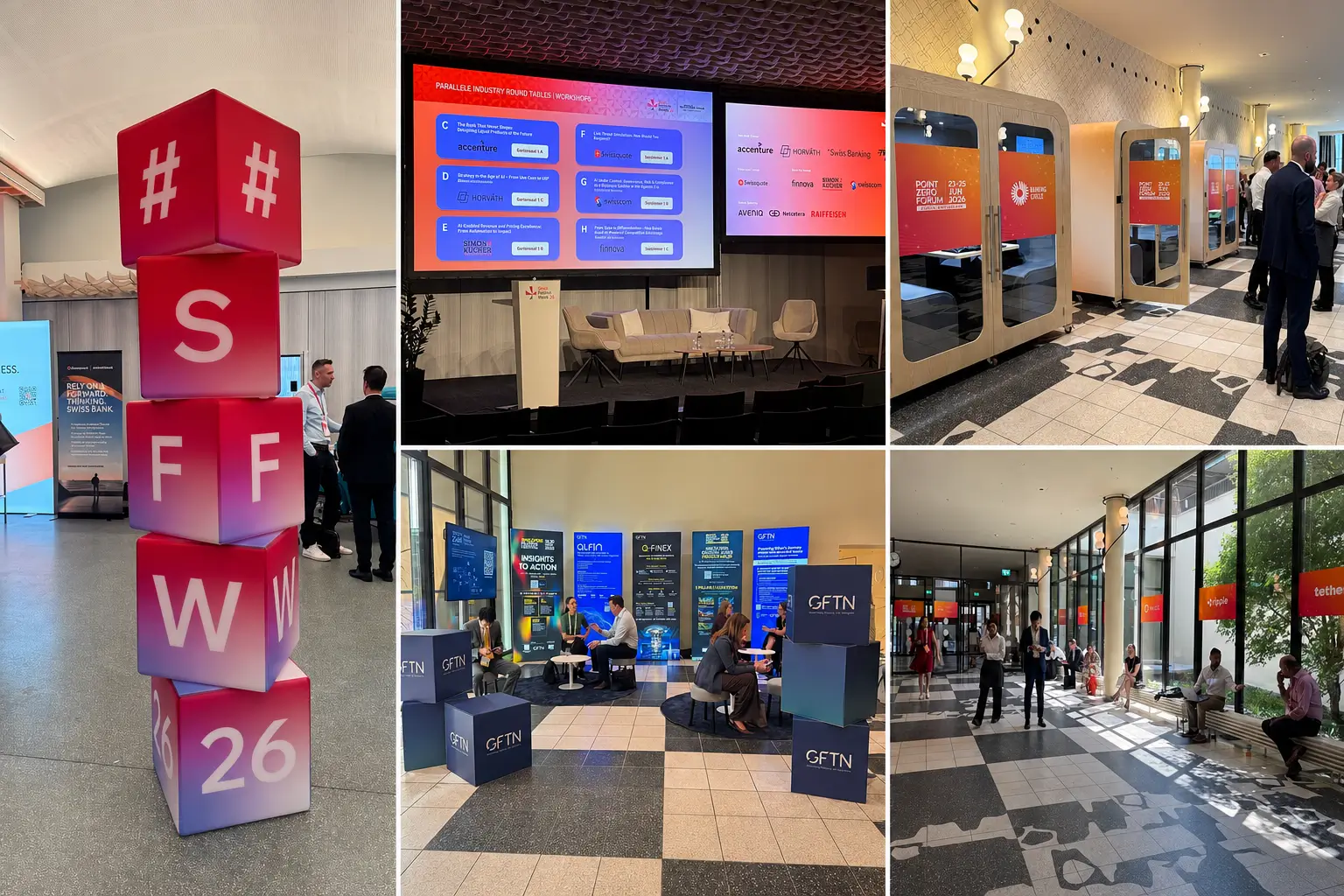
Point Zero Forum 2026 marked the fifth edition of this annual international fintech gathering. It was held at Kongresshaus Zürich under the theme “A Financial System Rewired: Trust, Compliance and Protocols in a Shifting World.” This year, the event ran as part of Swiss Fintech Week.
Swiss Fintech Week is this year’s premiere edition of the weekly event course that brought together startups, financial institutions, investors, policymakers, and technology leaders. The main sessions of the Swiss Fintech Week (SFW) took place at the Kongresshaus Zurich. They were also complemented by ecosystem-led side events across the city. The SFW agenda comprised SwissHacks 2026 48-hour startup hackathon, Finanz und Wirtschaft (FuW) Forum, SFW Startup Fair, Point Zero Forum, innovation tours, and Swiss FinTech Awards that recognized outstanding fintech start-ups and influencers chosen by a renowned jury consisting of 20 fintech experts.
For the context, 2025 edition of the Point Zero Forum drew more than 1,300 participants from over 60 countries. This year, Point Zero Forum (PZF) attracted over 2,000 industry professionals and over 300 speakers, expanding its international reach to 66 countries.
The forum was organised by the Swiss State Secretariat for International Finance and the Singapore-headquartered Global Finance and Technology Network (GFTN), positioning itself as a platform for aligning on how next-generation financial systems are designed, governed, and deployed at scale.
The speakers for the 2026 edition spanned public sector officials, including Karin Keller-Sutter, Federal Councillor and Head of the Federal Department of Finance for Switzerland, and Maria Luís Albuquerque, European Commissioner for Financial Services and the Savings and Investments Union. Central bank representation included Piero Cipollone of the European Central Bank, Sarah Breeden of the Bank of England, and Prof Marlene Amstad, Chair of the Board of Directors at Switzerland’s FINMA. Industry speakers included Sergio Ermotti, Group CEO of UBS Group AG, alongside representatives from Tether, Circle, Mastercard, PayPal, and NVIDIA. Overall, over 80 different regulators and Central Banks were present at Point Zero Forum 2026.
Karin Keller-Sutter said international cooperation and trust have become increasingly critical, and that Switzerland aims to foster dialogue supporting stability and resilience. Meanwhile, GFTN Group CEO Sopnendu Mohanty described finance as undergoing continuous, real-time change. In these circumstances, the central challenge is balancing consumer protection against the pace of technological adoption. These concepts were sitting at the core of this year’s industry discussions.
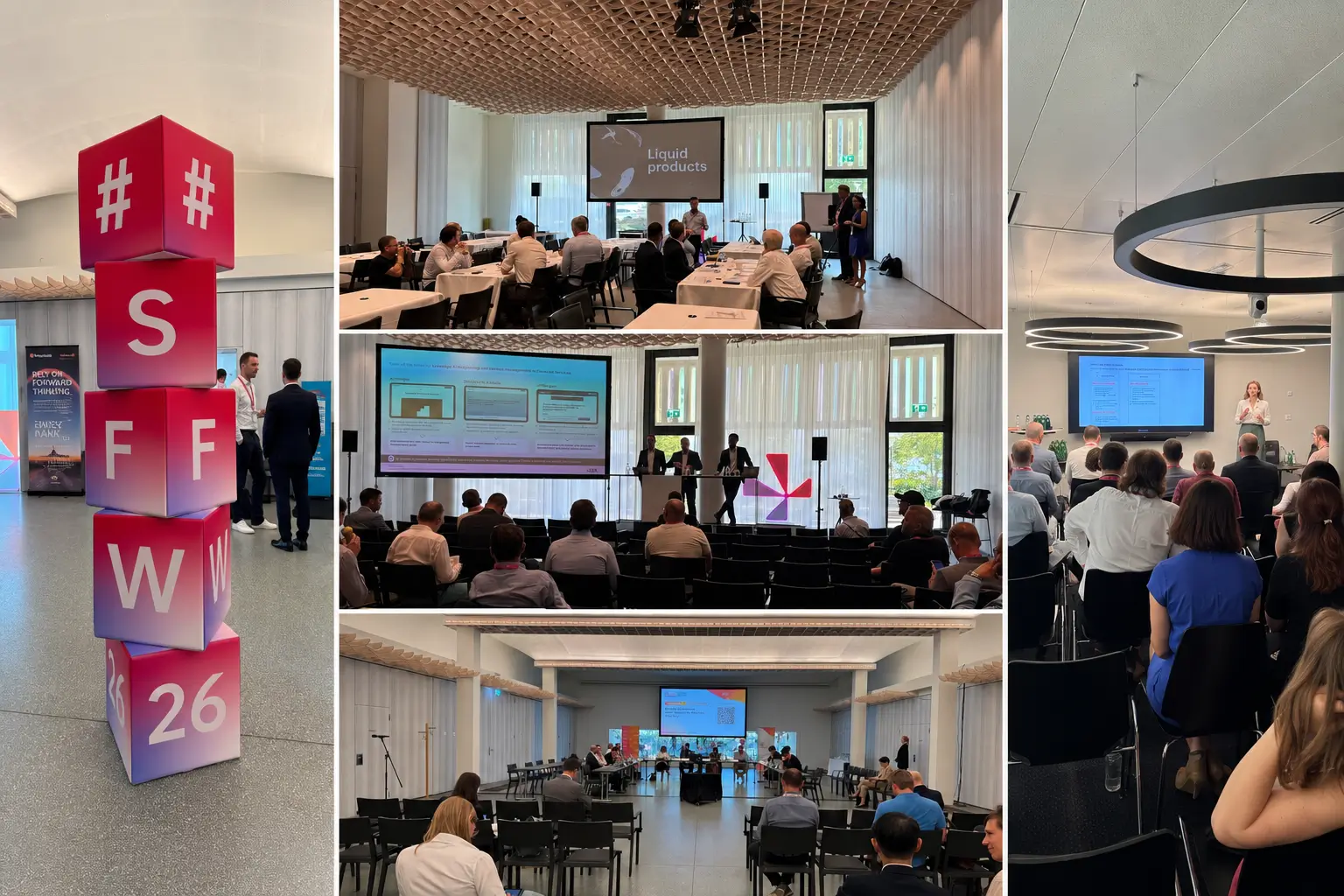
Below are highlights from select event sessions captured by the PaySpace Magazine Global team on the ground.
Swiss Fintech Week: Industry Round Tables & Workshops
During SFW, several round table discussions and workshops were conducted in parallel by Accenture, Horváth, Simon-Kucher, Swissquote, Swisscom, and Finnova.
Accenture Track – FinTech Forum ’26 Spotlight: The End of the Product Catalogue & Workshop: The Bank That Never Sleeps
Accenture, which was the Core Partner of Swiss Fintech Week 2026, presented a session titled “The End of the Product Catalogue: How Cognitive AI Makes Every Bank Truly Personal” on June 22. Rodrigo Alvarez, Global Financial Services Accenture Song Lead, delivered the spotlight talk. The session explored how cognitive AI is transforming banking as we know it. Instead of marketing individual accounts, loans, or investment products, banks today can use AI to understand what individual or business customers genuinely look for and create the most suitable personalized solution. Besides, with AI in their toolbox, banks can make their services proactive, anticipating customer needs before they even voice them.
Accenture also ran a workshop titled “The Bank That Never Sleeps: Designing Liquid Products of the Future,” the same day. Rodrigo Alvarez co-presented with Tobias Stüssi, Lead for Financial Services in Switzerland, and Carolin Jung Gutiérrez, Senior Manager for Financial Services.
Among other things, the workshop and interactive sessions outlined “The 6 big bets for the future of banking”. These are:
- Contextual experience
- Personalization owned
- Liquid products
- Augmented human in the lead
- Agentic and cognitive core
- Trust as the foundation
The workshop argued that the future of banking will be shaped by AI-powered, highly personalized services that adapt to customers’ needs in real time rather than relying on fixed products and traditional interactions. It highlighted six strategic priorities: delivering contextual experiences, giving customers greater control over personalization, creating flexible financial products, combining human expertise with AI, building intelligent banking operations through agentic and cognitive AI, and maintaining trust through security, transparency, and responsible data use.
These six trends were also discussed in practice during the Accenture Innovation Tour “The Future of Swiss Banking: 6 Transformational Trends Shaping the Banking Hub”.
Simon-Kucher Session: AI-Enabled Revenue and Pricing Excellence
Simon-Kucher experts Enrico Costenaro, Frédéric Boua, and Fabien Maillard held an interactive session titled “AI-Enabled Revenue and Pricing Excellence: From Automation to Impact,” aiming to help enterprises “Unlock better growth” in the age of overwhelming AI presence.
The session explored how AI is helping financial institutions optimize pricing and revenue strategies by combining automation with predictive analytics and real-time decision support. Speakers discussed the use of AI to deliver more personalized pricing, identify growth opportunities, improve commercial performance, and support faster, data-driven decision-making while maintaining appropriate human oversight.
The experts explained how to leverage AI in Pricing and Revenue Management in Financial Services. They benchmarked three approaches side by side: Anthropic, BlackRock’s Aladdin platform, and JPMorgan so that the attendees can learn from the best industry players who choose slightly diverse strategies when it comes to artificial intelligence use for the purpose.
Point Zero Forum 2026
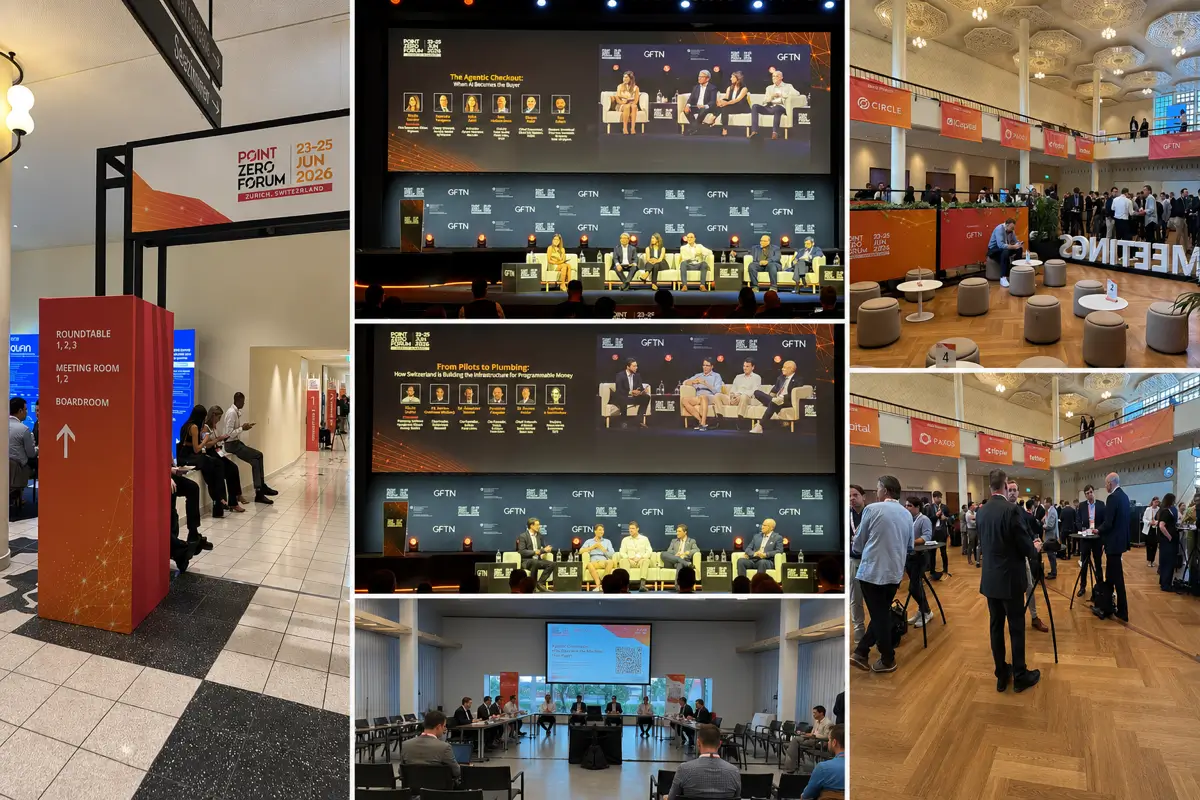
Throughout the three days, Point Zero Forum hosted numerous roundtables examining the infrastructure, governance, and trust frameworks that will underpin the next generation of digital finance and AI-enabled commerce. Here are some of them.
June 23: Agentic Commerce – Who Governs the Machine That Pays?
Moderated by Jaskaran Bhalla, Head of Content at Global Finance & Technology Network (GFTN), the session brought together Amira Karim (Amazon), Chan Yam Ki (Circle), Colin Payne (Financial Conduct Authority), Dea Markova(Fireblocks), Georg Schneider (Digital Asset), Jesse McWaters (Mastercard), Dr. Mansour Alsaleh (Saudi Central Bank), Nicole Sandler (Ubyx), Simon Taylor (Tempo), Sophie Gilder (Commonwealth Bank of Australia), Tang Wei(Stripe), and Thibault Murel (DFNS) to examine how autonomous AI agents could reshape payments.
We speak a lot about AI agents soon being able to buy everything for humans. They should be doing it autonomously, but still some level of control is surely needed. AI agents are developed by all e-commerce ecosystem participants: PSPs, fintechs, banks, e-commerce platforms, crypto companies. So, who’s going to be responsible for their actions in the end? The conversation targeted governance issues that may arise due to the capability of AI systems to make purchasing and payment decisions on behalf of individuals. The attendees also discussed such challenges as accountability, authorization, digital identity, consumer protection, and regulatory supervision. The common opinion was that trustworthy identity frameworks, transparent governance processes, and standardized solutions are all crucial to implementing agentic commerce in a safe and reliable way.
June 23: The Future of Commercial Bank Money On-Chain
Moderated by Erwin Voloder of Blockchain for Europe, this roundtable featured Alex Gluchowski (Matter Labs/ZKsync), Andrew Brinson (Pave Bank), Aymeric Salley (Banking Circle), Daniel Nagy (Forefront), Keisuke Kimura (Japan Cryptoasset Business Association), Mai Kaneko (DeCurret DCP), Manuel Klein (Deutsche Bank), Martin Bruncko (Schuman Financial), Dr. Michael Blaschke (Bitcoin, Fiat & Rock’n’Roll), and Sébastien Van Campenhoudt (Euroclear).
The meeting was focused on the increasing importance of tokenized digital bank money in the still-growing ecosystem of finance in the digital world. The speakers covered the subject of how tokenized deposits could serve as viable substitutes for the currencies represented by stablecoins or central banks while being secure settlement means for the market. The significance of interoperability, clarity of regulations, and cooperation between commercial banks and market infrastructures was also underlined.
June 23: Solving for the Fundamentals: Identity Wallets, Trust Infrastructure, and Preparing for the Agentic Economy
Moderated by Ivan Mortimer-Schutts, Global Head of vLEI at the Global Legal Entity Identifier Foundation (GLEIF), the session convened Aoife Houlihan (Visa), Bridget Rose Mesina-Romero (Bangko Sentral ng Pilipinas), Christina Wu (Circle), Felix Laufenberg (Fireblocks), Gary Liu (Terminal 3), Guillermo Galicia Rabadan (The World Bank), Liam Glennon (TRM Labs), Livia Benisty (Banking Circle), Mai Fujimoto (zERC20), Dr. Nicolas Jacquemart(Cardano Foundation), and Vedran Lalic (United Nations University-EGOV).
The debate focused on the digital identity system required for the formation of an economy that is relying on intelligent machines that communicate and trade on behalf of bringers. The participants studied the impact of identity wallets, verifiable credentials, trust systems, and standards for secure digital transactions. A recurring message throughout the session and overall forum agenda was that trusted identity infrastructure will be a foundational component of future AI-driven financial services, requiring close cooperation between governments, financial institutions, technology providers, and international organizations.
June 24: Morning Roundtables Recap
The Forum Stage on the morning of 24 June focused on the transformation of financial infrastructure, examining how digital assets, programmable money, and next-generation payment networks are reshaping the global financial system. Together, the sessions reflected a common theme running throughout the Forum: the convergence of traditional finance and digital assets, and the infrastructure, policy, and governance required to support the next generation of programmable financial systems.
The programme opened with “A Blueprint for High Growth and Open Economies: From GEL₮ to Programmable Banking,” which explored how programmable banking and digital financial infrastructure can support economic growth, innovation, and more connected financial ecosystems.
This was followed by “The $320 Trillion Rewiring: Infrastructure, Rules and the Race to Move Money,” a discussion on the modernization of global payments, highlighting the technologies, regulatory frameworks, and market infrastructure driving faster, more interoperable cross-border money movement.
The next session, “Europe’s Currency at a Crossroads: Digital Euro, Stablecoins, and the Mutiny of Money,”examined Europe’s evolving monetary landscape, comparing the potential roles of a digital euro, regulated stablecoins, and other forms of digital money while considering their implications for monetary sovereignty and financial stability.
The morning concluded with “The Exchange as Settlement Layer: How Tokenization Rewires the Role of a Crypto Platform,” which explored how tokenization is expanding the role of exchanges beyond trading venues into infrastructure providers for digital asset issuance, settlement, and programmable financial services.
June 24: The Agentic Checkout – When AI Becomes the Buyer
Moderated by Nicole Sandler, Chief Ecosystem Officer at Ubyx, the session brought together Mamerto Tangonan, Deputy Governor of Bangko Sentral ng Pilipinas, Saira Zahid, Director of Agentic Payments at Amazon, Sam Hinton-Smith, Head of International Public Policy at Stripe, Shayan Hazir, Chief Digital Officer, Asia (excluding Hong Kong) and MENAT at HSBC, and Tom Mutton, Executive Director of Payments Innovation & Fintech at the Bank of England, to examine how AI agents are reshaping the payments landscape.
The discussion focused on a future in which AI agents can independently book travel, manage subscriptions, negotiate purchases, and initiate payments without direct human involvement. Today, not even half of all the shoppers can imagine that or trust AI to buy on their behalf. However, payment companies must be AI-ready nonetheless. The technology develops so fast that what seems improbable today is a matter-of-fact reality tomorrow.
Speakers explored how payment infrastructure must evolve to support machine-to-machine commerce, addressing questions around authentication, liability, fraud prevention, and regulatory oversight when autonomous systems become the buyer. A key takeaway was that existing payment rails were designed around human decision-makers. Quite soon, they won’t be in majority behind the payment decisions. Thus, making new trust models, machine-native authorization mechanisms, and interoperable standards is essential to safely support the next generation of autonomous commerce.
June 24: From Pilots to Plumbing – How Switzerland Is Building the Infrastructure for Programmable Money
Moderated by Nicola Plain, Principal Business Consultant for Digital Assets at Zühlke, the session featured Dr. Alexander Thoma, Head of Digital Assets at PostFinance, H.E. Adrian Cachinero Vasiljevic, Co-founder of Steakhouse Financial, Dr. Roman Studer, Chief Executive Officer of the Swiss Bankers Association, Frederik Gregaard, Chief Executive Officer of the Cardano Foundation, and Stephanie K. Wickihalder, President of Swiss FinTech Innovations (SFTI).
The practical conversation highlighted Switzerland’s transition from experimenting with programmable money to building production-ready financial infrastructure. This discussion is extremely timely, as the first wave of live agentic transactions is already underway in Europe. Those increasingly use blockchain technology and on-chain assets as the easiest way for agents to transact and have their intents/decisions thoroughly recorded.
So, rather than debating the potential of tokenized money, speakers examined how deposit tokens, stablecoins, and central bank digital currencies each serve distinct roles within the financial system, and how these technologies can move from pilot projects into everyday financial operations. In particular, Frederik Gregaard emphasized that regulatory standards are becoming more consistent across jurisdictions, making them a practical starting point for organizations developing programmable money and digital asset infrastructure.
Participants emphasized that scalable programmable money will depend on clear governance, interoperable infrastructure, and close collaboration between banks, technology providers, regulators, and market participants. The discussion positioned Switzerland’s approach as a practical blueprint for jurisdictions seeking to modernize financial market infrastructure through tokenization and digital money.

Media Announcements Made at Point Zero Forum
Several companies used Point Zero Forum 2026 to make important announcements for media and fellow industry players.
Cleanverse International: Programmed Governance Playbook and GovOS
Cleanverse International published a playbook titled “Programmed Governance – The Next Evolution of Financial Supervision for On-Chain Finance” presented at Point Zero Forum 2026. The playbook introduces an Operational Governance Framework intended to translate regulatory policy into programmable controls, aiming to embed trust, accountability, supervision, and auditability into the movement of value itself. Alongside the playbook, Cleanverse also launched a beta platform called GovOS (Governance Operating System), described as a practical implementation environment where policymakers, regulators, and compliance practitioners can test a shift from governance reporting toward governance operations.
The playbook served as a guiding document for the panel “From Law to Operations: The Digital Asset Ecosystem’s New Reality,” held on June 25 and moderated by Ceridwen Choo, CEO and Co-founder of Cleanverse International.
Forward Edge-AI: India Partnership Announcement
Forward Edge-AI, Inc. announced a strategic partnership to launch Forward Edge-AI India Private Limited, a new entity intended to deliver post-quantum cryptography (PQC) and cyber-resilience capabilities within India. The announcement was made by Forward Edge-AI Founder and CEO Eric Adolphe, alongside the company’s Indian leadership team.
Fuze and Halborn: Digital Asset Security Partnership
Fuze, a regulated digital assets infrastructure provider, and Halborn, a blockchain cybersecurity firm, announced a strategic partnership ahead of a co-hosted event during Point Zero Forum in Zurich. The partnership combines Fuze’s regulated digital assets infrastructure with Halborn’s security expertise to help banks and financial institutions launch more secure, compliant digital asset services.
As part of the announcement, the companies presented a framework intended to help institutions build security-first digital asset infrastructure. Putting security at the forefront is essential as Chainalysis estimates that digital asset platforms lost more than $3 billion to hacks and exploits in 2025. Meanwhile, the 2026 Coinbase and EY-Parthenon Institutional Investor Survey found that 73% of institutional investors plan to increase digital asset allocations in 2026, with 81% now preferring spot exposure through regulated investment vehicles.
Fuze CEO Mo Ali Yusuf said trusted infrastructure, cybersecurity, and regulatory alignment have become essential as institutional adoption of digital assets accelerates. Halborn Co-Founder, Executive Chairman, and President Rob Behnke added that digital asset security underpins institutional adoption, and that financial institutions need security, governance, and operational controls to manage risk as tokenization and custody activity grows.
Under the partnership, Fuze and Halborn plan to collaborate on regulatory, security, and industry policy; share security best practices; work jointly on go-to-market implementation; co-author content; and co-host events.