The Business Research Company reports rapid growth driven by fraud prevention and next generation banking technology
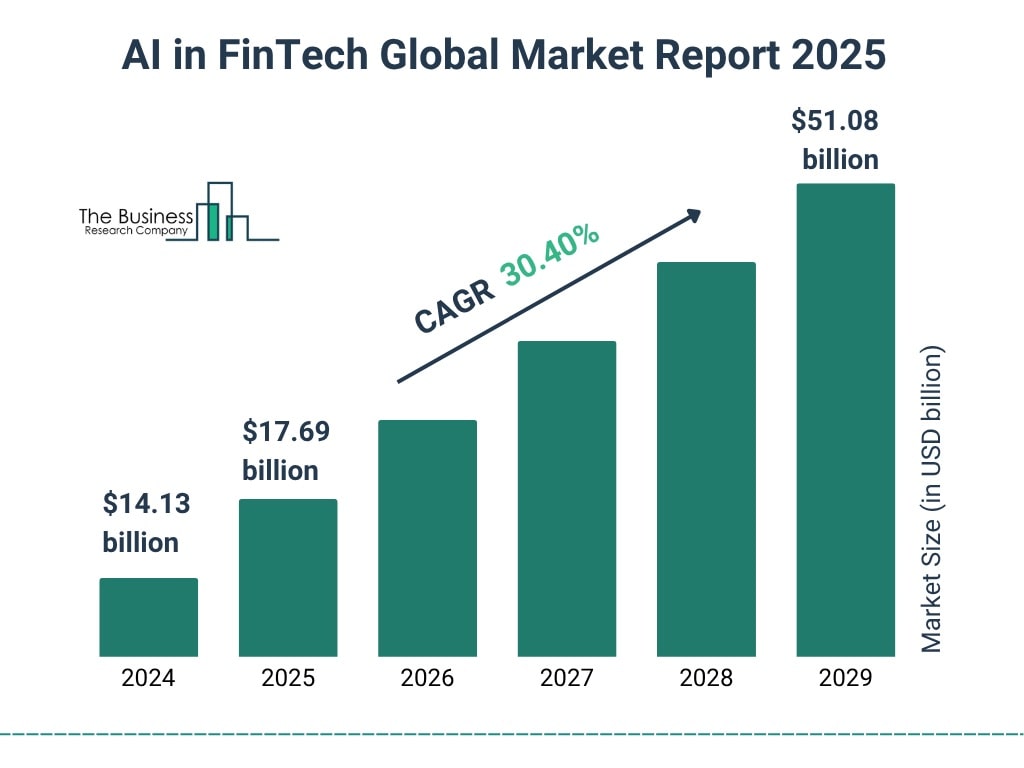
Artificial intelligence has become one of the most powerful forces shaping the future of financial services. According to The Business Research Company, the AI in FinTech market has reached $14 billion in 2024. Over the next five years, this figure is expected to more than triple, rising to $51 billion by 2029 at a compound annual growth rate of 30 %.
This remarkable expansion highlights how financial institutions are relying on AI not only to solve problems but to completely redesign the digital banking experience.
Why Is AI Becoming Essential in the FinTech Market?
As more transactions move online, financial institutions face higher risks and rising losses. AI has become the strongest defence, allowing banks to detect unusual patterns, block suspicious activity in real time, and protect customers with greater accuracy than ever before.
At the same time, a wave of new small enterprises is adopting AI to automate daily tasks, manage risk, improve decision-making, and deliver faster customer service. This has created widespread demand for smarter, more scalable financial tools.
Together, these two drivers have pushed AI from being optional to being essential.
What Is Shaping the Future of the FinTech Market?
As companies adopt more advanced technology, several trends are becoming central to FinTech’s future.
Important trends include:
- AI infused banking platforms that study customer behavior, recommend products, predict risk, and support customer agents with instant insights.
- AI based wealth management systems that update portfolios automatically, evaluate risk tolerance, and guide advisors with personalized investment intelligence.
- Automated financial planning tools that help users make smarter decisions with less effort.
These innovations are transforming how banks operate and how people interact with their money.
How Are Trade Tensions Affecting Fintech Market Growth?
Despite the strong outlook, global trade tensions have introduced new challenges. Increased tariffs on chips, circuitry, and networking equipment have raised the cost of AI systems. This has slightly reduced the growth forecast compared to previous estimates.
Even so, the market continues to grow rapidly as companies diversify suppliers, enhance automation, and build more resilient operations.
Which Companies Are Leading the AI in FinTech Revolution?
Some of the most influential players include Alphabet, Microsoft, Klarna, Amazon Web Services, Intel, IBM, PayPal, Square, Salesforce, Stripe, Robinhood, Ripple Labs, Chainalysis, Darktrace, and Wealthfront. These companies are pushing the boundaries of what AI can achieve in fraud detection, customer engagement, risk assessment, and investment intelligence.
Their innovations are helping shape the next generation of global financial systems.
The rise of AI in FinTech marks a defining shift in how the world manages money. With the market on track to hit $51 billion by 2029, the momentum shows no signs of slowing. Financial institutions, technology leaders, and fast-growing startups are all accelerating their investments in AI to strengthen security, automate decision-making, and deliver smarter customer experiences. Even with supply chain pressures and higher component costs, the industry continues to innovate at an impressive pace. As AI becomes deeply embedded in fraud prevention, wealth management, and digital banking, it is reshaping financial systems globally and setting the stage for a more intelligent, secure, and personalized financial future.
Learn more on the AI in Fintech market here
About The Business Research Company
The Business Research Company has produced over 17,500 reports spanning pharmaceuticals, biotechnology, medical devices, and 27 additional industries. Supported by 1.5 million datasets and extensive expert interviews, the company delivers continuous and tailored market intelligence, including Market Entry Research, Competitor Tracking, Supplier & Distributor Packages, and more.
Its Global Market Model provides continually updated healthcare market forecasts for strategic planning.