The strategic AI agent collaboration combines Google Cloud’s advanced AI and data infrastructure with Nexi Group’s extensive European payment network and acquiring expertise.

Nexi Group, one of Europe’s leading paytech companies, has signed a Memorandum of Understanding (MoU) with Google Cloud to accelerate the development of agentic commerce across Europe. Together, the companies plan to build foundational infrastructure enabling AI agents to autonomously manage customers’ shopping journeys and execute secure, authorized payments on behalf of consumers.
The strategic partnership also includes transforming Nexi’s internal operations through AI-driven fraud detection, compliance automation, and merchant onboarding optimization.
What Is Agentic Commerce?
Agentic commerce refers to a next-generation digital commerce model in which AI agents act on behalf of consumers. Their roles might be limited to several of these functions: discovering products, comparing offers, and completing purchases, or they might be invested with full end-to-end shopping process powers, strictly based on explicit user authorization.
Nexi Group has been at the forefront of this emerging e-commerce scenario, having recently joined European Agentic Commerce Alliance (ACA) to directly participate in shaping the future of agent-driven commerce by establishing open, interoperable standards for autonomous AI agents in online shopping along with other industry players.
Key Areas of Collaboration
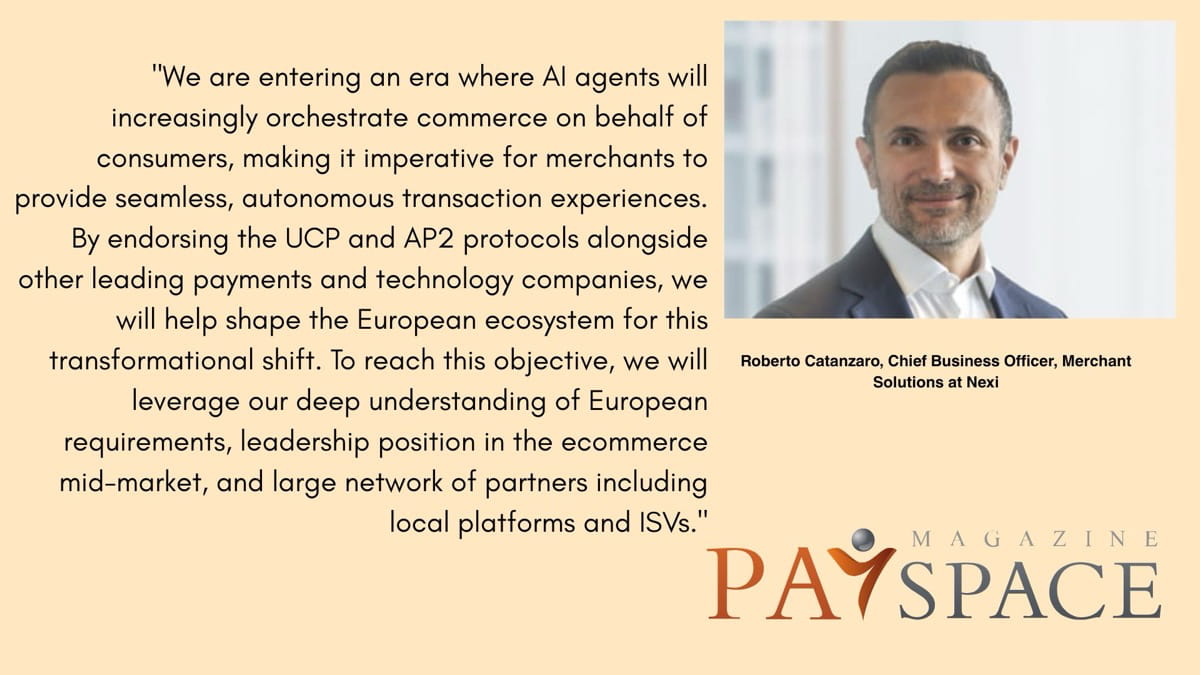
Under the new MoU with Google, Nexi has committed to supporting the freshly established open commerce standards, including the tech giant’s Universal Commerce Protocol (UCP) and Agent Payments Protocol (AP2), to enable secure and interoperable AI-powered transactions.
1. UCP and AP2 Protocol Integration
The open standards mentioned above will be used by Nexi to orchestrate the full AI commerce lifecycle. UCP will manage end-to-end AI-driven shopping journeys, while AP2 will function as a dedicated trust layer for secure transactions.
This two-part framework will enable AI agents to execute payments autonomously, using cryptographically signed mandates and verifiable credentials, creating a compliant and secure transaction environment aligned with European regulations.
2. Conversational and AI-Driven Sales Channels
Besides targeting customers’ fund control concerns, the collaboration between Nexi and Google also aims to help merchants capture purchase intent in real time, whether it originates from a search query, chatbot interaction, or video recommendation, and convert it instantly into AI-facilitated purchases.
What matters for merchants in the agentic commerce scenario is transparency. As the recent infamous case with backlash over Amazon’s newest experimental AI-driven shopping tools which lacked sellers consent to begin with showed, not only end clients but also merchants need to understand what’s happening behind the AI agent sales and how to manage them.
By bridging interaction and transaction, the two partner companies aim to reduce friction and increase conversion rates in digital commerce in verified and secure settings.
3. Secure and Standardized European Infrastructure
The partnership will work toward delivering a standardized AI-ready payment engine tailored to European regulatory requirements. The goal is to ensure AI agents can operate securely, transparently, and in full compliance with EU frameworks.
The EU has been working on implementing supervision of machine intelligence for over a year now. The AI Act law, that provides for transparency for general-purpose artificial intelligence and additional rules for technologies that contain systemic risk, formally entered into force on 1 August 2024. However, its requirements are being phased in over time, so that AI Act will become fully applicable for most regulated AI systems only in August 2026. Some specific obligations, e.g. those for high-risk systems embedded in regulated products, may have even longer extended compliance deadlines up to August 2027.
Leadership Commentary
“As consumer journeys shift toward agentic commerce, trust and security become the primary currencies of the digital economy,” added Tara Brady, president of Google Cloud EMEA. “Google Cloud is at the forefront of delivering secure, agentic AI technologies to the financial sector. With these capabilities, Nexi will accelerate innovation, optimize transaction workflows, and define the next generation of digital payments for the European market.”
Operational Transformation and Fraud Detection
Beyond customer-facing innovation, Nexi plans to leverage Google Cloud’s AI and data analytics capabilities to enhance its internal operational resilience and efficiency.
The two companies will explore opportunities to:
- Optimize real-time fraud detection
- Automate regulatory compliance processes
- Streamline merchant onboarding
- Improve cost efficiency across core payment platforms
Additionally, Nexi intends to expand access to its payment infrastructure for independent software vendors (ISVs) using Google Cloud technologies, further strengthening the European digital commerce ecosystem.
The MoU signals a broader shift in Europe’s digital payments landscape, as financial institutions and technology providers prepare for AI-driven commerce models. By combining payment network scale with AI infrastructure, Nexi and Google Cloud aim to create a trusted foundation for secure, autonomous transactions across European markets.