What are smart contracts, and how can technology be applied in practice?

The hype around blockchain hasn’t lessened in years it exists. On the contrary, it has reached a crescendo, and this is far from over. Most of us have heard about cryptocurrency and blockchain, but today we will consider another “branch” of crypto – smart contracts.
PaySpace Magazine offers to figure out what a smart contract is, and how it can be put into practice.
What is a smart contract?
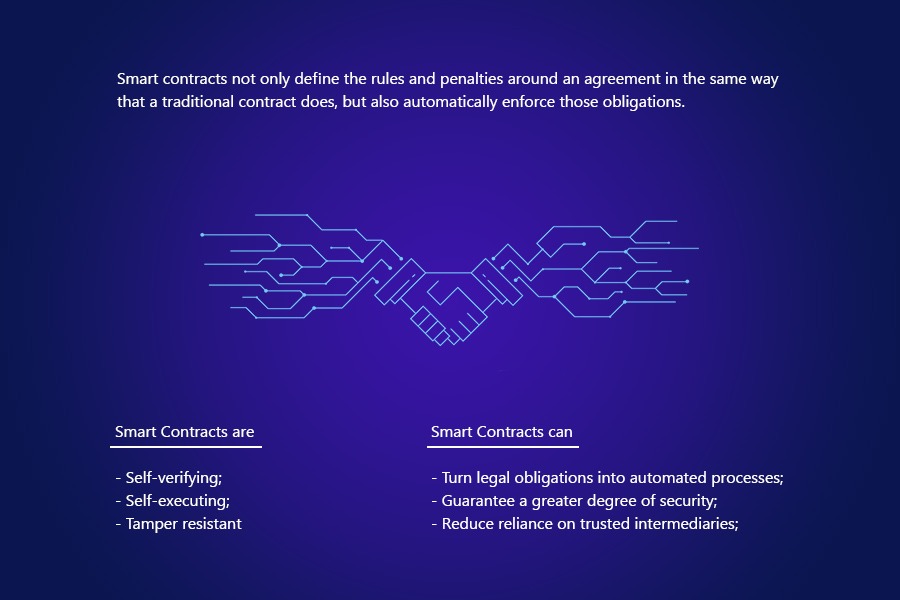
A smart contract is an electronic protocol (computer code), which runs on top of a blockchain containing a set of rules under which the parties to that smart contract agree to interact with each other.
In other words, smart contracts can be compared to a vending machine principle. Normally, one goes to a lawyer or a notary, pay the required price, and wait until the papers are ready. Using a smart contract, you are merely dropping a crypto coin into the vending machine (in our case, ledger), and your escrow, driver’s license, or whatever drops into your account.
How do smart contracts work?
First and foremost, the terms of the contract are recorded (in the form of code) and inputted into the block of the blockchain. This contract is distributed and duplicated several times between the nodes of the platform. After the trigger is activated, the contract is executed in accordance with the specified conditions. The program automatically checks the fulfillment of obligations.
Major working principles of smart contracts:
- Initiated transaction (cryptocurrency transfer, transmittal of information, etc) is sent into the computer network of the nods;
- Nodes network confirms a transaction and user’s status;
- A transaction is combined with other ones and forms a new block, which has its own unique place in the blockchain. What is more, this block can’t be changed or corrupted;
- The finalizing. After all these steps a transaction is considered to be completed.
How smart contracts can be used?
The simplest example of the use of smart contracts is multisignature. The participants of a particular system are able to freeze a certain amount of cryptocurrency on the blockchain with the help of this digital signature scheme. If one desires to spend funds, they need to get signatures of at least half of the participants. If they succeed, they activate their keys, confirming that they are part of this particular project. In general, smart contracts can be used for any kind of financial activity (insurance, lending, registrations and transfer of property, etc).
Here are some examples of possible cases of smart contract use:
- International payments. Smart contracts are immediate and guaranteed;
- Facilitation of the trading process. A dishonest merchant would be fined in the event they have provided goods of poor quality;
- You can maintain records of financial data within one unified ledger;
- Smart contracts can automate payments processing;
- Tracking of the full supply chain is possible as well;
- Medicine. A medical examination can be streamlined since a doctor can transmit patient data with the help of blockchain;
- Agentic payments. AI agents can pay for services on their own, and smart contracts and stablecoin settlement keep those payments rule-based and verifiable.
Smart contracts and agentic payments
Agentic payments are payments that an autonomous AI agent initiates, authorizes and settles without a person approving each transaction. Smart contracts are a natural fit for this model. An agent cannot open a bank account, pass KYC checks or hold a card. It can hold a wallet and follow rules written in code.
Most agentic payments settle in stablecoins, which are themselves smart contracts on a blockchain. The agent’s owner can also define limits in code: a maximum amount per payment, a daily budget, a list of approved recipients. Payments outside those rules are not executed. Escrow works in the same way. Funds stay locked in a contract until the agent’s task is confirmed as complete, and then they are released automatically.
The best-known standard in this field is x402. It is an open protocol that uses the HTTP 402 “Payment Required” status code, so a website or an API can ask for a stablecoin payment directly in the request. The agent pays, and the resource is delivered. According to the Solana Foundation, x402 has processed over 180 million transactions in about a year since launch. The same recap says Cloudflare, Stripe and AWS reference the standard in their documentation and workflows.
Scale is one of the reasons this approach has attracted attention. A May 2026 Keyrock report, cited by DEV Community, found that 76% of AI-agent transactions fall below the $0.30 fixed fee that card processors charge per transaction. Fees alone would exceed the value of such payments on card rails. Stablecoin settlement removes that floor.
Infrastructure providers are also entering the segment. On May 20, 2026, Fireblocks joined the x402 Foundation and launched an Agentic Payments Suite. It includes a gateway for payment service providers that want to accept stablecoin payments from agents, and wallets that let fintechs’ customers delegate spending to AI agents within defined limits. Coinbase and Google have added x402 as a stablecoin facilitator to Google’s Agentic Payments Protocol, which lets agents on Google’s A2A network settle in stablecoins.
Some caution is also visible in the market. A recent RZLT analysis notes that roughly half of x402 transaction volume appears to be testing rather than genuine commerce. Because every transaction is recorded on a public blockchain, an agent’s spending pattern can be audited by anyone, and this has raised privacy questions.
How technology is already used in real life
Asset Digitisation
In asset digitisation, smart contracts are used for tokenizing real estate, so that ownership of a property can be split into shares and transferred between buyers. They also handle tokenized commodities such as gold, fund and bond units, and private equity shares. Further uses include trade finance documents and invoices, art and collectibles with a recorded ownership history, and carbon credits. In each case the contract records who owns what, enforces transfer conditions such as investor eligibility, and distributes payments like rent, interest or dividends to holders automatically.
NEO is one example of a smart contract platform with different aims, compared to Ethereum. The NEO major goal is the “Smart Economy”, while its main principles are digital assets, digital identity, and smart contracts.
NEO is a platform that makes it possible for businesses to trade goods and services in a digitized form. Its current main network, Neo N3, went live in 2021 and supports contracts written in C#, Java, Python, Go and TypeScript. It also has native oracles, which let contracts request off-chain data such as price feeds. In April 2026, the network cut its block time to three seconds. Moreover, the platform has high security standards, which guarantee the implementation of defined trading rules.
Any asset (gold, precious stones, etc) would have a commensurate entry on blockchain. Thus, it would be no big deal to track and record the ownership.
Personal Finance
In personal finance, smart contracts are used for peer-to-peer lending and borrowing, where collateral is locked in a contract and returned automatically once the loan is repaid. They also power savings and staking products that pay out interest by preset rules, stablecoin transfers and remittances without a bank in between, and recurring payments such as subscriptions or scheduled transfers. Other uses include multisignature wallets for joint accounts and family funds, escrow for purchases between individuals, and parametric insurance that pays out automatically when a defined event is confirmed, for example a flight delay.
Many projects facilitate those use cases. The Tezos blockchain, for example, was launched in September 2018, and it has some promising dApps (decentralized applications) that would be able to destroy the wall between conventional financial products and blockchain technology.
Tezos has been upgraded regularly since then. Its 20th protocol upgrade, Tallinn, was activated on January 24, 2026, and brought block time down from eight seconds to six. Its Etherlink layer, which is EVM-compatible, is adding Michelson smart contracts through the Etherlink 7.0 proposal, so that Tezos-native and Ethereum-style contracts can interact in a single transaction.
The most interesting and attractive part about Tezos is that its financial dApps, once fully implemented, would reduce/eliminate the probability of programming bugs or human errors (to which smart contracts are highly exposed).
Health Care
Electronic medical records have become the norm for many hospitals and health care providers. In health care, smart contracts are used for managing patient consent and access to medical records, sharing data between clinics and labs, automating insurance claims and payouts, tracking drug supply chains, and rewarding patients who agree to share data for research.
The company called Medicalchain has launched a product which uses blockchain to implement secure access to medical records. What’s more, it also allows a patient to maintain control of their personal data.
But that’s not all. Medicalchain wanted to decentralize and secure medical records, so they developed an ERC-20 token on Ethereum called the MedToken. The ICO took place in February 2018 and raised around $24 million.