Money20/20 Europe just celebrated its tenth anniversary on the continent with the conference of a great magnitude and visionary discussions on agentic AI, stablecoin payments and supporting infrastructure, growing integration of fintech services and the importance of compliance in a fast-moving regulatory landscape. Besides the theoretical conversations, the panel participants brought some actionable insights and introduced novel solutions the industry will now test at scale.

Money20/20 Europe: general view
This year’s European edition of the flagship Money20/20 event ran between 2-4 June 2026. It took place at the RAI Amsterdam Convention Centre, drawing a reported 7,600 attendees from more than 100 countries and 2,000 companies, as Money20/20 president Tracey Davis noted in her opening remarks.
The show featured 450+ speakers across six stages. The industry influencers mainly spoke on four main themes framed as “pillars shaping the future of fintech” in the conference agenda:
- AI and the Agentic Age: autonomous AI reshaping decision-making and e-commerce routines once again on top of the discussion table;
- The Great Rebundling: integrated, seamless services are what make businesses more competitive (not new information but shift is now more evident);
- Money Stack Rewired: stablecoins and new blockchain and DLT-based financial infrastructure is fully rebuilding the basic plumbing of money;
- Regulation in the Fast Lane: laws evolve to accommodate for new forms of fintech interactions and only those who keep up with compliance remain in the game.
“AI is moving from experimentation to execution, stablecoins are entering the mainstream, regulation is accelerating, and every leader here is asking ‘who will build what comes next.”
Bryony Naylor, VP, Europe
Agentic AI moves from theory to production but key questions remain unanswered
Right at the opening day, Worldline, ING, and Mastercard jointly announced they had completed what the three companies describe as Europe’s first end-to-end agentic payment transaction executed in a live production environment. Hans Overeem, Head of Payments at ING Netherlands, described the milestone as “a concrete move towards a more intelligent, seamless future for banking and online shopping.” Though, as we see, agentic transactions are now everything the industry is talking about, their real-life progress is moving in baby steps. At the same time, once the practical rails are built and properly tested, their deployment might be unstoppable, given the popularity of the AI technology in all spheres of life and business.

Rory O’Neill, Checkout.com, and Ross Gallagher, 11:FS, in a fireside chat at the “Race to Checkout: How Agentic Changes Marketing in Financial Services” session held on the MoneyPot stage
At the conference, attendees were clearly divided as to whether the current advancements in AI and agentic payments are indeed beginning to move beyond theoretical applications and into real-world implementation of integrated, automated systems for finance. Although many companies have confirmed that they have sufficiently established technically viable solutions, agencies are finding themselves grappling with issues of getting actual value from their solutions as they are gradually transitioning from developed use cases to establishing unified, end-to-end AI stacks that integrate all of the key components: data, models, orchestration, and governance.
The representatives from leading companies, such as NVIDIA (currently the most profitable company in the world), noted the rapid emergence of transactional foundation models as illustrated by Revolut’s PRAGMA model designed to provide agentic orchestration functionality and establish an intelligent, integrated layer for risk, growth, and product management. However, there are still many implementation steps that need to be performed before the potential of foundation models can be fully realized, with most deployments occurring at an early stage and under strict controls, including restrictions on performance metrics and approvals required before implementation.
Dr Janet Bastiman, Chief Data Scientist at Napier AI, who led the conference session on What happens when regulators build with industry? where she discussed working with the FCA on testing new data and AI models commented:
“At Money20/20, the conversation around AI in payments has clearly shifted from hype to application, but not always in the ways the industry might hope. What stood out most is how quickly AI has become table stakes, yet how unevenly it’s being operationalised across the ecosystem.
We’re seeing continued attempts at convergence between fraud and AML, with a growing number of fraud-first players moving into financial crime compliance. However, the underlying challenge remains in that techniques that work well for fraud (where signals are immediate, positive labels forthcoming, and patterns more often repeated) don’t translate neatly into AML, which is inherently more complex and context driven. Perhaps most importantly, financial institutions rarely received confirmation of successfully identified money laundering with which to label transactions or alerts.
There’s also a strong push toward “agentic AI,” particularly in investigation workflows. While the promise of automation and efficiency gains is compelling, the reality is more nuanced. In practice, many of these solutions are best suited to augmenting analysts by summarising data, structuring investigations, and improving consistency, rather than fully replacing human decision-making, especially in higher-risk scenarios.
Perhaps most importantly, the industry is converging on a shared understanding: explainability, auditability, and control are non-negotiable. The narrative has firmly moved from black-box models to “glass-box” approaches that regulators and institutions can trust.
In payments, AI is no longer a future differentiator, it’s a present necessity. The real question now is how responsibly and effectively it’s deployed.”

Dr Janet Bastiman, Chief Data Scientist at Napier AI, speaking at Money20/20 Europe 2026
Meanwhile, the MoneyPot stage brought together Checkout.com CMO Rory O’Neill and Ross Gallagher, Director of Ventures at 11:FS, to examine how agentic AI is reshaping marketing in financial services. As AI agents increasingly handle purchasing decisions on behalf of consumers, the traditional acquisition playbook built around clicks, impressions, and interface-driven conversion loses its footing.
Traffic to retail sites from generative AI platforms has already increased 4,700% year-over-year, and ChatGPT, along with other AI chatbots popular today, is driving roughly twice as many new customers as traditional search channels. The central question the session posed: as agentic systems compress discovery, comparison, and checkout into a single automated sequence, firms must shift focus from winning a customer’s attention to winning the agent’s recommendation. Merchants who are not agent-compatible will be less visible or harder to recommend by AI shopping systems. The same discussion continues now at ShopTalk Europe, where a recurring theme across sessions is the structural decline of traditional keyword search and its replacement by AI-driven product discovery.
Stablecoins: where infrastructure matters more than digital money itself
Stablecoins were the next hot thing on the Money20/20 Europe agenda. Day One opened with a MoneyLab workshop from David Birch, Simon Taylor, and Nilixa Devlukia unpacking “The 239-Year History of Stablecoins,” followed by a closing debate: “Are Stablecoins Revolutionary or Rhetoric?”
One of the most important industry announcements on stablecoins came from Checkout.com. The fintech company announced a stablecoin acceptance capability built together with Coinbase Payments. It gives enterprise merchants the option to take stablecoin payments alongside cards, wallets, and bank transfers. Checkout.com also announced a new Fireblocks partnership, enabling US merchants to receive funds into a stablecoin wallet on a 24/7 rail. Such a function is supposed to remove cut-off times and other delays typical of traditional banking infrastructure.
In the meantime, TransferMate selected BVNK as its stablecoin infrastructure partner, integrating BVNK’s wallet and on/off-ramp capabilities into its network for the first time, with the service targeting customers in global payroll, e-commerce, and education.
The defining theme of the conference was that stablecoins have emerged as a necessary tool for both corporate (wholesale) treasury use and B2B cross-border settlement use. In every other session of the event, speakers and participants discussed that while the overall importance of stablecoins is significant, the rails they function on will far outweigh their importance over time. Additionally, stablecoin projects established over the past few years as pilots will now be moving into full operational mode, especially for cross-border payments, treasury management, liquidity management, and B2B payments. That leads us to the next critical discussion point, which enables the rapid stablecoin growth and is linked not to technical but legal aspects.

Money20/20 Europe 2026: Money Pot stage
Regulation & compliance are getting harder to keep up with as landscapes evolve faster than businesses can manage
Regulation arrived at Money20/20 Europe 2026 as a headline act in its own right. The event’s fourth content pillar called “Regulation in the Fast Lane” captured the industry mood quite accurately. In 2026, European financial services will no longer navigate one or two policy shifts at a time, but an entire simultaneous overhaul of the Union’s operating rules.
The list of legal updates the finance industry has to deal with this year reads like a compliance department’s fever dream:
- PSD3 and the accompanying Payment Services Regulation, which had just cleared national approval processes weeks before the conference, will collapse the separate licensing regimes for payment institutions and electronic money institutions into a single framework while introducing mandatory IBAN-name verification and expanded fraud liability.
- The Instant Payments Regulation is pushing real-time settlement from optional to standard.
- FiDA (the Financial Data Access framework) takes open banking logic and extends it across the broader financial sector.
- DORA is raising the bar on operational resilience and third-party risk management.
- The AML Package and the creation of a new EU-level anti-money laundering authority are reshaping how firms monitor and report suspicious activity.
- MiCA has moved crypto from a regulatory grey zone into a supervised asset class, with national transition windows now closing as July 1 deadline approaches.
- And above all of it sits the EU AI Act, applying tiered risk obligations to automated financial decision-making at the exact moment the industry is rushing to deploy it.
A recurring argument across sessions was that Europe’s almost or already implemented frameworks existing where other countries are still debating them can become the region’s structural advantage. With MiCA framework and AMLA agency that ensures the correct and consistent application of EU anti money-laundering rules, European institutions get a clearer operating environment for stablecoins and other crypto and DLT projects than rivals working under regulatory uncertainty elsewhere.
The harder question the conference raised was whether firms can keep pace. With each framework arriving on its own timeline, compliance has effectively become a continuous operational mode that increasingly demands the same technological infrastructure the industry is simultaneously trying to build for AI, stablecoins, embedded and open finance, and numerous other updates that keep entering the industry race.
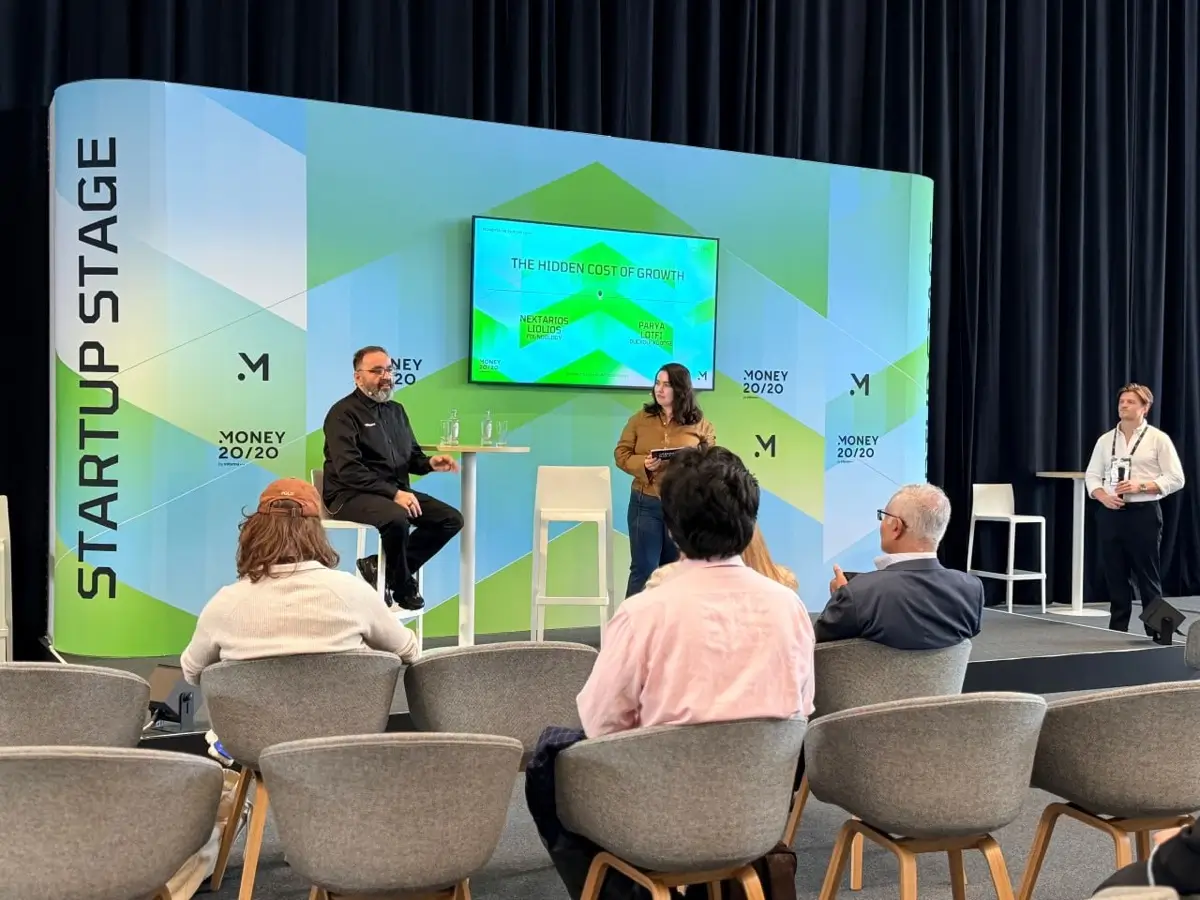
“The Hidden Cost of Growth” conversation at Startup Stage. Speakers: Nektarios Liolios (Foundology) and Parya Lotfi (DuckDuckGoose)
The Startup Stage hosted a candid conversation on what scaling a fintech actually costs beyond the headline metrics. With Nektarios Liolios, a veteran of the fintech accelerator world through Startupbootcamp and now venture builder Foundology, paired with Parya Lotfi, co-founder and CEO of deepfake detection startup DuckDuckGoose, the session brought a pointed angle: the compliance and trust infrastructure a fast-growing company must build is rarely visible in its growth story but increasingly unavoidable. For a company like DuckDuckGoose operating at the intersection of AI, fraud prevention, and financial regulation, growth means not just building a product but continuously proving to banks, regulators, and enterprise clients that the underlying technology can be trusted. Unfortunately, this cost compounds just as scale increases.
DuckDuckGoose is one of many companies worldwide helping organizations protect digital identity, media integrity, and institutional trust in the age of generative AI. Increasing fragmentation across national and private digital identity frameworks challenges that task. Luckily, solutions similar to the new Identity Gateway infrastructure layer presented by London Stock Exchange Group (LSEG) Risk Intelligence at Money20/20 Europe aim to simplify access to trusted digital identity schemes across multiple jurisdictions and can function as a unified ID access point for organisations. With a united ID system, tackling synthetic image, video, and audio threats becomes a tiny bit easier.
Last but not least, financial services integration got its fair share of attention at Money20/20 Europe
Among the many sessions, Lucy Demery (SVP Head of Visa Commercial Solutions EU) and James Gibson (Head of Revolut Business) explored how fintechs are reshaping commercial payments through embedded finance and rapid innovation. Though the share of embedded fintech services is growing quickly, recent studies show that 75% of senior leaders see implementation challenges as the biggest barrier to adopting embedded finance. Among the most frequently cited obstacles, 61% point to technical integration, while 49% highlight regulatory compliance and 43.5% mention a lack of internal expertise.
Yet, projects offering integrated financial services and expanding once single-function apps into an embedded financial ecosystem are numerous. For instance, at Money20/20 Europe, XTransfer signed an MOU with BBVA to deepen cross-border payment infrastructure across Latin America and Europe, covering FX conversion, local payments, and cross-border payments. What makes this collaboration notable is that the entities are not simply partnering for payment processing. They are combining banking infrastructure, FX, local payment rails, virtual accounts, APIs, compliance, and cross-border settlement into a more unified financial layer for SMEs. It also reflects another major Money20/20 theme: traditional banks are increasingly rebundling their services through fintech partnerships rather than trying to build every capability internally.
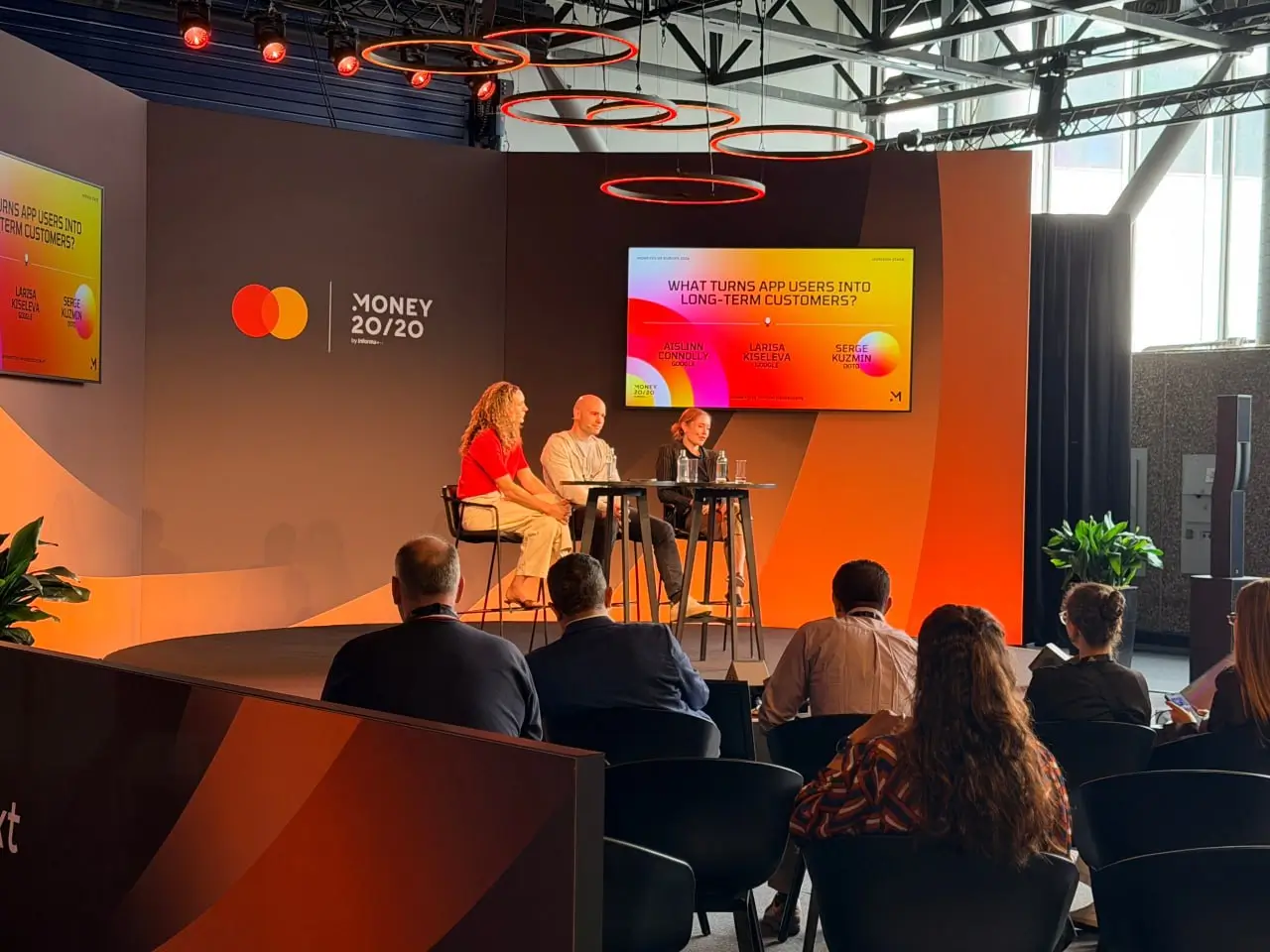
Aislinn Connolly, Head of App Development, Large Customer Sales, EMEA at Google, alongside Serge Kuzmin, CMO at Doto, and Larisa Kiseleva, Senior Apps Growth Manager at Google, discuss “What Turns App Users into Long-Term Customers?”
On the sponsored Mastercard-branded stage, “What Turns App Users into Long-Term Customers?” panel explored how fintechs can move beyond app downloads and turn users into engaged, long-term customers through AI-driven personalisation, smarter app growth strategies, and deeper behavioural engagement. Moderated by Larisa Kiseleva, Senior Apps Growth Manager at Google, the session featured Aislinn Connolly, Head of App Development, Large Customer Sales, EMEA at Google, alongside Serge Kuzmin, CMO at Doto.
Speakers discussed how fintech and trading apps can use AI, app campaigns, and data-led engagement strategies to drive retention, encourage habitual usage, and create lasting customer relationships rather than one-time interactions. This discussion brought the audience many actionable insights on the gap between app installs and genuine product engagement, what behavioural signals distinguish retained users from churned ones, and how financial services apps, which often get downloaded for a single use case, can expand their role in a customer’s financial life over time.
As commercial payments evolve in many ways, a new industry-led open banking payments scheme was launched at the Money 20/20 event to create a shared framework for commercial Variable Recurring Payments (VRPs). Its founding shareholders include Barclays, HSBC UK, Lloyds Banking Group, NatWest, Santander, Monzo, Revolut, Starling, Token.io, and TrueLayer. Acquired joined as a founding shareholder, and notably is the only participant with a full multi-rail recurring payments stack spanning cards, direct debit, sweeping VRPs, and commercial VRPs.
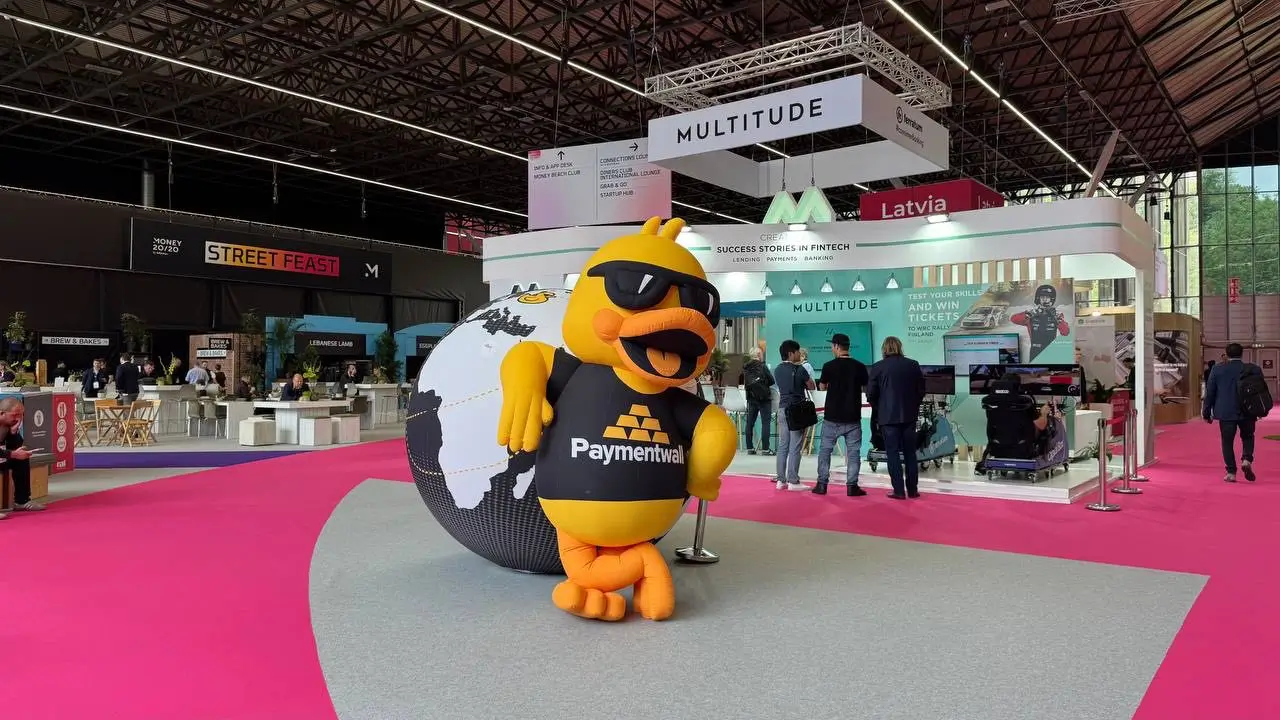
Paymentwall presented through sponsored installation at Money20/20 Europe 2026
To sum up the long read
Money20/20 Europe 2026 wrapped up with major discussions and announcements around agentic AI, stablecoins, embedded finance, compliance, and the future of financial infrastructure. A lot was said and done about AI moving from experimentation into real-world deployment, the growing role of stablecoins in cross-border payments and treasury operations, and the rise of integrated financial ecosystems driven by fintech-bank partnerships. Alongside strategic debates, the event also delivered practical insights, product launches, and infrastructure partnerships that highlighted how quickly fintech innovation is evolving across payments, compliance, identity, and embedded finance.
Beyond the conference stages, the atmosphere throughout the 10th anniversary event reflected the industry’s accelerating pace of transformation and collaboration, with thousands of fintech executives, banks, startups, regulators, and technology providers using the gathering as a key networking hub for partnerships, dealmaking, and cross-border industry connections.