Throughout the first three months of 2026, PaySpace Magazine Global team visited and kept in touch with a bunch of important fintech events in different corners of the world. Across various regions, from Europe to Africa and the Middle East, conversations and attitudes were versatile, but several themes kept resurfacing at almost every gathering, keeping them on top of the agenda for global fintech players. This article is a brief snapshot of what fintech attention was focused on in early 2026.
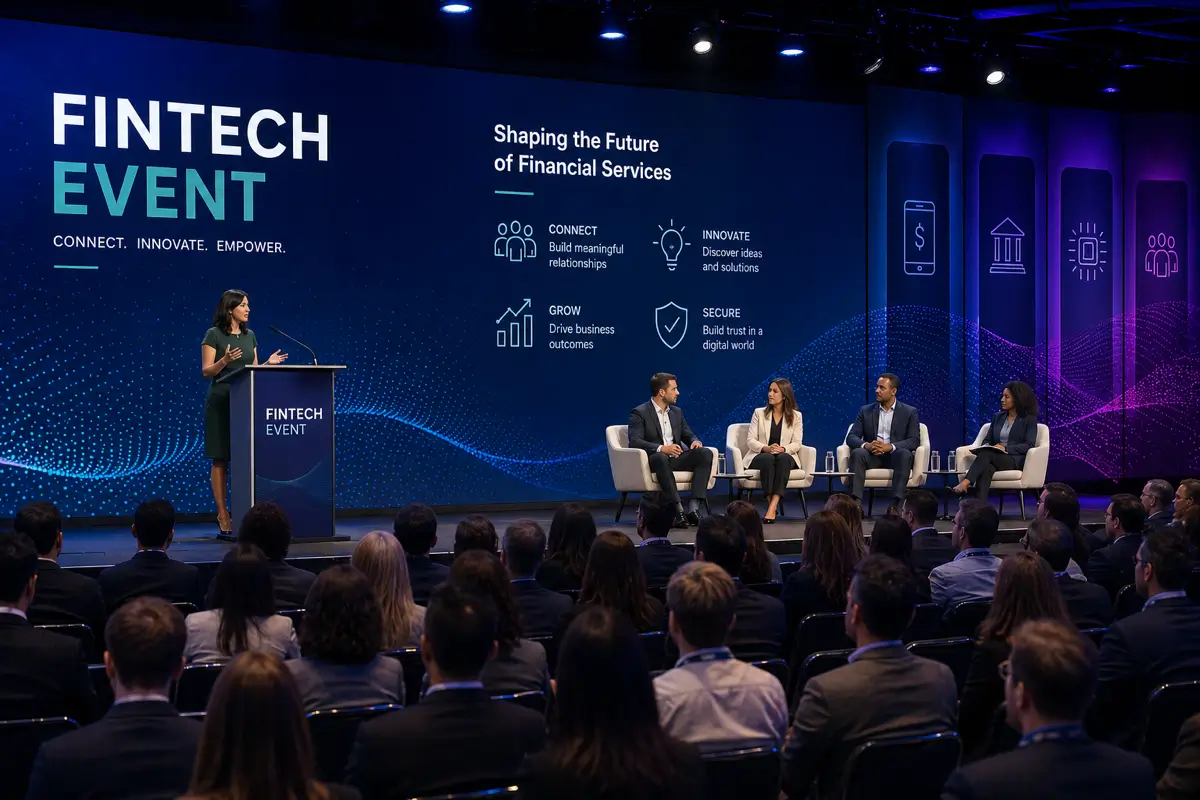
Image created via ChatGPT
Europe Hones Its Payments Infrastructure Focus
There were several notable fintech events in Europe in Q1 2026
- ATPS B2B (London, Feb 24–25)
- Baltic Payment Forum (March 2–3)
- Merchant Payments Ecosystem / MPE (March 17–19)
Across these conferences, a few important fintech trends were revealed. Merchant acquiring is evolving rapidly, with orchestration layers reshaping how businesses route and manage daily transactions. Real-time A2A payments are increasingly treated as a norm, but cross-border transaction efficiency still leaves much to be desired. Improving international payments quality was the topic that dominated technical discussions, reflecting growing pressure to reduce friction for cross-border merchants and customers.
Even in domestic operations, the ongoing efforts to enhance payment security face an important caveat that it needs to be done without introducing checkout friction. Meanwhile, European industry experts point out the rapid development of AI agents and suggest that agent-driven payments could become fully operational by 2027. The addition of an agentic layer doesn’t facilitate the task of balancing compliance with user experience which is not easily achieved even without the autonomous sales involved.
Perhaps most significantly, it is now obvious that payment infrastructure is shedding its “back-office” reputation. Across industries, it is increasingly treated as a strategic differentiator — a competitive lever that drives revenue, loyalty, and market positioning, rather than a mere utility that keeps operations running. For Europe, this discussion is hyped up at the union level, transforming to the pressing urge of EU payment sovereignty and seamless unified payment infrastructure.
Key themes discussed:
- Merchant acquiring evolution and payment orchestration layers
- Real-time payments & cross-border efficiency
- The growing role of payment infrastructure as a competitive edge
- Agentic payments and AI commerce
- Verification of Payee (VoP) framework, payment security
- Wero & SEPA
- Embedded payments
Africa: Where Financial Inclusion Meets Infrastructure Gaps
Q1 2026 saw African fintech communities convene at
- Connected Banking West Africa (Feb 25)
- Connected Banking Summit Nairobi (March 11)
- Africa Fintech Forum (March 24)
What the regional experts discussed most was that mobile-first banking is advancing at remarkable speed, with homegrown payment rails reaching populations long excluded from formal finance. Yet interoperability remains elusive, as fragmented systems across markets slow the kind of seamless connectivity that scale demands. The central paradox for the continent’s fintech industry is that adoption pace is outpacing infrastructure readiness. Innovation is genuine and accelerating, but building the durable foundations needed to sustain it equitably across diverse economies remains the defining challenge ahead.
Throughout the summits, industry leaders explored how financial institutions can embrace emerging technologies while maintaining security, compliance, and seamless customer experiences in an increasingly digital banking environment.
Key themes:
- Mobile-first banking and payment rails
- Interoperability across fragmented digital payment ecosystems
- Infrastructure gaps vs rapid adoption
- AI-powered banking
- cybersecurity resilience
- embedded finance
- financial inclusion initiatives
Middle East & Asia Explore AI and Digital Economy Acceleration
The unexpected war that erupted in the Middle East on the last day of February had plenty of wonderful fintech events postponed for an unknown amount of time. Hence, in this section we united the region with the wider Asia, especially since the topics discussed were common for both geographical areas.
- Black Swan Summit India (Feb 5–6)
- Fintech Revolution Summit Bahrain (Feb 11–12)
- ET NOW Global Business Summit 2026 (Feb 13–14)
These three high-profile gatherings held across India and Bahrain shared the diagnosis of where global finance is heading. Discussions centered on AI integration in financial services, the maturation of government-backed fintech ecosystems, and the urgency of digital identity and regulatory alignment. In India, the conversation focused on turning frontier technology disruption into tangible economic outcomes: jobs, sector transformation, and next-generation capability centres for regulated finance. In Bahrain, delegates examined how a streamlined regulatory environment and Vision 2030 objectives can anchor regional leadership in digital banking, payments, and blockchain. But the collective takeaway was that if strong institutional will meets coherent policy around high-tech, fintech maturity surely follows.
Key themes:
- AI integration in financial services
- Government-backed fintech ecosystems
- Digital identity and regulatory alignment
- Public-private partnerships
- Energy transition and sustainability
- Risks & resilience, cybersecurity
Commonwealth Realms Discuss Global Growth & Ecosystem Layer
Last but not least, we should mention the two fintech conferences that took place in Australia and Canada in early 2026:
- Open Banking Expo Canada 2026 (March 5)
- Black Swan Summit Australia 2026 (March 23–25)
Fintech gatherings in Canada and Australia brought complementary perspectives on the practical shift from legislative commitment to consumer-driven banking to its real implementation. In Canada, regulators, banks, and fintechs aligned around open data, real-time payments, and oversight frameworks. Meanwhile, in Australia, the financial ecosystem lens widened to include quantum computing, tokenisation, and green infrastructure alongside AI. Both events shared a conviction that the next phase of finance must be human-centred and inclusion-driven, and that moving from theoretic dialogue to action through policy coherence, cross-sector collaboration, and market readiness is now the defining challenge.
Key themes:
- Open banking moving toward open finance
- Partnerships as a core growth driver
- Quantum, AI, tokenization
- Green infrastructure
Fintech Trends Most Discussed in Q1 2026
Early 2026’s fintech gatherings across Europe, Africa, the Middle East, Asia, and the Commonwealth revealed a global industry in active transition. Despite regional differences in fintech maturity and underlying infrastructure, five themes surfaced consistently across virtually every event:
- AI integration — from fraud detection and credit scoring to agentic payments and AI-driven banking, artificial intelligence is moving from pilot to infrastructure level.
- Real-time and open payments — cross-border efficiency, A2A rails, and open banking frameworks are being stress-tested as they scale from ambition to implementation.
- Regulatory alignment and policy coherence — whether in Bahrain’s sandbox, Canada’s Consumer-Driven Banking Act, or the EU’s sovereignty push, regulation is now a competitive variable, supporting tech innovation with consumer safety in mind.
- Financial inclusion and infrastructure readiness — particularly acute in Africa, but present globally: adoption is outpacing the foundations needed to sustain it equitably.
- Security without friction — cybersecurity resilience, Verification of Payee, and compliance obligations must be met without degrading customer experience; this particular task is one issue no region has fully resolved.
Clearly, those fintech players who treat regulatory engagement, AI deployment, and infrastructure investment as strategic priorities are on the right path today. Although the rules for most of next-gen fintech innovations are still being written, one must stay proactive to secure a leading industry position right at the onset.