A growing number of retailers are abandoning cash payments as digital transactions continue to dominate consumer spending habits worldwide.

New research highlighted by Finextra shows that one in seven UK high-street shops went cashless in the past year, reflecting a steady shift toward card, mobile, and contactless payments. The survey of small and medium-sized businesses found that around 14% of shops no longer accept cash, though most retailers still support both digital and physical payment methods.
Furthermore, about half (46%) of the stores supporting both cash and card actively encourage cash use, which so far remains the guarantee of economic equity and inclusion for vulnerable population segments. In fact, UK shoppers have used cash in stores 20% more often in the last two years for many reasons, including digital payment fatigue.
Despite all the ethics behind the corporate financial decisions, the cashless move is largely driven by practical considerations. Businesses report that handling cash can be expensive, time-consuming, and vulnerable to theft. Digital payments, by contrast, allow for faster checkout, simplified accounting, and reduced security risks.
Digital payments surge across Europe
The trend seen in the UK mirrors broader developments across Europe. According to a survey by the European Central Bank, cash accounted for 52% of point-of-sale transactions in the euro area in 2024, down sharply from 79% in 2016, since fewer people actually use paper money.
Despite the decline, cash still plays a significant role across the continent. In many eurozone countries, particularly in Southern and Eastern Europe, cash remains the most frequently used payment method. In contrast, digital payments dominate in places such as the Netherlands and Finland, where cash accounts for less than 30% of transactions.
Consumer preferences are also shifting. More than half of euro-area consumers now say they prefer paying with cards or other cashless methods when shopping in stores, according to the ECB’s latest payment behaviour study.
The US: cash declining but still present
The United States is experiencing a similar transition, although cash remains part of everyday spending. Cash accounts for about 14% of all transactions in the U.S., making it the third-most common payment method after debit and credit cards.
Surveys show that around 90% of Americans still use cash occasionally, and the average consumer carries roughly $67 in cash for small purchases or emergencies.
However, some businesses in major cities are moving toward fully digital payment systems, prompting debates about financial inclusion. Critics argue that cashless policies may disadvantage people without bank accounts or digital payment access.
The future of retail payments
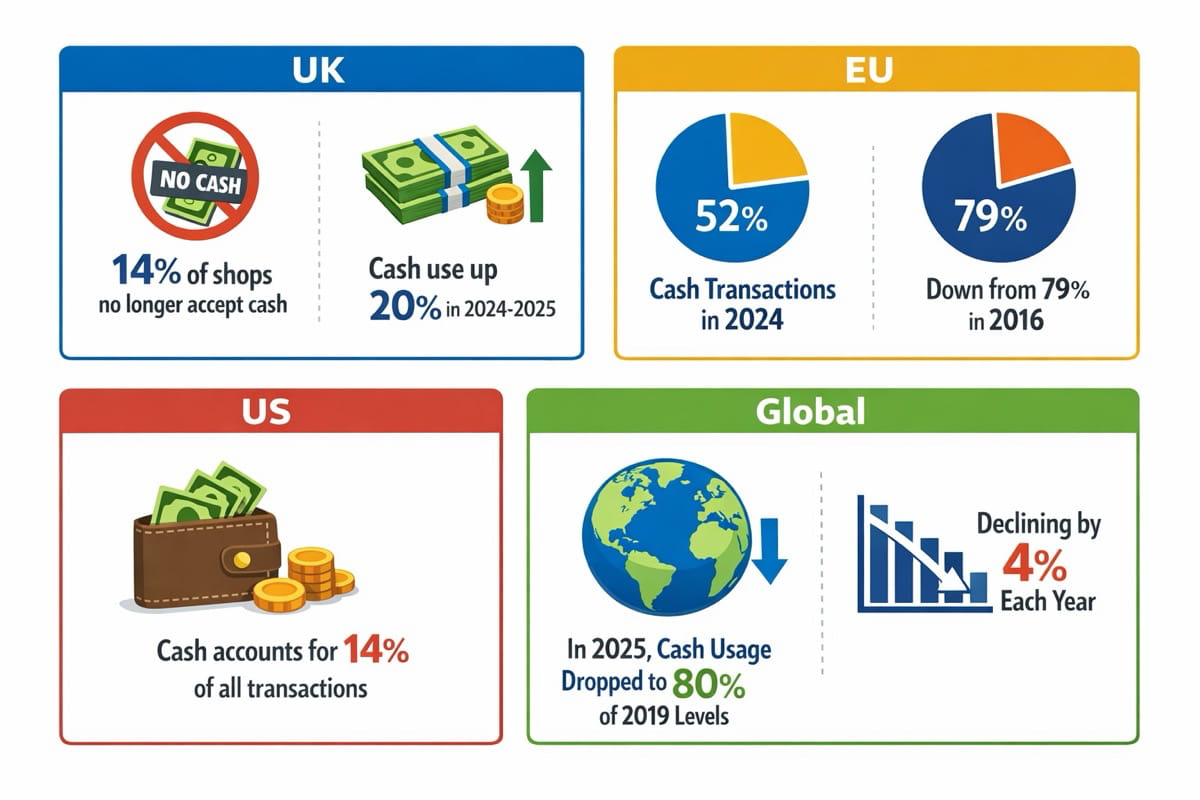
Cashless payment statistics across regions
In 2025, global cash usage dropped to 80% of its 2019 levels and is steadily decreasing by about 4% each year. While digital payments continue to substitute informal paper bills exchange globally, experts say cash is unlikely to disappear completely. Many consumers still value it for privacy, budgeting, and resilience during outages or system failures.
Many financial institutions adopt cash use to modern digital practices instead of completely abolishing paper money infrastructure. One example is Lloyds Bank’s introduction of a barcode cash paying-in feature, which has proven to be a significant success, with over £3 million deposited at PayPoint locations just within two months since its launch in August 2025.
As retailers balance convenience, costs, and accessibility, the future of payments may not be entirely cashless, but it is surely increasingly digital.