Following the cooperation on India’s first AI agent-powered conversational payment experience, Razorpay and OpenAI introduce a new intriguing joint initiative helping developers finally monetize their AI product development without friction.

Quick summary
- Razorpay integrates payments directly into OpenAI Codex
- The new solution is also available as an app inside ChatGPT
- Developers can build and monetise apps in one conversational setup
- Payments are automated via AI workflows
- Builds on earlier multilateral “agentic payments” initiative
- Marks a shift toward instant, AI-driven entrepreneurship
What’s new with Razorpay and OpenAI?
Razorpay, a leading Indian payment gateway provider for e-commerce, has announced a new revenue-building feature powered by OpenAI coding platform Codex.
Targeting indie and student developers, early-stage startups, and non-technical solo founders, the new tool enables clients to generate the app with AI help, automatically linking the Razorpay payment gateway checkout method without switching between multiple tabs or separate integrations.
What is the Razorpay & OpenAI Codex integration for?
Razorpay’s new integration with OpenAI’s Codex platform is designed to solve one of the biggest bottlenecks in AI product development: monetisation.
Adding a “Pay” button to an app or website may seem easy at a glance. However, without built-in monetisation tools, developers have to handle aspects many have no expertise in:
- Payment gateway integration (e.g. Stripe, Razorpay)
- Subscription logic (monthly, yearly, trials)
- Taxes (VAT, GST, regional rules)
- Currency support
- Refunds and chargebacks
The process is often slow and painstaking. Meanwhile, the new Codex/Razorpay solution offers what every developer dreams about: to build, launch, and start earning from AI applications in a single workflow at ease and speed, without any manual integration challenges.
Here’s how it happens in three simple steps. Developers
- Create an AI-powered app using Codex
- Define pricing (subscriptions, one-time payments, etc.)
- Automatically enable payments via Razorpay
Therefore, when the app is technically ready, monetization goes naturally with the flow. According to the payment solution company, it all happens within minutes, not days or weeks you typically expect for an app development and payment setup.
What do they mean by conversational experience?
To bring the idea to realization, one does not even need extensive coding skills. As they enable the Razorpay MCP integration on Codex, developers can simply describe what they want to build and how they want to charge for it in simple words. One example is: “I want you to build an AI-powered shopping and styling assistant app and let me monetize service revenue via Razorpay.” The Codex tool handles the rest of complicated behind-the-scenes tech.
Apart from Codex, Razorpay is also available as an app inside ChatGPT. Here’s how that goes about. Businesses install the Razorpay App from the ChatGPT directory and link their live payment dashboard directly into the conversation prompt.
In that casem they don’t need to export CSVs and spreadsheets or switch between different tabs or dashboards in search of transaction data. Instead, they simply ask chatbot questions and get answers within that conversation thread. Some examples of similar requests that Razorpay provides are: “Why did my payment conversion dip in Mumbai last week?” “Find all refunds raised by customers in the last 30 days.” “Match my settlements against this bank statement.” Of course, the actual use cases will vary and encompass much more than that.
The main idea of the integration is to move from unfiltered piles of financial data to using them for business decisions without the manual workload typically associated with these processes.
How does the technology actually work?
The integration is powered by a Model Context Protocol (MCP) layer, which allows AI systems to interact directly with external third-party services like payments.
In a nutshell:
- Codex generates the application logic
- Razorpay’s infrastructure is automatically configured in the background
- Checkout, billing, and transaction handling are pre-wired
This means developers don’t generate codealone but a fully functional, monetised product.
How does the new solution compare to traditional payment integration?
The collaborative effort of Razorpay and OpenAI clearly differs from legacy industry approaches.
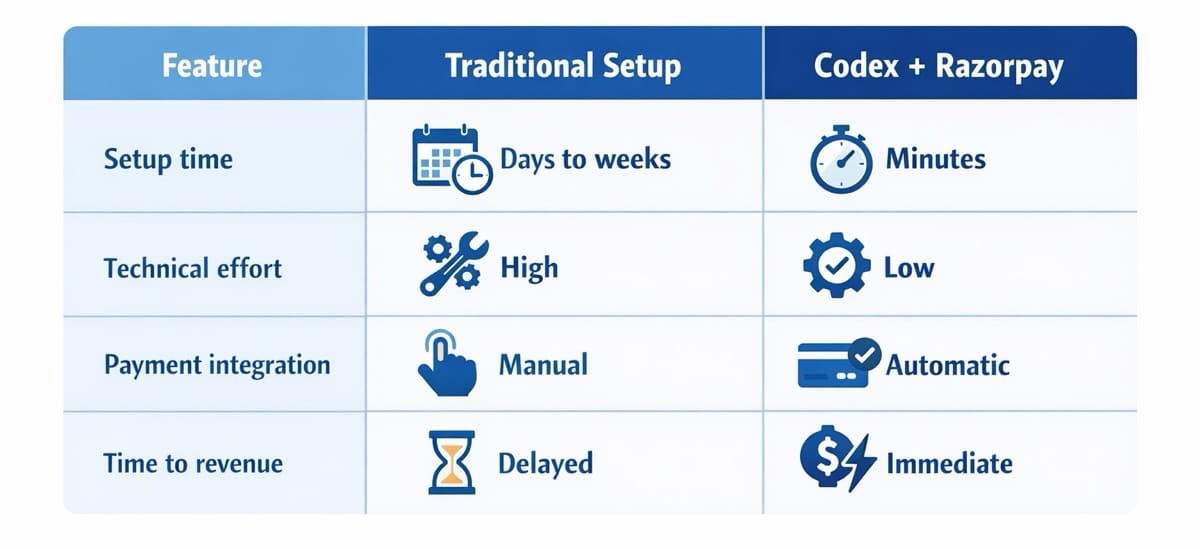
For years, payments and monetization have been a friction point for developers. With new, integrated approach, this is no longer the case, especially since once a single AI/payment initiative proves successful, more collaborations of the kind will surely follow.
Key benefits of the solution:
- No separate payment setup: Payments are embedded from the start
- Faster time-to-revenue: Launch monetised apps in minutes
- Lower technical barrier: No deep fintech or backend expertise required
In other words, building software becomes easier and monetising this very software becomes instant.
For fast experimentation and MVP launches, Codex + Razorpay setup is clearly the more efficient approach. Nevertheless, it doesn’t mean traditional setups will become obsolete altogether, as they still make sense for highly customised, large-scale platforms.
Razorpay & OpenAI earlier “agentic payments” initiative
This new development builds directly on Razorpay’s earlier collaboration with OpenAI and the National Payments Corporation of India. The three entities jointly launched a pilot enabling Unified Payments Interface (UPI) transactions directly within ChatGPT.
Within the framework of the pilot agentic payments project, users can browse, compare, and buy products without leaving ChatGPT, completing checkout via UPI in a few conversational steps. The system integrates ChatGPT’s AI interface, Razorpay’s payments infrastructure, and NPCI’s UPI rails, enabling frictionless, real-time payments between consumers and merchants. Early participants included Axis Bank, Airtel Payments Bank, and Bigbasket at launch.
This initiative is particularly relevant due to OpenAI recent scaling back of its earlier ambition to enable direct product checkout inside ChatGPT, opting instead to route purchases through third-party apps and retailer platforms people already rely on with their financial data.
Later on, the agentic payments pilot expanded also to popular Anthropic chatbot Claude. This platform currently makes it possible for select user participamts to shop for food, groceries, and everyday essentials from Zomato, Swiggy, and Zepto without ever leaving the conversation you’re already having with AI assistant.
Is forefront of agentic commerce moving to India?
The partners do believe India’s e-commerce market has a great potential for agentic shopping and payment overhaul. They note that India is already one of the fastest-growing markets for AI-powered apps and also easily processes over 20 billion UPI transactions every month. Being the world’s most used and active payment system, UPI offers rich capabilities for AI tools implementation. It has real-time, mandate-enabled framework built for speed, security, transparency, and consent-driven control. What’s a better sandbox for letting AI agents buy and pay for you?
What are the broader industry implications?
This fresh initiative signals a shift toward AI-native business creation, further facilitating access to online earning tools for different types of entrepreneurs. Along with using AI for seeking best deals and performing transactions, this creates a full-round AI-powered payment circuit. Meanwhile, firms like Razorpay that strike profound AI partnerships might serve as a payments layer for upcoming AI ecosystems.
“LLMs and AI-driven shopping are going to redefine commerce as we know it. But this revolution can’t truly take off without autonomous payments, where AI agents can complete transactions on your behalf,” believes Shashank Kumar, Founder & Managing Director, Razorpay
FAQ
Can beginners use this system?
Yes. The integration is designed to reduce technical complexity, making it accessible to non-experts.
Is this replacing traditional payment gateways?
Not entirely. It complements them, especially for rapid development and experimentation.
What’s the biggest advantage?
Speed. The ability to go from idea to revenue in minutes is the defining feature. Ease of use is also a welcome benefit.
How secure is payment data in the Razorpay-Codex integration?
Payment data is handled through Razorpay’s encrypted infrastructure, not directly by OpenAI Codex. The AI manages workflows, while sensitive information stays within compliant payment systems. Separation of roles is the key security premise.