PIX rewrote the rules in Brazil, SPEI holds firm in Mexico, and OXXO still helps 50 million unbanked consumers shop online with cash. We break down how six competing payment ecosystems are shaping the most dynamic payments market on the planet.
Why LatAm Is the World’s Most Interesting Payments Market
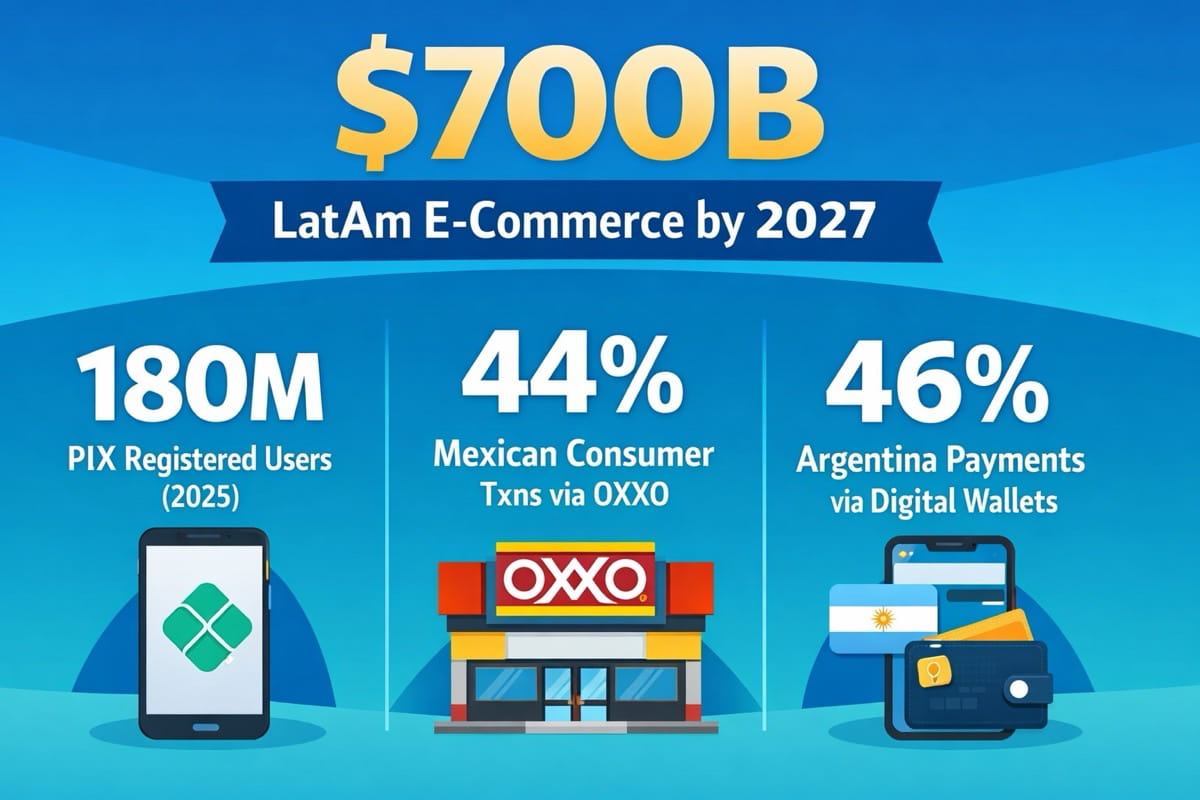
Latin America rarely features in textbooks as a model of financial innovation. But in 2026, it is the site of one of the fastest payment transformations in modern history. More than 300 million digital shoppers, an e-commerce market on track for $700 billion by 2027, and an extremely heterogeneous regulatory landscape have created a unique proving ground where state-run instant payment rails compete with cash vouchers and super-apps.
No other region in the world displays such sharp contrasts. Brazil has built a government-owned payment infrastructure that now processes more daily transactions than Visa and Mastercard combined within the country. Meanwhile, in Mexico, more than half the population remains unbanked, and millions of people pay for online orders in cash at a corner store. Between those poles, Colombia, Argentina, Chile and Peru each follow their own hierarchy of payment methods, regulatory frameworks, and financial inclusion levels.
That is why international businesses entering LatAm increasingly encounter a counterintuitive conclusion: the “card plus PayPal” strategy simply does not work here. Success requires localization at the country level, and sometimes even at the city level. The payment stack that converts, say, in São Paulo will underperform in Monterrey and fail entirely in Medellin.
Brazil: PIX as a Global Benchmark for Instant Payments
When Brazil’s Central Bank launched PIX in November 2020, few expected that within five years the system would set records unreachable by most developed economies. By the end of 2025, PIX processed approximately 80 billion transactions totaling over R$35.3 trillion (roughly $6.7 trillion) — a 34% increase over the previous year, according to the Banco Central do Brasil. The number of registered users exceeded 180 million, covering virtually the entire economically active population.
The key factor behind PIX’s success is not the technology itself but its governance model. The Central Bank serves as the sole operator and rule-setter, making the system free for consumers and businesses alike. That single decision eliminated the traditional barrier between those who want to pay digitally and those who can afford to. For micro-entrepreneurs — the millions of Brazilians running small or informal businesses — PIX replaced the cash register, the bank transfer, and the invoicing system all at once.
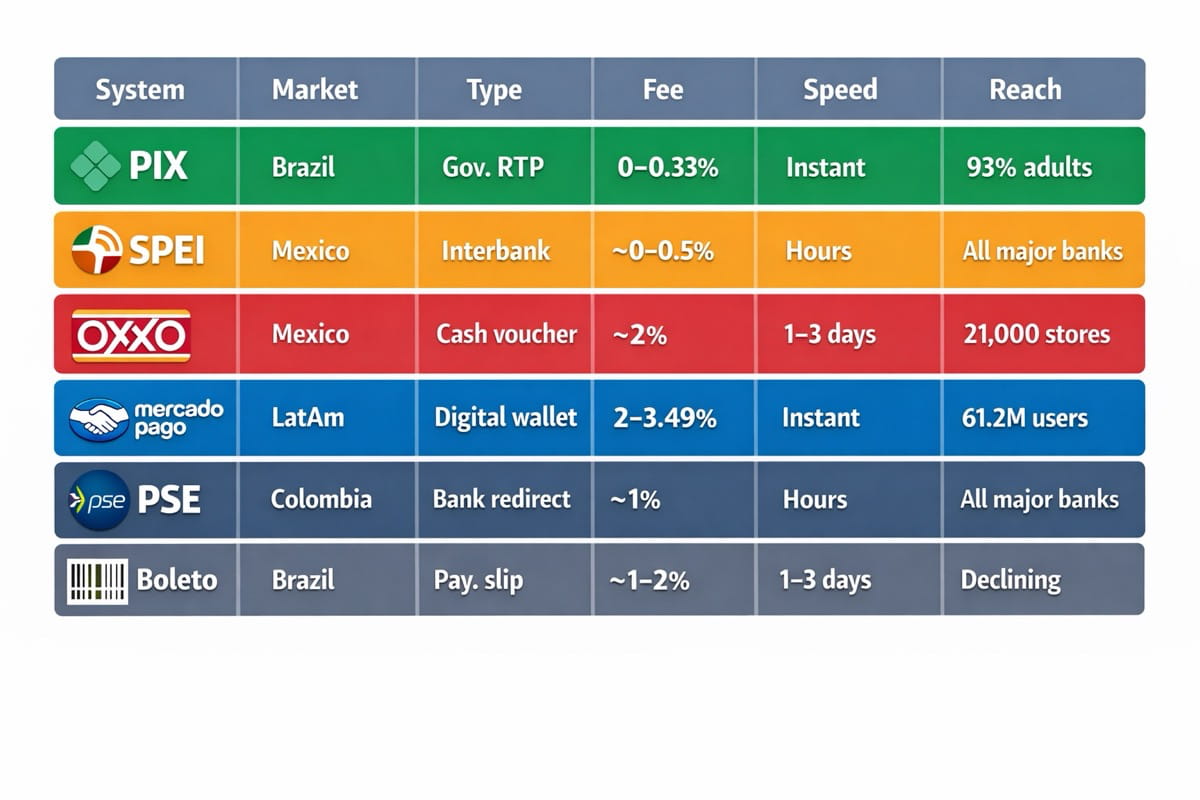
Today PIX commands 42% of Brazil’s e-commerce market, and PCMI analysts project growth to 51% by 2027 as credit cards fall to 36%. PIX Automático, launched in June 2025, opened a new segment: 60 million Brazilians without credit cards can now set up subscriptions and recurring payments. According to EBANX, subscriptions via PIX Automático are growing at 41% month-over-month.
In February 2025, PIX por Aproximação arrived — contactless PIX over NFC that lets users pay by tapping their phone to a terminal without a QR code. The Central Bank even developed a standard that bypasses Apple’s per-transaction fee — a principally important move for a market where a PIX transaction costs 0.33%, while cards charge 2–5%. Merchants who added PIX saw average revenue increase of 16% and customer base growth of 25% within six months, per EBANX data.
Mexico: SPEI and OXXO in a Duel Across an Unbanked Majority
Mexico is LatAm’s second-largest e-commerce market and also its most bifurcated. On one hand, the country is the global leader in remittance receipts — $66.2 billion in 2023, mostly from the United States. On the other, more than half its population remains unbanked or underbanked.
SPEI (Sistema de Pagos Electrónicos Interbancarios) is the government-operated interbank real-time transfer network that has become the standard for online transactions. It is faster than Boleto, cheaper than cards, and supported by every major bank. But OXXO, the convenience chain with over 21,000 locations nationwide, remains the indispensable bridge between the digital and cash economies, handling approximately 44% of all consumer transactions offline and around half of all voucher-based payments in digital commerce.
The OXXO model is straightforward and effective: a consumer places an order online, receives a unique barcode, and pays cash at the nearest store. This is not an anachronism but financial inclusion in practice. Amazon, Uber, and Netflix all support OXXO precisely because without it they forfeit tens of millions of potential customers. That said, cash is gradually losing ground. Digital wallets growth, led by Mercado Pago and Nubank, are gaining traction among younger Mexicans, and cross-border e-commerce is expected to grow another 40% through 2026.
Colombia, Argentina, Chile, Peru: Four Very Different Playbooks
None of the four remaining major LatAm economies replicates either the Brazilian or Mexican model. Each follows its own path, shaped by distinct histories of financial exclusion, inflation, and regulatory ambition.
Colombia relies on PSE (Pagos Seguros en Línea) — a bank redirect service that handles roughly 32% of online payments — alongside digital wallets Nequi and Daviplata, which have become the first banking product for millions of previously unbanked Colombians. Alternative payment methods collectively account for about 50% of the e-commerce market, one of the highest shares in the region.
Argentina presents the region’s most unusual case: 46% of all payments flow through digital wallets, far above the regional average. But the driver is not technological enthusiasm — it is chronic inflation. Consumers avoid holding money in traditional accounts and instead turn to Mercado Pago or Ualá, which automatically pay interest on balances and allow investment into rate-linked instruments with daily liquidity. Mercado Pago reached 61.2 million active unique users in Q4 2024, cementing its position as the dominant financial platform in the region.
Chile has one of the highest card penetration rates in LatAm and a comparatively mature payments market, where Mercado Pago, PayPal, and MACH lead the digital wallet segment. The segment is projected to grow at an 18% CAGR between 2024 and 2030, driven by younger demographics and expanding e-commerce infrastructure.
Peru remains more traditional: cards dominate e-commerce, and Pago Efectivo — a cash-plus-bank-transfer hybrid — is the primary alternative. QR payments and mobile solutions are growing steadily, particularly in urban centers, but the overall transition to digital rails is slower than in peer markets.
Three Trends Defining the LatAm Payments Market in 2026
1. Digital wallets evolving into super-apps. Mercado Pago’s 61.2 million active users in Q4 2024 tell only part of the story. The platform is now a marketplace, crypto wallet, credit facility, and subscription service in a single app. In 2025 the company launched Meli Dólar — a dollar-pegged stablecoin for Brazilian users. PicPay, NuPay, and Ualá are following the same trajectory. For a region where 30–50% of adults lacked any banking product just a few years ago, these wallets have become the first financial product many people ever hold.
2. Crypto and stablecoins as infrastructure, not speculation. Argentina and Venezuela, with chronically unstable currencies, have long been LatAm’s largest crypto markets by adoption. But in 2025–2026, more stable economies are joining the trend. Brazil’s new VASP licensing regime now places crypto firms under Central Bank supervision — with the same AML requirements as traditional banks. This lowers risk and opens the door for institutional capital, accelerating the mainstreaming of stablecoin-denominated commerce.
3. Open Finance as competitive moat. Brazil leads the world in Open Finance adoption: 60 million active consents and 100 billion API calls per month — four times the volume of the United Kingdom. This means companies accumulating customer data flows today are building personalized financial products that will be structurally inaccessible to later entrants. The window for establishing Open Finance-based advantages is open now and will not stay open indefinitely.
What This Means for Businesses Entering LatAm
The core conclusion from comparing LatAm payment ecosystems is simple and uncompromising: there is no single strategy. A processor that works well in Brazil may show catastrophic approval rates in Mexico. Ignoring OXXO in Mexico is a voluntary decision to forfeit 44% of potential transactions. Not supporting PIX in a Brazilian checkout in 2026 is simply bad business.
Transaction fees vary significantly across the region. Local rails like PIX, SPEI, and Boleto cost 0–2%, cards charge 2–5%, and wallets fall in the 2–3% range. Settlement timelines range from instant (PIX) to one to three business days (cards, Boleto). Cross-border payments in USD or EUR add 3–5% in conversion costs, which is why local acquiring is almost always the smarter choice for businesses with meaningful transaction volumes in the region.
The LatAm payments market in 2026 is not a market playing catch-up with the West. It is a market charting its own course — one where some solutions, PIX chief among them, are already ahead of what most developed economies have built. For companies willing to meet that reality on its own terms, what opens up is one of the largest untapped digital payments markets in the world.